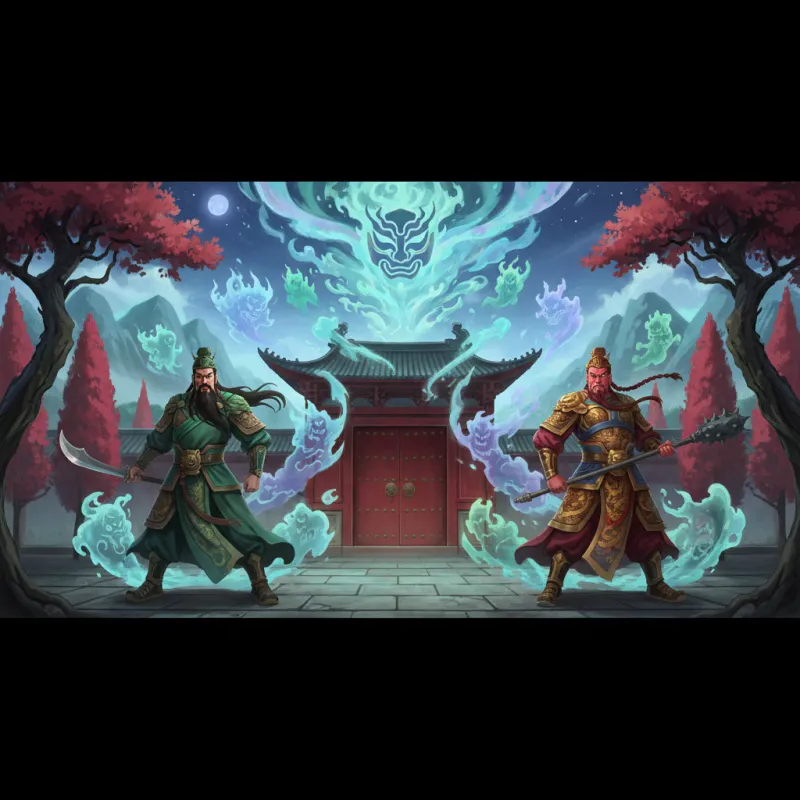
Every night, two fierce warriors stand guard at millions of Chinese doorways, their painted eyes scanning for demons that most modern residents no longer believe in. Yet the tradition persists — not as superstition, but as cultural muscle memory of a time when the threshold between home and chaos required supernatural enforcement. These are the 门神 (ménshén, door gods), and they represent just the most visible layer of what might be history's most paranoid home security system.
The Original Bodyguards: Shen Tu and Yu Lei
The door god tradition traces back over 2,000 years to two brothers whose job description was simple: catch demons and feed them to tigers. According to the Shanhaijing (Classic of Mountains and Seas), 神荼 (Shén Tú) and 郁垒 (Yù Lěi) stood guard beneath a massive peach tree on Mount Dushuo, where they inspected every ghost attempting to enter the mortal realm. Those who failed their vetting process were bound with reed ropes and thrown to tigers — a fate that apparently served as effective deterrent.
The brothers' reputation was so formidable that simply painting their images on peach wood boards and hanging them on doors was believed sufficient to repel evil spirits. The peach wood itself carried protective properties, a detail that persists in modern exorcism practices where peach wood swords remain standard equipment. By the Han Dynasty, these protective images had become standard household items, mass-produced and sold at markets before New Year celebrations.
What's remarkable is how this ancient practice adapted. The original door gods were supernatural bureaucrats doing their job. Later versions would transform them into historical figures, military heroes, and even Buddhist guardians — but the core function remained unchanged: these images turned your doorway into a checkpoint that malevolent entities couldn't pass.
The Tang Dynasty Upgrade: When Generals Became Gods
The most popular door gods today aren't ancient demon-catchers but Tang Dynasty generals: 秦琼 (Qín Qióng, also known as Qin Shubao) and 尉迟恭 (Yùchí Gōng, also known as Yuchi Jingde). Their promotion to divine status came through one of Chinese folklore's most famous ghost stories — and it involved an emperor who couldn't sleep.
Emperor Taizong of Tang was being haunted. Every night, ghosts of those he'd killed during his rise to power would gather outside his bedroom, wailing and throwing roof tiles. The emperor was losing his mind from sleep deprivation. His solution? Station his two most intimidating generals outside his bedroom door each night. It worked. The generals' mere presence — their 煞气 (shàqì, killing aura) accumulated from years of battlefield slaughter — was enough to keep the vengeful spirits at bay.
But you can't keep your top military commanders standing guard duty indefinitely. So the emperor commissioned portraits of the two generals in full battle armor, weapons drawn, faces twisted in war-fury. The paintings worked just as well as the living men. Word spread. Soon every household wanted their own copies. The door god industry exploded.
What made Qin Qiong and Yuchi Jingde so effective wasn't divine power — it was their accumulated 杀气 (shāqì, murderous aura). They'd killed so many people that their spiritual presence alone was toxic to ghosts. This reveals something crucial about Chinese supernatural logic: sometimes the best defense against the dead is someone who's sent a lot of people to join them.
The Layered Defense System
Door gods are impressive, but they're just the outer perimeter. Traditional Chinese homes employed defense-in-depth strategies that would make a military engineer proud. Each layer served a specific function, and together they created a security system that addressed different types of supernatural threats.
The 影壁 (yǐngbì, spirit wall) stands directly opposite the main gate in traditional courtyard homes. Its purpose is simple: ghosts can only travel in straight lines. The wall forces them to turn, which they supposedly cannot do. This architectural feature reveals the bureaucratic nature of Chinese ghosts — they're bound by rules, limited by their nature, exploitable through clever design. Modern feng shui practitioners still recommend spirit walls, though they've rebranded the concept as "energy flow management."
The threshold itself — that raised wooden beam at the base of doorways — serves as another barrier. Ghosts cannot cross thresholds, which is why you'll see elderly Chinese people carefully step over rather than on these beams. Stepping on the threshold is considered disrespectful not because of superstition, but because you're potentially damaging a critical defensive structure. It's like kicking a hole in your own security fence.
Inside the home, the 灶神 (Zàoshén, Kitchen God) maintains surveillance. His image hangs above the stove, watching the family's behavior throughout the year. On the 23rd day of the 12th lunar month, he ascends to heaven to report on the household's conduct. Families traditionally smear honey on his lips before his departure — a bribe to ensure his report emphasizes the sweet over the bitter. This isn't just folklore; it's a supernatural panopticon, a reminder that someone is always watching.
Regional Variations and Specialist Guards
Not all door gods are created equal, and Chinese folk religion shows remarkable regional diversity in its protective pantheon. In some areas, you'll find 钟馗 (Zhōng Kuí), the demon-queller who failed the imperial examinations and became the supernatural world's most overqualified bouncer. His specialty is hunting down and destroying demons, making him particularly popular in regions with high supernatural activity — or at least regions that believe they have high supernatural activity.
Buddhist households might employ the 四大天王 (Sì Dà Tiānwáng, Four Heavenly Kings) as door guardians, particularly in southern China where Buddhist influence runs deeper. These aren't the gentle, contemplative figures of meditation halls — they're wrathful protectors, trampling demons underfoot, wielding weapons that could double as medieval torture devices. The message is clear: enlightenment doesn't mean passivity when evil comes knocking.
Daoist households have their own options, often featuring 雷神 (Léishén, Thunder God) or other celestial officials from the Daoist bureaucracy. The choice of door god often reflects not just religious affiliation but specific concerns. Merchants might choose gods associated with wealth protection. Families with young children might select guardians known for protecting against child-stealing demons like the terrifying Nü Gui who target the vulnerable.
The diversity reveals something important: Chinese supernatural protection isn't one-size-fits-all. It's customizable, adaptable, responsive to specific threats and household needs. You wouldn't use the same security system for a jewelry store and a daycare center — why would supernatural protection be any different?
The Modern Decline and Unexpected Persistence
Walk through any modern Chinese apartment complex and you'll notice something: door gods are disappearing. Steel security doors don't accommodate traditional paintings. Young urbanites consider the practice superstitious. The elaborate multi-layered protection systems of traditional homes have been reduced to, at best, a small 福 (fú, fortune) character pasted upside-down on the door during New Year.
Yet the tradition persists in unexpected ways. Rural areas maintain the full traditional system. Temple entrances still feature fierce door guardians, their paint refreshed annually. Even in cities, you'll find elderly residents who insist on maintaining at least token protective measures — a small talisman tucked beside the doorframe, a mirror positioned to deflect negative energy, a threshold that must never be stepped upon.
The persistence suggests these practices serve functions beyond literal ghost-prevention. They're cultural markers, connections to ancestral practice, psychological comfort in an uncertain world. When my grandmother insists on hanging door god images in her apartment, she's not necessarily defending against demons — she's maintaining continuity with a tradition that stretches back millennia, asserting that some things shouldn't be abandoned just because we've stopped believing in their literal efficacy.
There's also a pragmatic element. As one elderly neighbor explained: "Maybe ghosts aren't real. But if they are, and I didn't put up door gods, I'd feel pretty stupid." It's Pascal's Wager applied to home security — the cost of protection is minimal, the potential cost of being wrong is catastrophic.
What Door Gods Reveal About Chinese Supernatural Logic
The door god tradition illuminates fundamental principles of Chinese supernatural belief that differ markedly from Western ghost lore. Chinese ghosts aren't all-powerful supernatural entities — they're bound by rules, limited by their nature, vulnerable to the right countermeasures. They can't cross thresholds, can't turn corners, can't withstand the presence of sufficient 阳气 (yángqì, yang energy) or martial aura.
This creates a supernatural world that's less about faith and more about knowledge. You don't need to be particularly virtuous or spiritually advanced to protect yourself — you just need to know the rules and apply the right techniques. It's a democratic approach to supernatural security, accessible to anyone willing to learn the system.
The emphasis on visual deterrence is also telling. Door gods work because ghosts can see them and recognize the threat they represent. This suggests Chinese supernatural entities possess intelligence and self-preservation instincts — they're not mindless forces but rational actors who can be intimidated, deceived, or outmaneuvered. The supernatural world operates on logic, just different logic than the mortal realm.
Compare this to Western ghost traditions, where protection often requires faith, prayer, or divine intervention. Chinese supernatural security is more DIY — here's the threat, here's the countermeasure, apply as needed. It's practical, systematic, and remarkably consistent across centuries of practice.
The Security System That Never Sleeps
The genius of the door god system lies in its permanence. Unlike ritual exorcisms that require specialist knowledge, door gods provide 24/7 protection without maintenance. They don't need to be fed, paid, or convinced to do their job. They're always on duty, always vigilant, always ready to repel whatever supernatural threats approach your threshold.
This makes them the perfect first line of defense in a comprehensive supernatural security strategy. They handle routine threats automatically, freeing human residents from constant vigilance. Only when something particularly powerful or persistent appears do you need to escalate to more active measures — calling in a Daoist priest, performing cleansing rituals, or deploying specialized talismans.
The system reflects a sophisticated understanding of threat management. Most supernatural encounters are low-level — wandering ghosts, minor demons, ambient negative energy. Door gods handle these automatically. The rare serious threats require professional intervention, but by that point, your door gods have already bought you time and prevented the situation from becoming catastrophic.
Even in our modern, supposedly rational age, there's something appealing about this approach. We install security cameras, alarm systems, and reinforced locks to protect against physical threats. The door god tradition simply extends this logic to the supernatural realm. And who's to say which threats are more real? The burglar you can see, or the hungry ghost you can't?
Related Reading
- Zhong Kui: The Demon Queller Who Protects Chinese Homes
- Door Gods: Guardians Against Evil Spirits
- The Complete Guide to Chinese Supernatural Folklore: Ghosts, Demons, and Spirit World
- Fox Spirits: China's Most Famous Shapeshifters
- The Chinese Underworld: A Complete Guide to Diyu
- Liaozhai Zhiyi: The Ghost Stories That Changed Chinese Literature
- Taoist Exorcism: Methods of Spirit Removal
- The Enigmatic Spirit-Animals of Chinese Supernatural Folklore and Afterlife Beliefs
Explore Chinese Culture
- Explore ancient mythical creatures
- Explore Daoist exorcism traditions
- Explore Chinese folk beliefs and superstitions