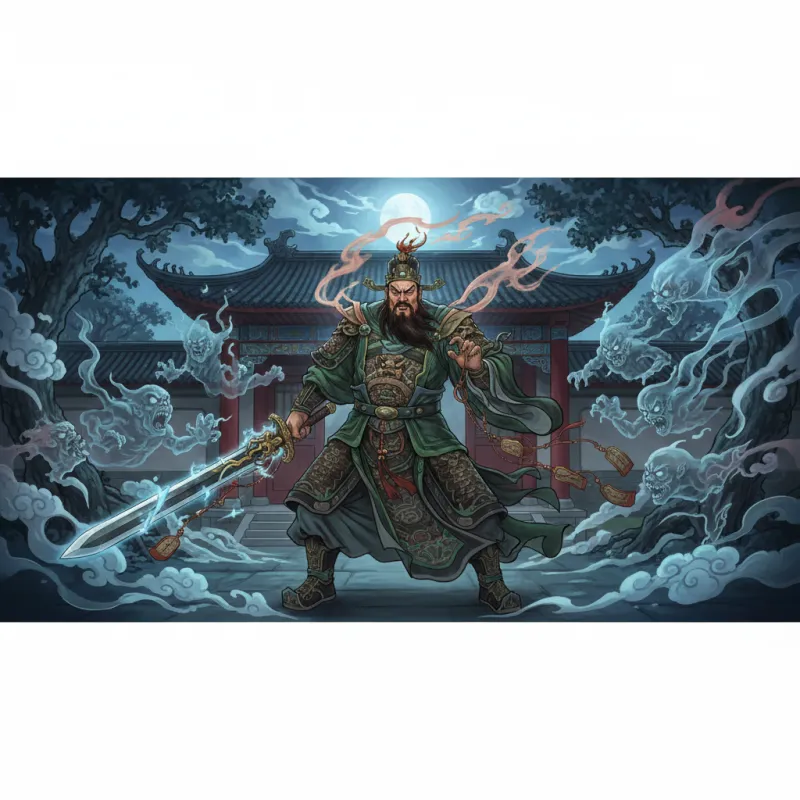
Every year on the fifth day of the fifth lunar month, millions of Chinese households paste a fierce, bug-eyed scholar on their doors — not despite his ugliness, but because of it. Zhong Kui (钟馗, Zhōng Kuí), the Demon Queller, is perhaps the only deity in world religion whose supernatural authority derives directly from being too ugly to pass a test. His story is a middle finger to meritocracy, a revenge fantasy for every qualified candidate rejected for superficial reasons, and a theological argument that the bureaucracy of hell is more just than the bureaucracy of heaven.
The Scholar Who Failed Because of His Face
The most widely accepted origin story places Zhong Kui in the Tang Dynasty (618-907 CE), though like most folklore, the details shift depending on who's telling it. According to the standard version, Zhong Kui was a brilliant scholar from Zhongnan Mountain in Shaanxi Province who traveled to the capital Chang'an to take the imperial examinations. He scored first place — the 状元 (zhuàngyuán), the highest honor in the land.
But when Emperor Xuanzong saw him during the palace ceremony, he recoiled. Zhong Kui's face was a disaster: bulging eyes, a wild black beard, skin like tree bark, features that seemed assembled by committee from different species. The emperor, unable to stomach the idea of this creature representing the scholarly elite, stripped him of his title on the spot.
Zhong Kui's response was immediate and dramatic. He threw himself headfirst into the palace steps, cracking his skull open and dying instantly. Some versions say he aimed for a pillar. Others say he simply bashed his head against the ground until it split. The method matters less than the message: if the system won't recognize merit, then the system can keep its recognition.
The Emperor's Fever Dream
Years later, Emperor Xuanzong fell gravely ill with a fever that no physician could cure. In his delirium, he dreamed of a small demon stealing his jade flute and one of Consort Yang's embroidered pouches — the kind of petty supernatural harassment that Chinese ghosts specialize in. Just as the little demon was about to escape, a massive figure appeared: a wild-eyed scholar in tattered robes, who caught the demon, gouged out its eyes, and ate it whole.
The emperor asked who this terrifying protector was. The figure bowed and identified himself as Zhong Kui, the scholar who had killed himself on the palace steps. He explained that Yanluo Wang (阎罗王, Yánluó Wáng), the King of Hell, had been so impressed by his righteous anger and scholarly merit that he appointed him Supreme Commander of Demon Quelling, with authority to hunt and consume evil spirits throughout the mortal and supernatural realms.
When the emperor woke, his fever had broken. He immediately summoned the court painter Wu Daozi and described the dream in detail. Wu painted Zhong Kui exactly as the emperor described — and that image, with minor variations, has been reproduced millions of times over the following twelve centuries.
The Demon Queller's Job Description
Zhong Kui's official title is 驱魔大神 (qūmó dàshén) — Great God of Demon Expulsion — but his actual job is more specific and more visceral than the title suggests. He doesn't just banish demons; he hunts them, catches them, and eats them. His weapon of choice is usually a sword, though some depictions show him wielding a bat (蝠, fú), which is a visual pun on good fortune (福, fú).
He commands an army of lesser demons and ghosts who have been pressed into service, a supernatural chain gang of reformed troublemakers. In some stories, these include the very demons he's caught and partially consumed, now bound to his service. It's a bureaucratic solution that would make sense to any Tang Dynasty administrator: why waste resources when you can repurpose your enemies?
His jurisdiction is comprehensive. He protects against 疫鬼 (yìguǐ, plague demons), 厉鬼 (lìguǐ, violent ghosts), and all manner of supernatural threats that might afflict a household. He's particularly active during the 端午节 (Duānwǔ Jié, Dragon Boat Festival) on the fifth day of the fifth lunar month, when the boundary between worlds grows thin and malevolent spirits become bold.
Why Ugly Works
The genius of Zhong Kui's iconography is that his ugliness is his qualification. He's not ugly despite being a protector deity — he's a protector deity because he's ugly. His face is a weapon. Demons take one look at those bulging eyes and that wild beard and think: "If the mortal world rejected this guy, what chance do I have?"
There's a deeper logic here that connects to Chinese cosmology. Beauty in Chinese thought is associated with 阴 (yīn) energy — soft, receptive, feminine. Ugliness, especially the aggressive, masculine ugliness of Zhong Kui, is pure 阳 (yáng) — hard, projective, overwhelming. Demons and ghosts are yin entities. They need yang force to counter them, and Zhong Kui is yang force personified, concentrated, and weaponized.
Compare this to door gods like Qin Shubao and Yuchi Gong, who protect through martial prowess and loyalty. They're handsome, dignified generals. Zhong Kui protects through sheer wrongness, through being so aggressively himself that evil spirits can't stand to be near him.
The Paintings and Their Power
A traditional Zhong Kui painting is not just decoration — it's a functional object, a piece of applied theology. The image typically shows him in scholarly robes (to emphasize his intellectual merit), with a sword (to demonstrate his authority), often accompanied by his demon servants carrying his belongings or captured ghosts in cages.
The paintings are hung during the Dragon Boat Festival and sometimes left up year-round. Some families commission new ones annually. The act of hanging the image is itself a ritual, often accompanied by incense and brief prayers. The painting doesn't represent Zhong Kui's protection — it is his protection, a portal through which his authority extends into the household.
Regional variations are significant. In some areas, he's shown with his sister, whom he's trying to marry off to a worthy scholar — a subplot that adds domestic comedy to his demon-quelling resume. In others, he's depicted drunk, because even supernatural bureaucrats need downtime. Suzhou versions often show him in more refined, elegant poses, while northern versions emphasize his wild, aggressive energy.
The Underdog's Patron Saint
What makes Zhong Kui enduringly popular isn't just his demon-quelling abilities — it's his origin story. He's the patron saint of everyone who's been judged on appearance rather than merit, everyone who's been rejected by a system that claims to be fair but isn't, everyone who's been told they're not quite right for the position despite being perfectly qualified.
His suicide is not portrayed as weakness but as righteous protest, a refusal to accept injustice quietly. And his appointment by the King of Hell is cosmic vindication: the afterlife recognizes what the mortal world couldn't see. It's a fantasy of meritocracy actually working, even if it takes death to get there.
This resonates across centuries because the imperial examination system, despite its claims of objectivity, was never truly fair. Connections mattered. Appearance mattered. Regional prejudices mattered. Zhong Kui's story acknowledges this reality while offering supernatural compensation.
Living With the Demon Queller
In modern Chinese households, Zhong Kui's presence has evolved but not diminished. You'll find him on New Year prints, door hangings, and increasingly, as tattoos on people who identify with his outsider status. He appears in video games, comics, and films — always recognizable by those bulging eyes and that magnificent beard.
Some families still maintain the traditional practice of hanging his image during the Dragon Boat Festival, though the ritual aspects have often faded into cultural habit. The painting goes up because grandmother insists, because it's always been done, because even if you don't quite believe in demons anymore, why take chances?
And maybe that's the final irony of Zhong Kui: a deity born from imperial rejection who has outlasted the empire itself, still protecting homes, still scaring away evil, still proving that sometimes the system's rejects are exactly what we need.
Related Reading
- Hungry Ghost Festival: Traditions and Taboos
- Door Gods: Guardians Against Evil Spirits
- Door Gods and Protective Spirits: China's Supernatural Security System
- Lady White Snake: China's Greatest Love Story
- Exploring Chinese Supernatural Folklore: Ghosts, Spirits, and Afterlife Beliefs
- The Enigmatic Spirit-Animals of Chinese Supernatural Folklore and Afterlife Beliefs
- The Best Chinese Horror Films: A Genre Guide — Cnspirit Perspective
- Painted Skin: The Most Terrifying Story in Chinese Literature
Explore Chinese Culture
- Explore ancient mythical creatures
- Explore Daoist exorcism traditions
- Explore Chinese folk beliefs and superstitions