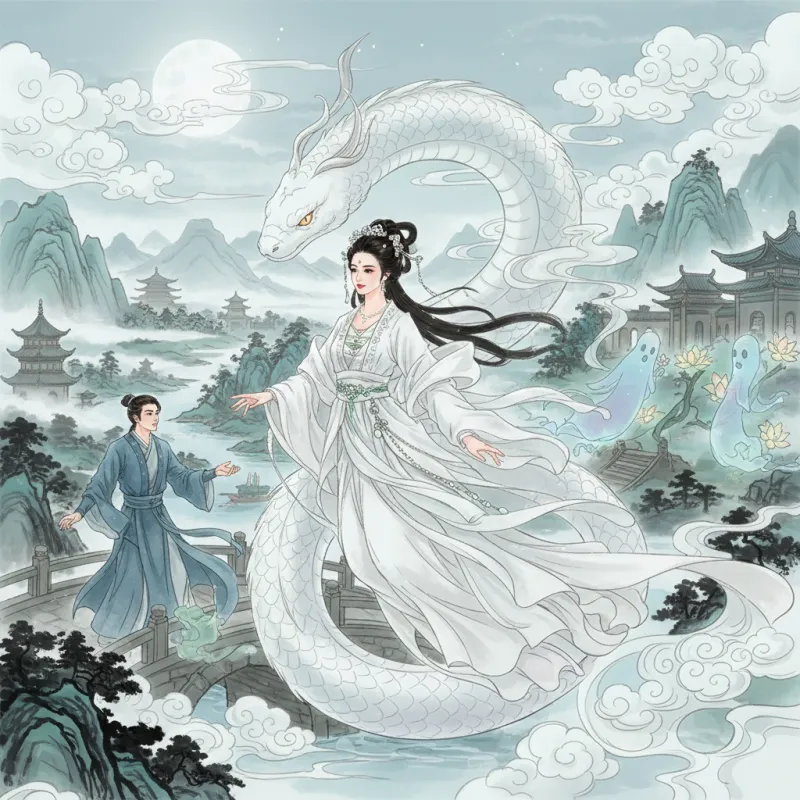
A white snake coils around a willow branch by West Lake, watching a young scholar stumble in the rain. She's been waiting a thousand years for this moment—not for enlightenment, not for immortality, but for the chance to repay a debt of kindness with something far more dangerous: love. This is how China's most famous supernatural romance begins, and it's a story that asks an uncomfortable question: when a demon loves a human, who's really the monster?
The Debt That Started Everything
The Legend of the White Snake (白蛇传, Bái Shé Zhuàn) didn't begin as a love story—it started as a transaction. A thousand years before the main events, a young boy named Xu Xian saved a small white snake from a snake catcher near West Lake in Hangzhou. That snake was Bai Suzhen (白素贞, Bái Sùzhēn), who would spend the next millennium cultivating her spiritual power, transforming from an animal spirit into something approaching divinity.
But here's what makes this tale different from typical Chinese fox spirit stories: Bai Suzhen doesn't seduce Xu Xian to drain his life force or steal his yang energy. She genuinely wants to repay his childhood kindness. The problem? A thousand years of meditation hasn't prepared her for actual human emotions. When she finally takes human form and meets the reincarnated Xu Xian—now a timid herbalist—gratitude transforms into obsession, then into something that might actually be love.
The Medicine Shop and the Monk
Bai Suzhen doesn't arrive alone. Her companion is Xiaoqing (小青, Xiǎo Qīng), a green snake spirit with far less patience for human nonsense. Together, they orchestrate a "chance" meeting with Xu Xian during a rainstorm at West Lake—the broken umbrella, the lingering glances, the whole romantic setup. It works. Xu Xian falls hard for this mysterious, beautiful woman who seems too good to be true.
Because she is.
They marry quickly and open a medicine shop called Baohetang (保和堂, Bǎohé Táng). Here's where the story gets interesting: Bai Suzhen is an incredible healer. Her supernatural knowledge of herbs and medicine makes their shop wildly successful. They're not just happy—they're thriving. For a brief moment, it seems like a demon and a human really can build a life together.
Enter Fa Hai (法海, Fǎ Hǎi), a Buddhist monk from Jinshan Temple who makes it his personal mission to "save" Xu Xian from this demonic marriage. Fa Hai represents orthodox religious authority, the kind that sees the world in rigid categories: human and demon, pure and impure, natural and abomination. That Bai Suzhen has harmed no one, that she's actually helping people with her medical skills—none of this matters to him. She's a demon, therefore she must be destroyed.
The Realgar Wine Incident
The story's most iconic scene happens during the Dragon Boat Festival (端午节, Duānwǔ Jié), when tradition demands drinking realgar wine (雄黄酒, xiónghuáng jiǔ)—a liquor believed to repel evil spirits and reveal supernatural beings. Bai Suzhen knows this will expose her true form, but Xu Xian, influenced by Fa Hai's warnings, insists she drink.
She does. And she transforms back into a massive white serpent.
Xu Xian literally dies of fright. Just drops dead from shock.
This is the moment that elevates the story from simple romance to genuine tragedy. Bai Suzhen's love is so powerful that she risks everything to bring him back. She travels to Kunlun Mountain to steal a magical herb called lingzhi (灵芝, língzhī) that can resurrect the dead. She fights celestial guardians, nearly dies herself, and succeeds only because the gods take pity on her devotion.
When Xu Xian wakes up, Bai Suzhen convinces him that he had a nightmare, that he never saw a snake, that everything is fine. And here's the complicated part: he chooses to believe her. Whether from love, denial, or simple cowardice, Xu Xian accepts the lie and they continue their marriage.
Flooding Jinshan Temple
But Fa Hai won't let it go. He kidnaps Xu Xian and imprisons him in Jinshan Temple, forcing Bai Suzhen into direct confrontation. What follows is one of Chinese folklore's most spectacular supernatural battles: Bai Suzhen summons the waters of West Lake and floods the entire temple, trying to rescue her husband.
This scene appears in countless operas, paintings, and modern adaptations because it's the moment when Bai Suzhen stops pretending to be human. She's a thousand-year-old demon with the power to command nature itself, and she's willing to drown a temple full of monks to get her husband back. It's romantic, terrifying, and morally ambiguous—everything great folklore should be.
The flood fails. Fa Hai's Buddhist powers are too strong, and Bai Suzhen is pregnant, which weakens her spiritual energy. She's forced to retreat, and Xu Xian remains imprisoned, now thoroughly convinced by Fa Hai that his wife is a dangerous monster who must be abandoned.
The Leifeng Pagoda
The story's ending depends on which version you encounter, but the most traditional one is brutal: after Bai Suzhen gives birth to their son, Fa Hai traps her under Leifeng Pagoda (雷峰塔, Léifēng Tǎ) on the shores of West Lake. She's imprisoned there, separated from her child and husband, until "the lake dries up and the pagoda falls."
Xu Xian becomes a monk. Their son grows up to become a successful scholar. And Bai Suzhen waits.
This ending haunted Chinese audiences for centuries because it's so unjust. Bai Suzhen's only crime was loving someone. She healed people, saved her husband's life, and tried to build a family. Yet she's punished while Fa Hai—who destroyed a marriage and separated a mother from her child—is celebrated as a righteous defender of cosmic order.
Modern versions often add a happier ending: the son returns as an adult, tops the imperial examinations, and uses his success to petition the gods for his mother's release. The pagoda falls, Bai Suzhen is freed, and the family reunites. It's a more satisfying conclusion, but something is lost. The original ending's bleakness was the point—it was a critique of rigid moral systems that can't accommodate love that crosses boundaries.
Why This Story Endures
The Legend of the White Snake has been retold in every Chinese artistic medium for over a thousand years: Tang dynasty tales, Ming dynasty novels, Qing dynasty operas, Republican-era films, and countless modern TV series and movies. Each generation finds something new in it.
For some, it's a romance about love conquering all obstacles. For others, it's a tragedy about society's inability to accept difference. Some see it as a Buddhist parable about attachment and illusion, while others read it as a feminist text about a powerful woman destroyed by patriarchal religious authority.
What makes Bai Suzhen compelling is her complexity. She's not a fox spirit using seduction as a weapon, nor is she a mindless demon driven by hunger. She's someone who's spent a millennium becoming more than human, only to discover that humanity's greatest gift—the ability to love—is also its greatest curse. She's more moral than most humans in the story, more loyal than Xu Xian, more compassionate than Fa Hai. Yet she's the one who gets buried under a pagoda.
The real horror of the White Snake legend isn't that demons exist—it's that we punish them for being too human.
Related Reading
- The Complete Guide to Chinese Supernatural Folklore: Ghosts, Demons, and Spirit World
- Chinese Folklore: The Stories That Grandmothers Tell
- Door Gods and Protective Spirits: China's Supernatural Security System
- Zhong Kui: The Demon Queller Who Protects Chinese Homes
- The Chinese Underworld: A Complete Guide to Diyu
- The Tongji: Spirit Mediums of Southeast Asia's Chinese Communities
- 10 Famous Fox Spirit Stories That Defined Chinese Supernatural Fiction
- Feng Shui for Ghost Prevention: Protecting Your Home
Explore Chinese Culture
- Explore ancient mythical creatures
- Explore Daoist exorcism traditions
- Explore Chinese folk beliefs and superstitions