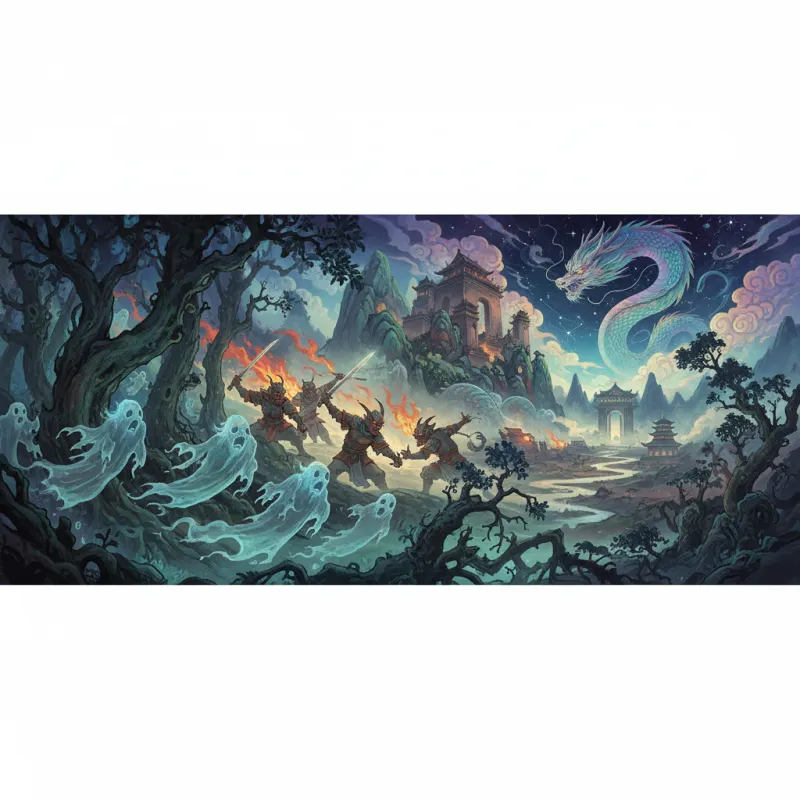
The old woman selling incense outside Longshan Temple in Taipei once told me something I'll never forget: "The dead aren't gone. They're just on the other side of a very thin curtain." She was preparing offerings for Ghost Month, and the way she said it—matter-of-fact, like discussing the weather—made me realize that for hundreds of millions of people, the supernatural isn't supernatural at all. It's just... natural. The spirit world in Chinese culture isn't some distant realm of fantasy. It's woven into daily life, complete with its own geography, hierarchies, and rules as complex as any living government.
The Chinese Afterlife: A Bureaucracy of the Dead
Forget Dante's circles or the Greek underworld. The Chinese afterlife, Diyu (地狱, dìyù), operates like an imperial administration—because that's exactly what it was modeled after. During the Tang Dynasty (618-907 CE), Buddhist concepts of hell merged with Daoist cosmology and Confucian ethics to create something uniquely Chinese: an underworld with ten courts, each presided over by a judge-king who reviews your life's deeds and assigns appropriate punishments.
The first judge you meet is Qin Guang Wang (秦广王, Qínguǎng Wáng), who maintains the register of life and death. He's essentially the intake officer. Depending on your karma, you might pass through quickly to reincarnation, or you'll be sent deeper into Diyu's courts. The fifth court, ruled by Yanluo Wang (阎罗王, Yánluó Wáng)—the Chinese version of Yama—is particularly dreaded. This is where serious sinners face the Mirror of Retribution, which shows every misdeed of their lives in excruciating detail.
What makes this system fascinating is its flexibility. Unlike Western concepts of eternal damnation, Chinese hell is temporary. You serve your sentence—maybe having your tongue pulled out for lying, or being sawed in half for adultery—and then you're reincarnated. The bureaucracy even allows for appeals. Wealthy families would commission elaborate rituals and paper offerings to reduce their deceased relatives' sentences, essentially bribing the underworld officials. The classic Ming Dynasty novel "Journey to the West" features a scene where a Tang emperor's soul is saved from hell by his subjects burning paper money for him.
Gui: The Many Faces of Chinese Ghosts
The Chinese word gui (鬼, guǐ) gets translated as "ghost," but that's like calling the ocean "water"—technically true but missing the complexity. Chinese ghosts come in dozens of varieties, each with specific origins, behaviors, and dangers.
Yuanhun (冤魂, yuānhún), or "wronged souls," are perhaps the most dangerous. These are people who died unjustly—murdered, falsely accused, or denied proper burial rites. They can't move on to the afterlife until their grievances are addressed. The classic Qing Dynasty collection "Strange Tales from a Chinese Studio" by Pu Songling is packed with yuanhun stories. In one tale, a woman wrongly executed for adultery returns as a ghost to prove her innocence, systematically haunting the corrupt magistrate who condemned her until he confesses and commits suicide.
Then there are the hungry ghosts, or egui (饿鬼, èguǐ). These wretched beings have enormous bellies but needle-thin throats, condemned to eternal hunger as punishment for greed in life. During the seventh lunar month—Ghost Month—the gates of the underworld open, and hungry ghosts roam the earth. This isn't metaphorical. Businesses across Taiwan and Hong Kong still avoid major transactions during Ghost Month. Construction projects pause. People don't swim at night (ghosts might pull you under). Elaborate feasts are laid out on streets, not for the living but for wandering spirits.
The shuigui (水鬼, shuǐguǐ), or "water ghost," represents a particularly cruel fate. When someone drowns, their spirit is trapped at the drowning site until they can find a substitute—luring another person to drown in the same spot. Only then can the original victim reincarnate. This belief is so persistent that even today, some Chinese parents warn children away from rivers and ponds by invoking shuigui.
Yao and Mo: Demons, Monsters, and Things That Go Bump
If gui are human spirits gone wrong, yao (妖, yāo) and mo (魔, mó) are something else entirely—supernatural beings that were never human. The distinction matters because it determines how you fight them.
Fox spirits, or huli jing (狐狸精, húlijīng), occupy a fascinating gray area. After living for fifty years, a fox can transform into a woman. After a hundred years, she can become a beautiful maiden or a medium who communicates with the dead. After a thousand years, she becomes a celestial fox with nine tails, capable of seeing a thousand miles away. These aren't necessarily evil creatures—Pu Songling's stories often portray fox spirits as more honorable than the corrupt scholars they seduce. But they're dangerous because they blur boundaries. A fox spirit might genuinely fall in love with a human man, but her supernatural nature inevitably brings disaster.
The jiangshi (僵尸, jiāngshī), or "hopping vampire," is probably China's most famous monster export, thanks to Hong Kong horror-comedies of the 1980s. But the original folklore is far creepier. A jiangshi is a reanimated corpse, stiff with rigor mortis, that hops because its joints don't bend. It's created when a person's po soul (魄, pò)—the earthly, physical soul—fails to leave the body after death. Unlike Western vampires, jiangshi don't drink blood to survive; they drain qi (气, qì), the life force itself. They're attracted to the breath of the living and can sense your qi from a distance.
The nian (年, nián) beast, which gave us Chinese New Year traditions, was originally a terrifying monster that emerged once a year to devour crops, livestock, and people. The discovery that nian feared loud noises, fire, and the color red led to the traditions of firecrackers, lanterns, and red decorations. What I find remarkable is how a monster story became a celebration—the Chinese cultural tendency to transform fear into festivity.
The Exorcist's Toolkit: Daoist Magic and Buddhist Rituals
When I visited a Daoist temple in Chengdu, I watched a priest prepare for a ritual exorcism. His tools looked like props from a fantasy film: yellow paper talismans covered in red cinnabar ink, a peachwood sword, a bronze mirror, and a string of ancient coins. But these aren't random objects—each has specific supernatural properties rooted in centuries of practice.
The fulu (符箓, fúlù), or Daoist talisman, is essentially a written command to the spirit world. These aren't prayers or requests; they're orders, backed by the authority of the Celestial Masters. A properly drawn talisman, written in a specialized script that mixes Chinese characters with secret symbols, can trap demons, protect buildings, or even summon celestial generals. The catch? The priest must be properly ordained and maintain ritual purity, or the talisman is just paper. The classic novel "Investiture of the Gods" features elaborate battles where Daoist immortals hurl talismans that explode into fire or transform into golden dragons.
Peachwood, or taomu (桃木, táomù), has been used against evil spirits since at least the Han Dynasty (206 BCE - 220 CE). Why peaches? Ancient texts suggest that peach trees grow at the boundary between the living world and the spirit realm, making their wood naturally resistant to supernatural influence. A peachwood sword doesn't cut demons—it disrupts their qi, forcing them back to their original form. Even today, you'll find peachwood charms hanging above doorways in traditional Chinese homes.
Buddhist monks take a different approach. Rather than commanding spirits, they offer salvation. The Ullambana Sutra, which describes how the monk Mulian rescued his mother from the hungry ghost realm, became the basis for Ghost Month rituals. Monks chant sutras to ease the suffering of wandering spirits and guide them toward rebirth. The massive Ghost Month ceremonies in Taiwan, where monks feed thousands of "good brothers" (a euphemism for ghosts), blend Buddhist compassion with Daoist ritual and folk tradition into something uniquely syncretic.
Spirit Mediums and Shamanic Traditions
In the Matsu temples of Taiwan, I've watched tangki (童乩, tóngjī)—spirit mediums—enter trance states and channel deities. These aren't quiet, contemplative possessions. The medium's body convulses, their face transforms, and they speak in voices not their own. Some pierce their cheeks with skewers or slash their tongues with swords, drawing blood that's used to write talismans. The pain doesn't register because, supposedly, the deity has taken full control.
This practice predates organized religion in China. Shamanic traditions among ethnic minorities—the Miao, Yao, and Zhuang peoples—preserve even older forms of spirit communication. The wu (巫, wū), ancient shamans mentioned in texts from the Shang Dynasty (1600-1046 BCE), could ascend to heaven and descend to the underworld, negotiating with spirits on behalf of the living.
What's striking is how these practices persist. In Singapore and Malaysia, Chinese communities maintain elaborate spirit medium traditions. During the Nine Emperor Gods Festival, mediums channel warrior deities and perform feats of self-mortification. Skeptics call it performance or self-hypnosis, but the believers—and there are millions—see genuine divine possession. The anthropologist Jack Katz spent years studying Singaporean spirit mediums and concluded that whether or not gods literally possess these bodies, the social and psychological effects are undeniably real.
The Seventh Month: When the Veil Grows Thin
Ghost Month isn't a single festival—it's an entire month when the normal rules don't apply. The gates of the underworld open on the first day of the seventh lunar month, and spirits flood into the mortal realm. The fifteenth day, Zhongyuan Festival (中元节, Zhōngyuán Jié), is the peak, when the most elaborate offerings are made.
I've walked through Taiwanese neighborhoods during Ghost Month and seen entire streets transformed. Tables laden with food, incense burning in massive coils, paper houses and cars ready to be burned. But here's what outsiders often miss: these aren't just offerings for your own ancestors. The most important offerings are for the "good brothers"—wandering ghosts with no living descendants to care for them. These are the dangerous ones, the hungry and resentful spirits who might cause trouble if not properly fed and respected.
The taboos during Ghost Month are extensive and taken seriously. Don't whistle at night (you'll attract ghosts). Don't swim (water ghosts are hunting). Don't pick up money on the street (it's ghost money, meant to trap you). Don't get married (inauspicious). Don't move house. Don't start a business. Some hospitals in Taiwan report that elective surgeries drop significantly during Ghost Month—people genuinely fear that wandering spirits might interfere with medical procedures.
The economic impact is measurable. Real estate transactions in Hong Kong and Taiwan drop by 20-30% during Ghost Month. The Hong Kong stock market shows historically lower trading volumes. This isn't ancient history—this is happening right now, in modern, technologically advanced societies. The supernatural remains a force in daily decision-making.
Living Traditions in a Modern World
The question everyone asks: do people really believe this? The answer is complicated. A young Taiwanese engineer might laugh at ghost stories while still avoiding swimming during Ghost Month "just in case." A Hong Kong banker might consult a feng shui master before signing a major deal. Belief exists on a spectrum, and for many Chinese people, supernatural traditions are less about literal belief and more about cultural practice and risk management.
What's changed is the commercialization. Ghost Month has become big business—paper offerings now include paper iPhones, paper credit cards, even paper mistresses for deceased men. The Hungry Ghost Festival in Penang, Malaysia, has become a tourist attraction, with elaborate Chinese opera performances staged specifically for ghost audiences (the front rows are left empty for spirits). Some temples now accept online donations for ritual services, and you can order paper offerings through e-commerce platforms.
Yet the core remains. When a construction worker dies on a job site in Hong Kong, work stops for elaborate appeasement rituals. When a new building opens in Singapore, Daoist priests are hired to cleanse the space. The Chinese supernatural tradition has proven remarkably adaptable, absorbing new technologies and modern contexts while maintaining its essential character.
For those interested in exploring these traditions further, understanding Chinese funeral customs and ancestor worship provides crucial context for why ghost beliefs remain so powerful. The connection between the living and dead isn't severed at death—it's maintained through ritual and remembrance. Similarly, the role of Daoist priests in Chinese folk religion reveals how organized religious specialists navigate the spirit world on behalf of ordinary people.
The old woman at Longshan Temple was right. The curtain between worlds is thin in Chinese culture—not because Chinese people are more superstitious, but because the tradition never drew a hard line between natural and supernatural in the first place. The spirit world isn't separate from the physical world; it's another layer of the same reality, operating by different rules but no less real to those who navigate it. Whether you believe in ghosts or not, understanding this worldview is essential to understanding Chinese culture itself. The dead aren't gone. They're just on the other side, waiting for their offerings, watching over their descendants, and occasionally, when the conditions are right, crossing back over to remind us they're still here.
Related Reading
- Door Gods and Protective Spirits: China's Supernatural Security System
- Chinese Folklore: The Stories That Grandmothers Tell
- Door Gods: Guardians Against Evil Spirits
- Exploring Chinese Supernatural Folklore: Ghosts, Spirits, and Afterlife Beliefs
- Lady White Snake: China's Greatest Love Story
- Ghost Stories from the Three Kingdoms: When Heroes Became Haunters
- Exploring the Depths of Chinese Supernatural Folklore: Ghosts, Spirits, and Afterlife Beliefs
- Snake Spirits and the Legend of the White Snake
Explore Chinese Culture
- Explore ancient mythical creatures
- Explore Daoist exorcism traditions
- Explore Chinese folk beliefs and superstitions