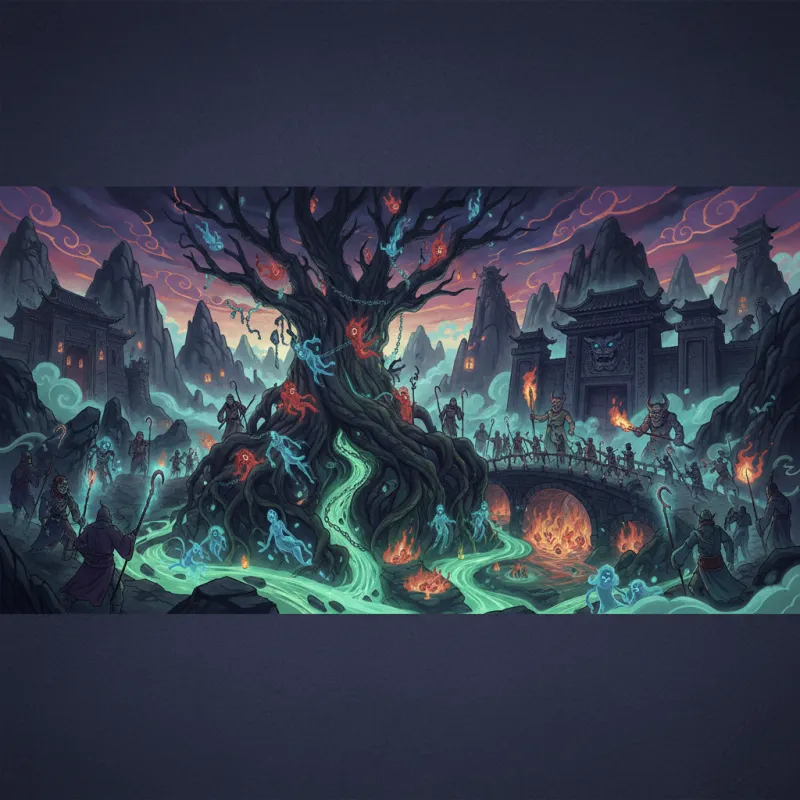
The judge slammed his gavel, and the dead man's tongue stretched three feet from his mouth. Not metaphorically — literally. In the Court of Tongue-Ripping, the Fifth Hall of Diyu, liars get exactly what they deserve. The bailiff, a bull-headed demon with surprisingly neat calligraphy, recorded the sentence in triplicate while the man screamed through his elongated tongue. Welcome to the Chinese afterlife, where karma isn't just a concept — it's processed through fourteen levels of bureaucratic hell.
The Bureaucracy of the Dead
The Chinese underworld operates like the imperial government it mirrors, because that's exactly what it is: a celestial extension of earthly authority. Diyu (地狱, dìyù, "earth prison") isn't ruled by a single devil but by ten judges called the Yanluo Kings (十殿阎罗 shí diàn yánluó), each presiding over one of ten courts. The system expanded over centuries — early Buddhist texts mentioned only one Yama King, but by the Tang Dynasty (618-907 CE), Chinese theologians had multiplied him into ten, because apparently one judge couldn't handle the caseload of the world's most populous civilization.
Each king specializes in particular sins. King Qinguang (秦广王 Qínguǎng Wáng) runs the First Court, where all souls arrive for initial processing and judgment. Think of him as intake — he reviews your life record, determines your general moral standing, and routes you to the appropriate court for detailed sentencing. The virtuous skip most of the process and head straight to reincarnation. Everyone else gets forwarded to the relevant specialist.
King Chujiang (楚江王 Chǔjiāng Wáng) handles the Second Court, punishing thieves and corrupt officials. King Songdi (宋帝王 Sòngdì Wáng) in the Third Court deals with the ungrateful and disrespectful. And so it continues through all ten courts, each with its own torture chambers, each with its own meticulous record-keeping. The system reflects a deeply Confucian anxiety: that without proper administration, even cosmic justice would collapse into chaos.
The Eighteen Levels of Creative Punishment
Beneath the ten courts lie the eighteen levels of hell (十八层地狱 shíbā céng dìyù), and this is where Chinese cosmology gets genuinely creative with suffering. These aren't just fire and brimstone — they're targeted, specific, and often darkly ironic punishments tailored to particular transgressions.
The Tongue-Ripping Hell awaits those who lied, slandered, or sowed discord. The Mountain of Knives Hell forces climbers to scale peaks made of blades — appropriate for those who drove others to their deaths. The Pool of Blood Hell, particularly horrifying, punishes women who died in childbirth (considered polluting) and those who disrespected blood relatives. The Ice Hell freezes those who were cold-hearted in life. The Oil Cauldron Hell boils rapists, prostitutes, and those who wasted food.
What strikes me about these hells is their specificity. They're not generic torment but precise karmic mirrors. The Saw Hell cuts apart those who exploited legal loopholes. The Grinding Hell pulverizes corrupt merchants who used false weights. There's even a hell for people who wasted paper with writing on it — a reflection of how sacred literacy was in imperial China.
The punishments aren't eternal, though. This is crucial. You serve your sentence — maybe a few years, maybe several lifetimes — and then you move on. The system is rehabilitative, not purely punitive. Even the worst sinners eventually get processed through to reincarnation, though they might come back as insects or hungry ghosts rather than humans.
The Support Staff: Demons, Judges, and Ox-Head
The underworld employs a vast workforce of supernatural beings, and they're far more interesting than the judges they serve. The most famous are Ox-Head (牛头 Niútóu) and Horse-Face (马面 Mǎmiàn), the bailiffs who escort souls from the mortal world to the underworld. They appear at deathbeds, chains in hand, ready to drag the deceased to judgment. In folk religion, people leave offerings to these two specifically, hoping for gentle treatment during the journey.
Then there are the Black and White Impermanence (黑白无常 Hēibái Wúcháng), another pair of psychopomps who appear in Chinese opera and temple processions. The White Impermanence is tall, wears white, and smiles — he died of happiness. The Black Impermanence is short, wears black, and scowls — he died of anger. Together they represent the dual nature of death: sometimes peaceful, sometimes violent, but always inevitable.
The judges themselves have assistants: clerks who maintain the life records, torturers who carry out sentences, and guards who prevent escapes. Yes, escapes. Chinese hell isn't perfectly secure. Folk tales are full of clever souls who bribe officials, exploit bureaucratic errors, or simply walk out when nobody's watching. In the Journey to the West (西游记 Xīyóu Jì), Sun Wukong literally breaks into hell and erases his name from the death registry, making himself immortal through paperwork fraud.
This reflects a deeply cynical but realistic view of government: even cosmic justice can be corrupted, confused, or circumvented. The underworld isn't run by omniscient beings but by officials who make mistakes, accept bribes, and sometimes just don't care enough to do their jobs properly.
The Geography of Suffering
Diyu exists beneath Mount Tai (泰山 Tàishān) in Shandong Province, according to most traditions. This isn't metaphorical — people genuinely believed there was a physical entrance to the underworld somewhere on that mountain. Mount Tai became a pilgrimage site partly because of this association, and the mountain's god, Dongyue Dadi (东岳大帝 Dōngyuè Dàdì), serves as a kind of regional administrator for the dead.
The underworld itself is described as a dark, gloomy place lit by ghost fires and filled with the sounds of suffering. Rivers of blood and pus flow between the levels. The architecture mirrors imperial palaces and government offices, complete with courtyards, throne rooms, and filing chambers. Some accounts describe entire cities in the underworld, populated by the dead awaiting judgment or serving their sentences.
The most famous landmark is the Bridge of Helplessness (奈何桥 Nàihé Qiáo), which souls must cross before reincarnation. At the bridge sits Meng Po (孟婆 Mèng Pó), an old woman who serves a tea that erases all memories of past lives. You drink, you forget, and you're ready to be reborn. Some souls try to refuse the tea, hoping to remember their past lives, but Meng Po is patient and persistent. Eventually, everyone drinks.
This geography matters because it makes the afterlife concrete and navigable. It's not an abstract spiritual state but a place you could theoretically map, with roads and buildings and administrative districts. This concreteness made the underworld feel real to ordinary people and gave them a framework for understanding death.
Living Visitors and Bureaucratic Appeals
Chinese literature is full of stories about living people visiting the underworld, and these tales reveal how the system actually works. In Strange Tales from a Chinese Studio (聊斋志异 Liáozhāi Zhìyì), Pu Songling records dozens of accounts of people who died temporarily, toured hell, and came back to report what they saw. These near-death experiences follow a pattern: the person arrives, realizes there's been a mistake (they weren't supposed to die yet), appeals to the judges, and gets sent back with a warning to live better.
The appeals process is crucial. The underworld makes mistakes — wrong person grabbed, paperwork error, clerical confusion. When this happens, you can file a complaint. If your case is strong, the judges will correct the error and send you back to life. This isn't divine mercy; it's bureaucratic error correction. The system has checks and balances.
Some living people visit intentionally, usually shamans or monks who journey to the underworld to rescue souls or negotiate with the judges. These spiritual specialists know the protocols, understand the hierarchy, and can navigate the bureaucracy effectively. They're like lawyers for the dead, arguing cases before the Yanluo Kings and sometimes winning reduced sentences or early releases.
The most famous living visitor is Mulian (目连 Mùlián), a Buddhist monk who descended to hell to rescue his mother. She'd been condemned for her greed and disrespect, but Mulian's filial piety was so powerful that he convinced the judges to release her. His story became the basis for the Ghost Festival (中元节 Zhōngyuán Jié), when the gates of hell open and the living make offerings to suffering souls. The tale demonstrates that even underworld sentences can be appealed through proper channels and sufficient devotion.
Reincarnation: The Exit Strategy
The ultimate goal of the underworld system is reincarnation (轮回 lúnhuí), and this is where Buddhist and Daoist concepts merge with Chinese folk religion. After serving your sentence, you proceed to the Wheel of Reincarnation, where your next life is determined by your karma balance. Good karma means rebirth as a human or even a celestial being. Bad karma means rebirth as an animal, hungry ghost, or back into hell for another round.
The system includes six realms of rebirth: gods, humans, asuras (fighting spirits), animals, hungry ghosts, and hell beings. Most people cycle through the human and animal realms, occasionally dipping into hell for serious offenses or rising to the god realm for exceptional virtue. The goal, in Buddhist terms, is to escape the cycle entirely through enlightenment, but most souls just keep cycling.
Before rebirth, you cross the Bridge of Helplessness and drink Meng Po's tea. Some accounts say the tea tastes bitter, sweet, sour, or spicy depending on your past life experiences — a final reminder of what you're leaving behind. Then you forget everything and enter your new life with a clean slate.
This reincarnation system makes death less terrifying because it's not final. You'll be back, in some form, and if you live well this time, maybe you'll get a better deal next round. The underworld isn't the end of your story; it's just an intermission between acts.
The Modern Underworld
The Chinese underworld persists in contemporary culture, though often in adapted forms. Horror films like The Eye and The Maid draw on underworld imagery and rules. Video games set in Chinese mythology feature Diyu as a playable location. Even Chinese bureaucrats sometimes joke about the underworld's paperwork, recognizing the satirical edge in the traditional descriptions.
What fascinates me is how the underworld concept reflects Chinese attitudes toward authority, justice, and death. It's not a place of arbitrary divine wrath but of systematic, if imperfect, administration. It acknowledges that justice systems make mistakes, that officials can be corrupt, and that even cosmic law requires constant maintenance and oversight. The underworld is terrifying not because it's chaotic but because it's orderly — because it processes you with the same indifferent efficiency as any government office.
For more on the supernatural beings who inhabit this realm, see Chinese Demons and Evil Spirits. And if you're curious about how the living interact with the dead, explore The Hungry Ghost Festival.
The Chinese underworld remains one of the most elaborate afterlife systems ever conceived, a cosmic bureaucracy that turns death into paperwork and karma into case law. It's hell as government office, and somehow that's more unsettling than any lake of fire.
Related Reading
- Door Gods: Guardians Against Evil Spirits
- Zhong Kui: The Demon Queller Who Protects Chinese Homes
- Door Gods and Protective Spirits: China's Supernatural Security System
- Chinese Folklore: The Stories That Grandmothers Tell
- Exploring Chinese Supernatural Folklore: Ghosts, Spirits, and Afterlife Beliefs
- Exploring the Depths of Chinese Supernatural Folklore: Ghosts, Spirits, and Afterlife Beliefs
- Types of Chinese Demons: A Field Guide to Supernatural Beings
- Shamanism in Chinese Folk Religion: The Original Spirit Workers
Explore Chinese Culture
- Explore ancient mythical creatures
- Explore Daoist exorcism traditions
- Explore Chinese folk beliefs and superstitions