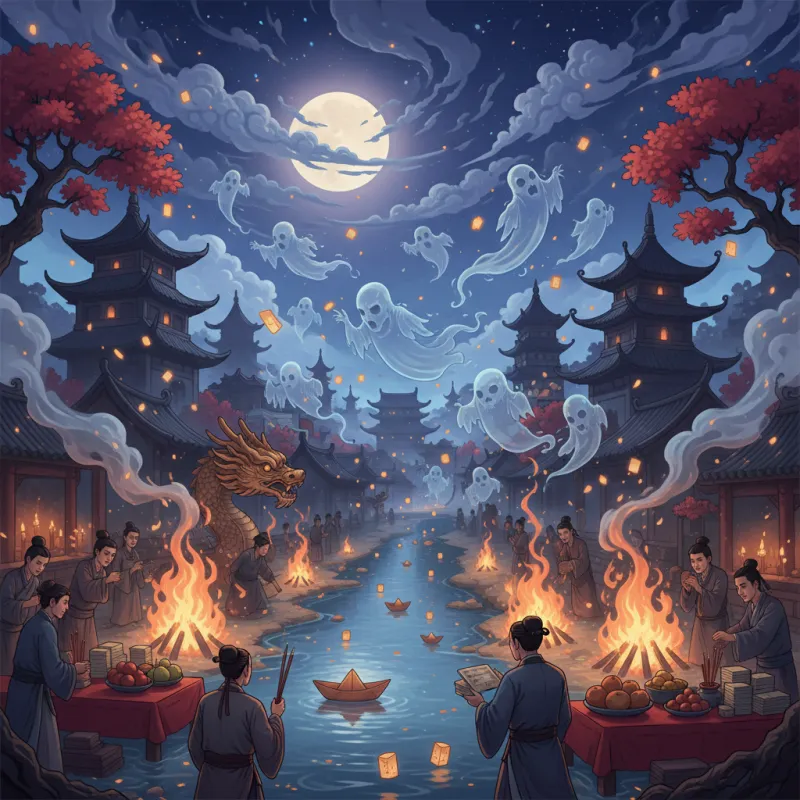
Every year when the seventh lunar month arrives, my grandmother would grab my arm before I could run outside after dinner. "Stay inside after dark," she'd whisper, eyes darting toward the window. "The gates are open." She wasn't talking about our courtyard gate. She meant the gates of the underworld—and for the next thirty days, the boundary between the living and the dead would blur like ink in water.
When Hell Takes a Holiday
The Hungry Ghost Festival (中元节, Zhōngyuán Jié) reaches its peak on the fifteenth day of the seventh lunar month, but the entire month is considered spiritually dangerous. Unlike the orderly ancestor veneration of Qingming Festival, this is when all the dead get a month-long furlough—not just your respectable ancestors, but the forgotten, the angry, and the ravenous. The Chinese call them hungry ghosts (饿鬼, èguǐ), spirits condemned to wander with throats as thin as needles and bellies that can never be filled.
The festival's origins tangle together three traditions like roots beneath old stones. Taoists mark it as the birthday of the Earthly Official (地官, Dìguān), one of the Three Pure Ones who descends to judge the living and absolve sins. Buddhists trace it to the Yulanpen Sutra, which tells of Mulian (目连, Mùlián), a monk who discovered his mother suffering in the hungry ghost realm and had to make offerings to monks on the fifteenth day to save her. Folk religion, older and more pragmatic than either, simply recognized that the dead get restless in the heat of late summer and need to be fed.
The Hungry Ghost Hierarchy
Not all wandering spirits are created equal during Ghost Month. Your own ancestors—assuming you've been diligent with offerings—are generally well-behaved guests. They'll appreciate the food you set out and won't cause trouble. The real concern is the orphan ghosts (孤魂野鬼, gūhún yěguǐ): those who died without descendants, died violently, or whose families have forgotten them. These are the desperate ones, the angry ones, the spirits who might drag a living person into the water or cause accidents out of jealousy and spite.
Then there are the truly dangerous entities. Water ghosts (水鬼, shuǐguǐ) lurk in rivers and lakes, seeking to drown someone so they can be reincarnated while their victim takes their place. Hanged ghosts (吊死鬼, diàosǐguǐ) haunt the places where they died, sometimes compelling the living to repeat their final act. My uncle, who worked night shifts at a factory, swore he once saw a woman in old-fashioned clothes standing beneath a tree at 3 AM, her feet not quite touching the ground. He didn't go back to work for a week.
Feeding the Hungry: Rituals and Offerings
The central act of the Hungry Ghost Festival is feeding—not just your ancestors, but any wandering spirit who might be hungry. Families set up elaborate outdoor feasts with whole roasted pigs, pyramids of fruit, rice wine, and incense thick enough to choke on. The food must be placed outside, never inside your home, because you don't want to invite these guests across your threshold.
The most dramatic offerings happen at community-organized ghost feasts (普渡, pǔdù), where entire neighborhoods pool resources for massive banquets. Tables groan under the weight of food, and paper money burns in metal drums, sending wealth to the spirit world in columns of smoke and ash. Taoist or Buddhist priests chant sutras to guide lost souls toward salvation, while opera performances on makeshift stages entertain both the living and the dead. The front row is always left empty—reserved for ghostly VIPs.
But here's what the tourist guides don't tell you: the offerings aren't just about generosity. They're protection money. You feed the hungry ghosts so they won't be hungry for you. The logic is transactional, almost mafia-like: show respect, provide sustenance, and maybe—maybe—they'll leave you alone. This is why people scatter rice and coins on the ground, why they pour tea in three directions, why they burn paper houses and paper servants and paper iPads (yes, really—the afterlife has apparently gone digital).
The Taboos: What Not to Do When Hell's Gates Are Open
Ghost Month comes with a suffocating list of prohibitions, and while younger generations roll their eyes, I've noticed even the skeptics get a little cautious when the seventh month rolls around. Some taboos are universal across Chinese communities; others vary by region, but they all share the same logic: don't attract attention, don't provoke, don't give the spirits any reason to notice you.
Swimming is the most serious taboo. Water ghosts are always hunting for substitutes, and they're strongest during Ghost Month. Lakes and rivers that seem perfectly safe in June become off-limits in July. My cousin's swimming team used to cancel all practices during the seventh month, and the coach—a man who claimed to believe in nothing but chlorine and lap times—never questioned it.
Don't whistle or call out names after dark. Whistling attracts wandering spirits, and if you call someone's name, a ghost might answer instead—or worse, steal that person's soul by responding in their place. Don't hang clothes outside at night; spirits might try them on, and you definitely don't want to wear something a ghost has inhabited. Don't pick up money you find on the street; it might be ghost money, left as an offering, and taking it means accepting a debt to the dead.
Weddings, business openings, and moving house are all postponed until the eighth month. Why start something new when the spiritual atmosphere is so unstable? Even hospitals see fewer elective surgeries. One doctor told me, off the record, that they schedule around it because too many patients request it anyway—easier to just avoid the conflict.
The taboo I find most unsettling: don't pat someone on the shoulder or head. Chinese folk belief holds that every person has three flames (三把火, sān bǎ huǒ)—one on the head and one on each shoulder—that protect against spiritual possession. Pat someone's shoulder and you might extinguish their flame, leaving them vulnerable. It sounds absurd until you're walking home alone at night during Ghost Month and you feel a hand on your shoulder, and you remember that no one was behind you.
Regional Variations: How Different Communities Honor the Dead
The Hungry Ghost Festival looks different depending on where you are. In Taiwan, the celebrations are massive and public, with entire streets shut down for ghost feasts and religious processions. The Keelung Ghost Festival is famous for its elaborate water lantern ceremonies, where thousands of lotus lanterns float out to sea, guiding lost souls home. In Hong Kong, you'll see Cantonese opera performances in bamboo theaters erected specifically for the festival, with the best seats left empty for the spirits.
Teochew communities in Southeast Asia practice a particularly intense version called the Hungry Ghosts Festival Auction, where blessed items are auctioned off, with the proceeds going to temple maintenance. The bidding gets fierce—not just for the religious merit, but because winning an auction item is considered lucky, a sign that the spirits favor you. In Singapore and Malaysia, getai (歌台, gētái) performances—variety shows with pop songs, comedy, and dancers—are staged throughout the month, blending entertainment with religious observance in a way that feels uniquely Southeast Asian.
Mainland China's relationship with the festival is more complicated. The Communist Party spent decades trying to eliminate "feudal superstitions," and while the festival was never fully suppressed, it went underground in many areas. It's been making a comeback since the 1990s, but it's often rebranded as "Zhongyuan Festival" with emphasis on the Taoist and Buddhist elements rather than the folk ghost-feeding aspects. Still, if you visit rural villages in Fujian or Guangdong during the seventh month, you'll find the old practices alive and well—paper money burning in the streets, food offerings on doorsteps, and a palpable sense that something unseen is watching.
The Psychology of Ghost Month: Fear as Social Glue
Western observers often dismiss Ghost Month taboos as superstition, but I think they're missing something important. These prohibitions create a shared psychological space, a collective acknowledgment that the world contains forces beyond our control. When everyone in your community observes the same taboos, it builds social cohesion in a way that's hard to replicate through purely rational means.
There's also something psychologically healthy about having a designated time to confront death and the dead. Modern life encourages us to ignore mortality, to pretend death happens to other people, somewhere else, not to us. Ghost Month forces the opposite: for thirty days, death is everywhere, unavoidable, demanding recognition. You feed the dead, you remember the dead, you acknowledge that you too will someday be dead. It's uncomfortable, but maybe that discomfort serves a purpose.
I'm not arguing that water ghosts are literally real or that patting someone's shoulder will extinguish their protective flame. But I am suggesting that these beliefs encode genuine wisdom about respect, caution, and the limits of human knowledge. The old woman who won't swim during Ghost Month has probably internalized a useful wariness about water safety. The family that makes offerings together is maintaining bonds across generations. The community that gathers for a ghost feast is practicing mutual care, even if the ostensible beneficiaries are spirits.
Living with the Dead: Ghost Month in Modern Times
Walk through any Chinese neighborhood during the seventh lunar month and you'll see the contradictions of modern Ghost Month observance. A teenager in designer sneakers carefully steps over a line of rice scattered across the sidewalk. A businessman in a BMW pulls over to let a funeral procession pass, even though he's late for a meeting. An elderly woman burns paper money in a metal drum while her granddaughter films it for TikTok, adding filters that make the smoke glow purple.
The festival is adapting, sometimes in ways that would horrify traditionalists. You can now buy paper offerings shaped like luxury cars, designer handbags, and smartphones—complete with paper chargers. Some temples accept digital donations instead of physical offerings. There are apps that remind you which taboos apply on which days, gamifying spiritual observance with achievement badges.
But underneath the modern trappings, the core impulse remains: the need to acknowledge the dead, to maintain relationships that transcend the boundary between life and death, to admit that the universe might contain more than what we can measure and control. Whether you believe in hungry ghosts or not, there's something profound about a culture that sets aside an entire month to remember that the dead were once living, and the living will someday be dead.
As my grandmother used to say, lighting incense on her doorstep as the sun went down: "Better to feed a ghost that doesn't exist than to ignore one that does." I still don't know if I believe in hungry ghosts. But every seventh month, when the air gets heavy and the shadows seem darker, I find myself staying inside after dark, just in case. Some traditions survive not because we believe them, but because we're not quite brave enough to test whether they're true.
For more on Chinese supernatural beliefs, explore our articles on Chinese Ghost Classifications and Hierarchies and Exorcism Rituals in Chinese Folk Religion.
Related Reading
- Door Gods: Guardians Against Evil Spirits
- Door Gods and Protective Spirits: China's Supernatural Security System
- Exploring Chinese Supernatural Folklore: Ghosts, Spirits, and Afterlife Beliefs
- The Complete Guide to Chinese Supernatural Folklore: Ghosts, Demons, and Spirit World
- Fox Spirits: China's Most Famous Shapeshifters
- Talismans and Fu: The Ancient Art of Paper Magic
- River Gods and Water Deities in Chinese Mythology
- Exploring the Multifaceted World of Chinese Supernatural Folklore and Afterlife Beliefs
Explore Chinese Culture
- Explore ancient mythical creatures
- Explore Daoist exorcism traditions
- Explore Chinese folk beliefs and superstitions