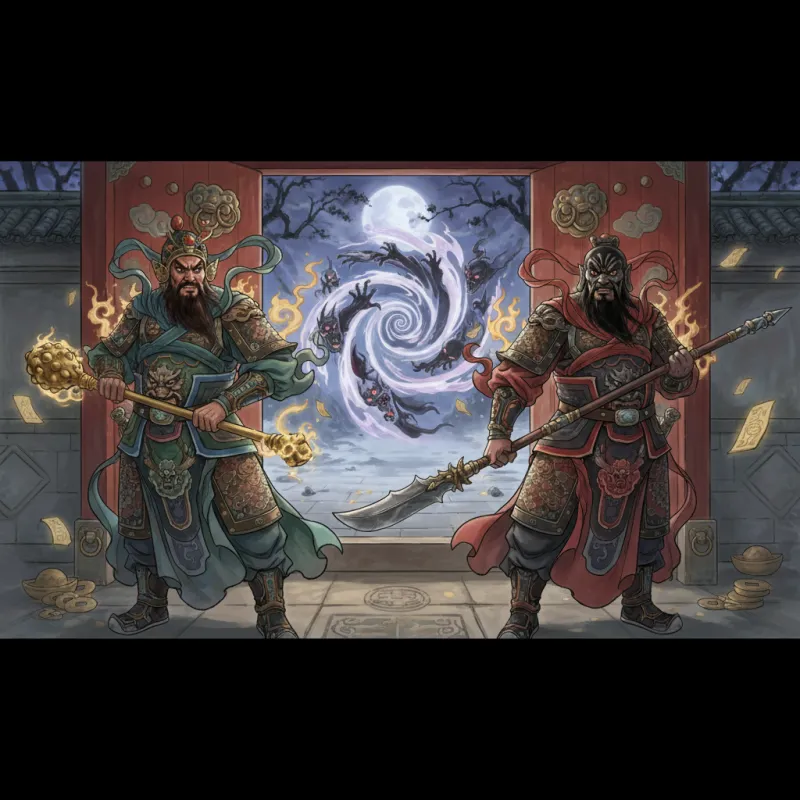
Every Chinese New Year, millions of households paste fierce-looking warriors onto their front doors—not as decoration, but as a literal line of defense against the spirit world. These aren't just any warriors. They're Door Gods (门神, mén shén), and according to centuries of folklore, they're the reason malevolent entities think twice before crossing your threshold.
The Tang Dynasty Murder That Started It All
Most people don't know that the most famous Door Gods in Chinese history got their job because of a ghost with a serious grudge. During the Tang Dynasty, Emperor Taizong (reigned 626-649 AD) was being tormented nightly by the vengeful spirit of a dragon king he'd had executed. The emperor couldn't sleep. His health deteriorated. His advisors were desperate.
Enter two of the emperor's most loyal generals: Qin Shubao (秦叔宝, Qín Shūbǎo) and Yuchi Gong (尉迟恭, Yùchí Gōng). These weren't bureaucrats or scholars—they were battle-hardened warriors who'd helped Taizong seize the throne. When they volunteered to stand guard outside the emperor's bedchamber in full armor, weapons drawn, the ghost attacks stopped immediately. The problem? The generals couldn't stand guard forever. So the emperor commissioned artists to paint their portraits in their most intimidating battle gear and mounted these images on his doors. The protection held.
This story, popularized in the Ming Dynasty novel Journey to the West (西游记, Xīyóu Jì), cemented Qin and Yuchi as the definitive Door Gods. But they weren't the first, and they're certainly not the only ones.
The Earlier Guardians: Shentu and Yulei
Before Tang Dynasty generals became the face of door protection, two mythological brothers held the position. Shentu (神荼, Shéntú) and Yulei (郁垒, Yùlěi) appear in texts dating back to the Han Dynasty (206 BC – 220 AD), making them the OG Door Gods by at least 800 years.
According to the Classic of Mountains and Seas (山海经, Shān Hǎi Jīng) and later commentaries, these brothers lived on Mount Dushuo (度朔山, Dùshuò Shān) beneath a massive peach tree. Every night, they would inspect the ghosts returning to the spirit world. Any ghost that had caused harm to humans during the day would be bound with reed ropes and fed to tigers. Yes, tigers. The punishment for malevolent spirits wasn't exile or imprisonment—it was being tiger food.
The peach tree detail matters. In Chinese folklore, peach wood (桃木, táomù) is inherently hostile to supernatural entities, which is why peach wood swords remain popular exorcism tools to this day. The brothers' association with this tree amplified their ghost-repelling credentials.
What Makes Door Gods Actually Work?
Here's where it gets interesting. Door Gods aren't just symbolic—they're functional within the logic of Chinese supernatural belief. Several factors contribute to their effectiveness:
Martial prowess matters. Notice that the most popular Door Gods are warriors, not scholars or monks. Qin Shubao was known for his skill with the mace, while Yuchi Gong wielded iron whips and was said to have skin so tough that blades couldn't pierce it. Ghosts and demons, despite being incorporeal, apparently respect military might. This reflects a broader pattern in Chinese folklore where physical strength translates to spiritual authority.
The gaze is everything. Look closely at traditional Door God paintings. Their eyes are always wide open, staring directly outward with an intensity that borders on rage. This isn't artistic choice—it's tactical. The belief holds that malevolent spirits cannot pass under the direct gaze of a righteous warrior. It's why Door Gods are always painted in pairs facing outward, creating an inescapable field of vision.
Symmetry creates a barrier. Door Gods always come in pairs, one on each door panel. This bilateral symmetry isn't just aesthetically pleasing—it's spiritually necessary. The two guardians create a complete protective field. A single Door God, no matter how fierce, leaves gaps in the defense. This principle appears throughout Chinese protective magic, from fu talismans to the arrangement of guardian statues at temple entrances.
Regional Variations and Specialized Protectors
While Qin and Yuchi dominate in northern China, southern regions often prefer different guardians. In Fujian and Taiwan, you'll frequently see Zhong Kui (钟馗, Zhōng Kuí), the demon-quelling scholar who failed the imperial examinations but became heaven's official ghost hunter. His Door God images show him with a wild beard, bulging eyes, and usually accompanied by his five ghost servants who do his bidding.
Some households use civil officials instead of military generals, particularly wealthy merchant families who prefer the symbolism of scholarly success. These civil Door Gods often hold tablets and wear official robes rather than armor. They're believed to bring both protection and prosperity—a two-for-one deal that appeals to the business-minded.
Daoist temples take a different approach entirely, often featuring the Four Heavenly Kings (四大天王, Sì Dà Tiānwáng) or specialized deities like Wang Lingguan (王灵官, Wáng Línguān), a fierce protector with three eyes and a whip made of fire. These aren't just guardians against ghosts—they're cosmic enforcers who maintain order between the human and spirit realms.
The Ritual Timing: Why New Year Matters
You can't just slap Door Gods on your door any random Tuesday. The traditional time for replacing or installing Door God images is during Chinese New Year preparations, specifically on New Year's Eve. This timing is crucial for several reasons.
First, New Year's Eve is when the Kitchen God (灶神, Zàoshén) ascends to heaven to report on the household's behavior over the past year. The transition period when he's away leaves the home vulnerable—perfect timing to reinforce door protection. Second, the turn of the year is considered a moment when the boundary between worlds grows thin, making it easier for spirits to cross over. Fresh Door Gods at this liminal moment provide maximum protection for the coming year.
The old Door God images aren't simply thrown away. They must be burned respectfully, releasing the spirits of the guardians so they can return to the celestial realm. Burning them sends them "back to heaven" (送神, sòng shén). Tossing them in the trash would be not just disrespectful but dangerous—you'd essentially be trapping and angering powerful protective spirits.
Modern Adaptations and Persistent Belief
Walk through any traditional neighborhood in China, Taiwan, or overseas Chinese communities during New Year, and you'll still see Door Gods everywhere. But they've evolved. Modern printed versions have largely replaced hand-painted images, though collectors and traditionalists still commission artists for custom paintings. Some contemporary designs add elements like QR codes for temple information or incorporate modern military uniforms while maintaining traditional fierce expressions.
What's remarkable is how the practice persists even among younger, educated Chinese who might not believe in ghosts. When asked, many will say it's "just tradition" or "for the grandparents," but they still do it. This suggests Door Gods serve a psychological function beyond literal ghost protection—they mark boundaries, assert control over one's space, and connect individuals to centuries of cultural continuity.
The practice has even influenced architecture. Traditional Chinese doorways are designed with raised thresholds (门槛, ménkǎn) that spirits supposedly cannot cross, working in tandem with Door Gods. Modern apartment buildings might lack these physical barriers, making the symbolic protection of Door God images even more important to believers.
The Deeper Logic of Threshold Protection
Door Gods reveal something fundamental about Chinese supernatural worldview: boundaries matter immensely. The threshold between inside and outside, between home and world, between human space and spirit realm—these aren't just physical divisions but metaphysical ones. Doors are dangerous precisely because they're necessary. You need them to enter and exit, but that same permeability makes them vulnerable points.
This is why Chinese folklore is obsessed with threshold protection. It's not enough to have walls; the openings in those walls require active, aggressive defense. Door Gods aren't passive symbols—they're active agents, constantly vigilant, never sleeping, never distracted. They embody the principle that safety requires eternal watchfulness.
Compare this to Western traditions where protective symbols like horseshoes or crosses are often static objects. Door Gods have personality, history, and agency. They're not just warding off evil—they're ready to fight it. That distinction matters. It reflects a worldview where the supernatural isn't some distant, abstract force but an immediate, physical threat requiring immediate, physical response.
When you paste those fierce warriors on your door each New Year, you're not just following tradition. You're declaring that your threshold is defended, that malevolent forces will find no easy entry here, and that you're connected to centuries of households who made the same declaration. In a world where so much feels uncertain and uncontrollable, there's something deeply satisfying about having two immortal warriors standing permanent guard at your door.
Related Reading
- Zhong Kui: The Demon Queller Who Protects Chinese Homes
- Hungry Ghost Festival: Traditions and Taboos
- The Chinese Underworld: A Complete Guide to Diyu
- Chinese Folklore: The Stories That Grandmothers Tell
- Lady White Snake: China's Greatest Love Story
- Campus Ghost Stories in China: The Haunted Dormitories and Cursed Libraries
- The Tongji: Spirit Mediums of Southeast Asia's Chinese Communities
- Unraveling the Mystique of Chinese Supernatural Folklore and Afterlife Beliefs
Explore Chinese Culture
- Explore ancient mythical creatures
- Explore Daoist exorcism traditions
- Explore Chinese folk beliefs and superstitions