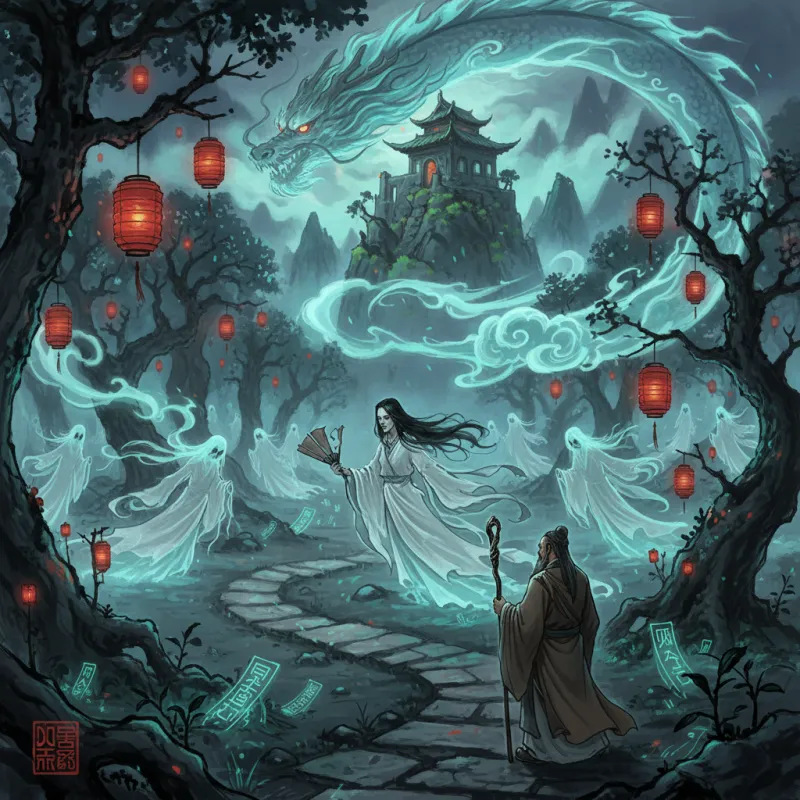
The first time you see a jiangshi (僵尸, jiāngshī) — a Chinese hopping vampire — on screen, you'll either laugh or feel a chill run down your spine. Probably both. Dressed in Qing dynasty official robes, arms outstretched, hopping stiffly through the night while a Daoist priest fights it off with yellow talismans and chicken blood, the jiangshi embodies everything that makes Chinese horror cinema gloriously, bewilderingly unique. This isn't the Gothic dread of Dracula or the psychological terror of The Shining. This is horror filtered through thousands of years of folklore, Daoist cosmology, and a cultural understanding that death is not an ending but a bureaucratic transition.
The Hong Kong Golden Age: When Horror Met Kung Fu
Hong Kong cinema in the 1980s and early 1990s didn't just make horror films — it invented an entirely new subgenre. Directors like Sammo Hung and Ricky Lau took the jiangshi from obscure folklore and turned it into box office gold. Mr. Vampire (1985) remains the definitive example: a perfect blend of supernatural horror, martial arts choreography, slapstick comedy, and genuine scares. The film's success spawned countless imitators and sequels, establishing a template where Daoist priests with peachwood swords and ink-line snapping techniques became action heroes.
What made this era special wasn't just the jiangshi films. Tsui Hark's A Chinese Ghost Story (1987) took the classic tale of scholar Ning Caichen and the ghost Nie Xiaoqian from Liaozhai Zhiyi and transformed it into a romantic fantasy-horror hybrid with groundbreaking special effects. The tree demon remains one of the most terrifying creatures in Chinese cinema — a massive tongue-wielding monster that makes Western horror's practical effects look quaint by comparison.
The freedom of Hong Kong's film industry before the 1997 handover allowed filmmakers to push boundaries. Category III films (Hong Kong's equivalent of NC-17) like The Untold Story (1993) and Ebola Syndrome (1996) delivered extreme violence and disturbing content that would never pass mainland censors. These weren't supernatural horror but "true crime" exploitation films that revealed the genre's darker, more transgressive possibilities.
Mainland Constraints and Creative Workarounds
Mainland Chinese horror operates under a fundamental restriction: ghosts cannot be real. Government censorship guidelines effectively ban supernatural horror, requiring that any apparent ghost or demon be revealed as a hoax, hallucination, or dream by the film's end. This seems like a death sentence for the genre, yet filmmakers have found remarkably creative solutions.
The key is ambiguity and psychological horror. Films like The Eye (2002), though technically a Hong Kong-Thai co-production, influenced mainland approaches by focusing on the subjective experience of supernatural encounters. More recently, The Looming Storm (2017) uses the framework of a serial killer investigation in 1990s China to create dread through atmosphere and social commentary rather than explicit supernatural elements.
Some directors embrace the restriction as a creative challenge. By the time the "rational explanation" arrives in the final minutes, the audience has already experienced 90 minutes of genuine horror. The censorship becomes a narrative device itself — a forced return to rationality that feels more unsettling than reassuring, like being told your nightmare wasn't real even as you still feel its grip.
The Karmic Justice Framework
Unlike Western horror, where evil often triumphs or at least leaves ambiguous endings, Chinese horror films almost always operate within a framework of karmic justice (因果报应, yīnguǒ bàoyìng). Ghosts return not randomly but with purpose — to right wrongs, punish the guilty, or complete unfinished business. This isn't a weakness of the genre but its philosophical foundation.
In A Chinese Ghost Story, Nie Xiaoqian is trapped serving an evil tree demon not because she's inherently malevolent but because she died before marriage and has no descendants to perform rituals for her. Her haunting of travelers is compelled servitude, not choice. The film's emotional power comes from this understanding — she's a victim seeking liberation, not a monster seeking revenge.
Even in more extreme films, karmic logic prevails. The ghosts in Rigor Mortis (2013) — a dark, artistic reimagining of the jiangshi genre — are products of suicide, abandonment, and urban decay. The horror emerges from broken social contracts and forgotten obligations, not supernatural malevolence. The film suggests that Hong Kong's aging public housing estates are haunted not by ghosts but by the living who've been left behind by economic progress.
Regional Variations and Folk Horror
Chinese horror isn't monolithic. Regional folklore creates distinct flavors of supernatural terror. Southern Chinese ghost stories, influenced by humid climates and water-based economies, feature drowned ghosts and river spirits. Northern tales incorporate harsh winters and the Manchurian jiangshi tradition. Tibetan horror, rarely seen in mainstream cinema, draws from Buddhist cosmology and the bardo realm between death and rebirth.
The best Chinese horror films mine these regional specificities. The Mermaid (2016), though primarily a comedy, incorporates Cantonese folklore about sea spirits and environmental destruction. The Wailing (2016), a Korean film heavily influenced by Chinese shamanic traditions, shows how these folk horror elements translate across East Asian cultures — the Japanese stranger, Korean shaman, and Chinese-style exorcism rituals all collide in a narrative about the failure of traditional spiritual protection in the modern world.
Folk horror works in Chinese cinema because the beliefs aren't historical curiosities — they're living traditions. Audiences don't need exposition about why you shouldn't move a corpse after rigor mortis sets in or why a Daoist priest uses chicken blood and sticky rice against vampires. These aren't exotic superstitions but cultural knowledge passed down through generations, making the horror feel immediate and personal.
The Modern Landscape: Streaming and Soft Power
Contemporary Chinese horror exists in a strange space between censorship, commercial pressure, and international ambition. Streaming platforms like iQiyi and Tencent Video have become major producers, creating web films and series that push boundaries slightly further than theatrical releases. These platforms allow for serialized storytelling that can develop supernatural mythology over multiple episodes, even if each installment must technically resolve with rational explanations.
The international success of films like Detention (2019) — a Taiwanese horror film about White Terror-era ghosts — shows there's global appetite for Chinese-language horror that engages with historical trauma. Taiwan's film industry, free from mainland censorship, has become increasingly important for preserving the genre's supernatural elements. Films like The Tag-Along (2015) and its sequels draw from indigenous Taiwanese folklore about the "little girl in red," creating horror that's culturally specific yet universally unsettling.
Meanwhile, mainland productions increasingly focus on "mystery" and "thriller" labels rather than "horror," allowing them to include frightening content while avoiding censorship triggers. The Victims' Game (2020) and similar productions blur the line between crime procedural and psychological horror, creating dread through human monstrosity rather than supernatural threats.
Why Chinese Horror Matters
Chinese horror cinema matters not because it's exotic or different but because it reveals how deeply culture shapes fear itself. The things that terrify us — death, the unknown, moral transgression — are universal, but how we process and represent those fears is profoundly cultural. A jiangshi hopping through the night is funny until you understand it represents a corpse that cannot rest, a soul trapped between worlds, a family's failure to properly honor their dead.
The genre's greatest strength is its refusal to separate horror from other emotions. Chinese horror films seamlessly blend terror with comedy, romance, action, and social commentary in ways that would feel jarring in Western horror. This isn't tonal inconsistency but a more holistic approach to storytelling — life contains multitudes, so why shouldn't horror?
For viewers raised on Western horror, Chinese horror films offer something genuinely new: a supernatural ecosystem with different rules, different monsters, and different stakes. The exorcism rituals aren't Catholic priests with holy water but Daoist masters with complex cosmological knowledge. The ghosts aren't vengeful spirits seeking random victims but agents of karmic justice operating within a moral universe. The scares come not from jump scares and gore but from the creeping realization that the boundary between life and death is thinner and more negotiable than you thought.
Start with Mr. Vampire for pure entertainment, A Chinese Ghost Story for romantic tragedy, and Rigor Mortis for artistic ambition. Then dive deeper into the regional variations, the Category III extremes, and the modern streaming experiments. Chinese horror cinema is a vast, strange, and endlessly rewarding genre — one that proves horror is most effective when it's rooted in the specific beliefs, fears, and folklore of a culture that still believes the dead are never truly gone.
Related Reading
- Jiangshi: The Hopping Vampire Genre That Conquered Hong Kong Cinema
- Chinese Internet Ghost Stories: The Creepypasta of the East — Cnspirit Perspective
- Chinese Horror Novels and Web Fiction: A Reading Guide
- Exploring the Mystical Realm of Chinese Ghosts and Afterlife Beliefs
- Chinese Urban Legends That Went Viral: From Elevator Ghosts to Cursed Phone Numbers
- Zhong Kui: The Demon Queller
Explore Chinese Culture
- Explore ancient mythical creatures
- Explore Daoist exorcism traditions
- Explore Chinese folk beliefs and superstitions