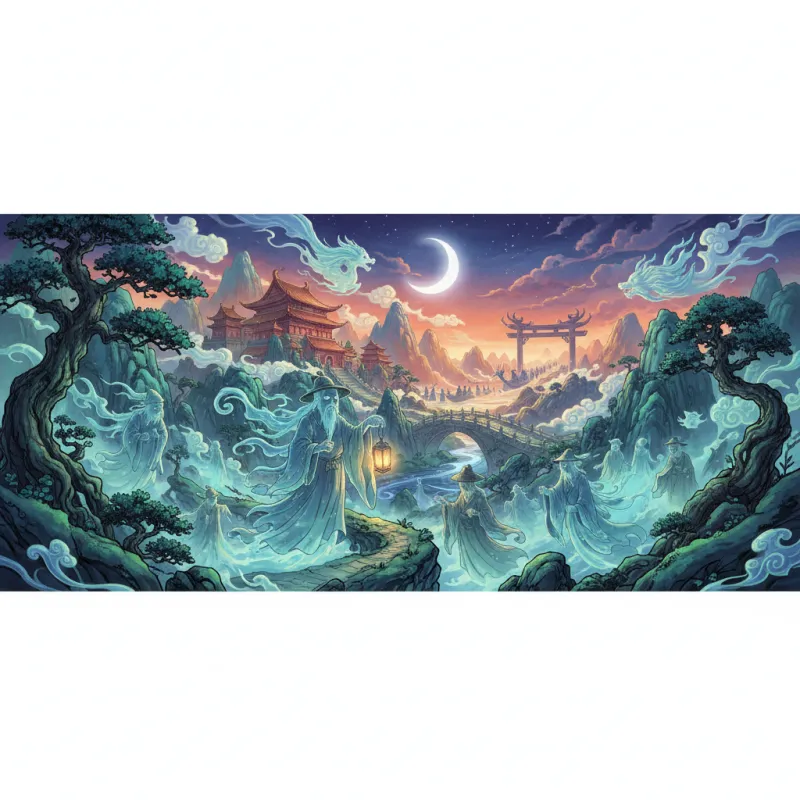
The old woman's funeral procession had barely left the village when her grandson saw her standing at the kitchen window, pointing frantically at the rice jar. Three days later, they found her life savings hidden beneath the grain—money she'd been too delirious to mention before dying. Stories like this aren't folklore curiosities in Chinese culture; they're Tuesday afternoon conversations, the kind of thing your aunt mentions over dinner without anyone batting an eye. The Chinese supernatural worldview doesn't treat ghosts as Halloween decorations or campfire entertainment—it treats them as neighbors who happen to be dead.
The Bureaucracy of the Dead
If you think earthly Chinese bureaucracy is complex, wait until you hear about the afterlife administration. The Chinese underworld operates like a cosmic DMV, complete with paperwork, stamps, and officials who can be bribed. At the top sits Yanluo Wang (阎罗王, Yánluó Wáng), the king of hell, but he's more middle manager than supreme ruler—he reports to the Jade Emperor and oversees ten courts of judgment, each handling specific sins.
When someone dies, their hun (魂, hún) and po (魄, pò) souls separate. The hun, your intellectual and spiritual essence, ascends and eventually joins the ancestors. The po, your physical and base nature, stays with the body and can become problematic if not properly managed. This is why traditional funerals involve so much ritual—you're essentially processing someone's cosmic paperwork to ensure smooth transit through the underworld bureaucracy.
The journey takes forty-nine days, during which the deceased faces judgment in each of the ten courts. Judge by judge, they're evaluated for specific transgressions: the first court handles those who died prematurely, the second deals with corrupt doctors, the fifth punishes loan sharks. It's remarkably specific. Families burn joss paper, hell money, and even paper iPhones to help their deceased relatives bribe officials or maintain comfort during this processing period. Mock capitalism for the dead, if you will.
Hungry Ghosts and Why They're Angry
Not everyone makes it through the system cleanly. Some souls get stuck, and these become gui (鬼, guǐ)—ghosts, but not the sheet-wearing kind. Chinese ghosts are hungry, literally and metaphorically. They're called egui (饿鬼, èguǐ) or hungry ghosts because they're perpetually unsatisfied, wandering with distended bellies and needle-thin throats that make eating impossible.
These aren't random hauntings. Hungry ghosts typically arise from specific circumstances: violent death, improper burial, no descendants to perform rituals, or dying with unfinished business. The woman who drowned herself after being falsely accused becomes a water ghost, pulling others under to take her place so she can reincarnate. The merchant murdered for his gold haunts the road where he died, not out of vengeance necessarily, but because he's literally stuck there, unable to move on without proper rites.
The seventh lunar month is Ghost Month, when the gates of hell open and these wandering spirits roam freely. It's not a celebration—it's more like a mandatory community service project. Families set out food offerings, burn incense, and avoid swimming, traveling, or moving house. The fifteenth day, Zhongyuan Jie (中元节, Zhōngyuán Jié), is the peak, when elaborate rituals appease these rootless souls. Think of it as feeding the neighborhood's most difficult residents to keep them from causing trouble.
Fox Spirits and the Seduction Problem
While ghosts are former humans, spirits (shen, 神, shén, or jing, 精, jīng) are different creatures entirely. Fox spirits, or huli jing (狐狸精, húli jīng), dominate Chinese supernatural literature, and they're far more interesting than Western werewolves or vampires. These foxes cultivate spiritual power over centuries, eventually gaining the ability to transform into beautiful women—or occasionally men, though the female fox spirit is the archetype.
Here's what makes them fascinating: they're morally ambiguous. A fox spirit might seduce a scholar to steal his yang energy and achieve immortality, or she might fall genuinely in love and become a devoted wife. The Strange Tales from a Chinese Studio (聊斋志异, Liáozhāi Zhìyì) by Pu Songling, written in the 17th century, contains hundreds of these stories, and they're rarely simple. One tale features a fox spirit who saves her lover's life multiple times, another shows a fox who ruins a man's family for sport.
The anxiety around fox spirits reflects deeper cultural concerns about female sexuality and social mobility. A beautiful woman appearing from nowhere, captivating a man, disrupting his family—this is the fox spirit narrative, but it's also the narrative of the courtesan, the second wife, the woman who doesn't fit into Confucian family structures. Fox spirits are dangerous not because they're evil, but because they're uncontrolled and uncontrollable.
Other transformation spirits include snake spirits (she jing, 蛇精, shé jīng), who follow similar patterns, and tree spirits, who tend to be more benevolent. The older the living thing, the more likely it can cultivate consciousness and power. That thousand-year-old tree in the village? Probably best to leave offerings and not cut it down.
Jiangshi: The Hopping Corpse Phenomenon
Western vampires drink blood and look sexy doing it. Chinese vampires—jiangshi (僵尸, jiāngshī)—hop stiffly with arms outstretched, wear Qing dynasty official robes, and have a piece of yellow paper with a spell stuck to their foreheads. They're simultaneously terrifying and absurd, which is very on-brand for Chinese horror.
Jiangshi aren't undead in the Dracula sense. They're corpses reanimated by their po soul refusing to dissipate, usually because of improper burial or dying far from home. The hopping comes from rigor mortis—they can't bend their joints. They navigate by sensing the breath of living beings, which is why holding your breath is the classic defense, along with holding a mirror (they're repelled by their own reflection) or scattering sticky rice (it absorbs the negative energy).
The jiangshi boom in Hong Kong cinema during the 1980s turned them into pop culture icons, but the folklore is much older. During the Qing dynasty, "corpse drivers" supposedly transported bodies back to their ancestral homes for proper burial by animating them to hop along roads at night. Whether this actually happened or was just a cover story for smuggling is debated, but the image stuck.
Exorcists, Priests, and Professional Ghost Handlers
Where there are ghosts, there are people who deal with them professionally. Daoist priests (daoshi, 道士, dàoshì) are the primary supernatural troubleshooters, armed with peachwood swords, yellow talismans, and ritual knowledge passed down through lineages. They don't just perform exorcisms—they're cosmic bureaucrats who can file complaints with underworld officials, redirect spiritual energy, and negotiate with entities.
The process isn't like Hollywood exorcisms with dramatic confrontations. It's more administrative. A Daoist priest might write a petition to the City God (Chenghuang, 城隍, Chénghuáng), the local supernatural administrator, requesting intervention. Or they'll create a talisman that essentially serves as a restraining order against a troublesome spirit. The rituals involve precise movements, chanted texts, and symbolic actions that manipulate qi (气, qì) and communicate with the spirit world.
Buddhist monks also handle supernatural problems, but their approach differs. They focus on compassion and helping spirits resolve their attachments so they can move on. A Buddhist ritual might involve chanting sutras to generate merit that's transferred to the ghost, essentially giving them spiritual currency to pay their way through the underworld courts.
Village mediums and shamans, often called wu (巫, wū), provide more direct communication. They enter trance states and allow spirits to speak through them, which can be useful for determining what a ghost wants or why they're causing problems. This practice continues today, particularly in rural areas and among overseas Chinese communities.
Modern Ghosts in Ancient Frameworks
Chinese supernatural beliefs haven't disappeared with modernization—they've adapted. Urban legends about haunted MRT stations in Singapore or Taipei follow the same logic as ancient ghost stories: violent death plus improper handling equals haunting. The woman who jumped in front of a train becomes the modern equivalent of the wronged maiden who drowned herself.
Online forums buzz with ghost encounter stories that read like updates to Strange Tales from a Chinese Studio. Someone's grandmother appeared in a dream to reveal where she hid jewelry. A taxi driver picked up a passenger who vanished, leaving behind hell money. These stories maintain the same framework: the dead have agency, they have needs, and the boundary between worlds is permeable.
The practice of burning offerings has gone digital in some places, with apps that let you send virtual hell money or paper goods to deceased relatives. It sounds absurd until you consider that the entire system is symbolic anyway—the smoke carries the essence of the offering to the spirit world, so why not digital smoke?
What persists is the fundamental worldview: death isn't an ending but a transition, the dead remain part of the family system, and maintaining proper relationships with the spirit world is practical necessity, not superstition. Whether you believe in ghosts or not, understanding this framework explains everything from why Chinese funerals are so elaborate to why that empty chair stays at the dinner table during holidays.
The Chinese supernatural worldview treats the invisible world as an extension of the visible one, complete with hierarchies, rules, and loopholes. It's bureaucratic, transactional, and deeply human—which is perhaps why these beliefs have survived thousands of years while remaining relevant. The dead, after all, were once living, and they remember how things work.
For more on specific supernatural entities, see our guide to Chinese demons and evil spirits. Those interested in protective practices should explore Chinese exorcism methods and Daoist rituals.
Related Reading
- The Chinese Underworld: A Complete Guide to Diyu
- Lady White Snake: China's Greatest Love Story
- Door Gods and Protective Spirits: China's Supernatural Security System
- Chinese Folklore: The Stories That Grandmothers Tell
- Hungry Ghost Festival: Traditions and Taboos
- Demons of Journey to the West: The Most Creative Monsters in Chinese Fiction
- Dream Spirits and Sleep Demons: The Supernatural World of Chinese Dreams
- Unveiling the Mysteries of Chinese Supernatural Folklore: Ghosts, Spirits, and Afterlife Beliefs
Explore Chinese Culture
- Explore ancient mythical creatures
- Explore Daoist exorcism traditions
- Explore Chinese folk beliefs and superstitions