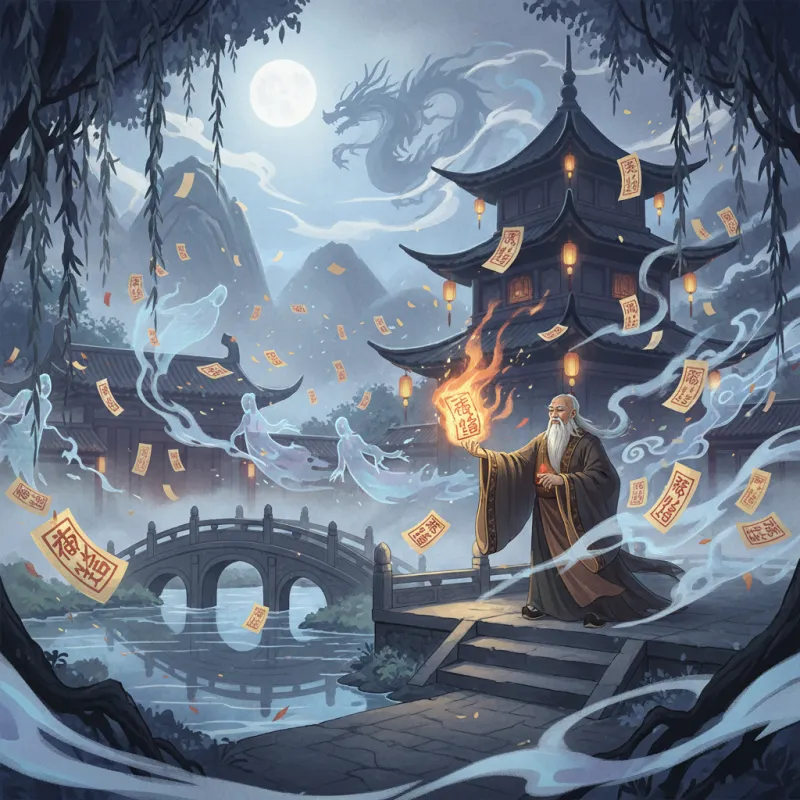
A Daoist priest once told me that writing a talisman is like programming in a language where the compiler is a god and the runtime environment is reality itself. Get one stroke wrong, reverse a single character, and you're not just debugging — you're potentially inviting the exact demon you meant to banish into your living room. No pressure.
This is the world of 符 (fú) — talismans, or what I prefer to call "paper magic" because that's essentially what it is. These aren't decorative charms or superstitious doodles. They're functional documents written in a specialized script that bridges the human and spirit worlds, and they've been the backbone of Chinese supernatural defense for over two thousand years.
The Anatomy of a Talisman
Look at a traditional talisman and your first thought might be that someone sneezed while holding a calligraphy brush. Chaotic lines intersect at odd angles. Characters appear compressed, distorted, sometimes barely recognizable. Dots and spirals seem randomly placed. The whole thing looks like abstract art designed by someone who failed penmanship.
But every element is deliberate. A talisman typically contains several layers of information: the name or seal of the deity being invoked, the specific command or request, directional markers, temporal indicators (date, time, astrological data), and what practitioners call 符膽 (fú dǎn) — the "talisman's gall" or core power character, usually hidden within the design.
The script itself is called 符文 (fú wén) or 雲篆 (yún zhuàn, "cloud seal script"), a deliberately obscured writing system that evolved from ancient seal script. It's meant to be illegible to humans and spirits alike — except for the specific deity the talisman addresses. Think of it as encryption: the message is encoded in a way that only the intended recipient can decode and execute.
The most common material is yellow paper (黃紙, huáng zhǐ), though the color varies by purpose. Yellow represents earth and the center in five-element theory, making it neutral and versatile. Red paper is used for celebrations and protection against evil. White paper, associated with death, appears in talismans for communicating with the deceased. The ink matters too: cinnabar (朱砂, zhū shā) mixed with water is traditional, valued for its bright red color and supposed spiritual potency.
The Three Powers: Heaven, Earth, and Human
Daoist theory holds that a talisman works through the alignment of 三才 (sān cái) — the Three Powers of Heaven, Earth, and Human. Heaven provides the authority (the deity's power), Earth provides the medium (the paper and ink), and Human provides the activation (the priest's cultivation and ritual).
This is why you can't just print talismans from a PDF. I've seen people try. They download images of famous talismans, print them on yellow paper, and wonder why nothing happens. A talisman without proper consecration is like a check without a signature — it has the form but lacks the authority.
The consecration process varies by sect, but generally involves several steps: purification of materials, invocation of the deity, writing the talisman while in a meditative or trance state, "dotting the eyes" (點睛, diǎn jīng) to activate it, and sealing it with the priest's personal seal or mudra. Some traditions require the priest to hold their breath while writing, or to write at specific astrologically auspicious times.
The most powerful talismans are said to be written with the priest's own blood mixed with cinnabar. This practice, called 血書符 (xiě shū fú), creates a direct energetic link between the practitioner and the talisman. It's not common — blood talismans are reserved for extreme situations, like exorcising particularly dangerous entities or protecting someone from a death curse.
Categories and Functions
Talismans are categorized by function, and the variety is staggering. The 道法會元 (Dào Fǎ Huì Yuán, "Collection of Daoist Ritual Methods"), a Song Dynasty compendium, lists hundreds of types. Here are the major categories:
Protection talismans (護身符, hù shēn fú) are the most common. These ward off evil spirits, prevent accidents, and provide general spiritual defense. You'll find them tucked into wallets, hung above doorways, or sewn into children's clothing. The 五雷符 (wǔ léi fú, "Five Thunder Talisman") is particularly famous — it invokes the power of thunder deities to obliterate demonic forces.
Healing talismans (治病符, zhì bìng fú) address specific illnesses, especially those believed to have supernatural causes. In traditional Chinese medicine, many diseases were attributed to spirit possession or imbalanced energies. A talisman might be burned and the ashes mixed with water for the patient to drink, or placed under the pillow, or worn on the body. The practice continues today, though usually alongside modern medicine rather than replacing it.
Wealth talismans (招財符, zhāo cái fú) attract prosperity and business success. These are popular with merchants and business owners, often placed in cash registers or above shop entrances. The 財神符 (cái shén fú) specifically invokes 財神 (Cái Shén), the God of Wealth.
Exorcism talismans (驅邪符, qū xié fú) are the heavy artillery of the talisman world. These don't just protect — they actively attack and banish malevolent entities. The most powerful versions can only be written by high-level priests and are used in formal exorcism rituals alongside other tools like the 桃木劍 (táo mù jiàn, peachwood sword) and 八卦鏡 (bā guà jìng, bagua mirror).
Communication talismans (傳信符, chuán xìn fú) serve as messages to deities or summons to spirits. These are burned, with the smoke carrying the message to the spiritual realm. It's the supernatural equivalent of sending an email, except the email is on fire and the recipient is a celestial bureaucrat.
The Lineage Problem
Here's something most articles about talismans won't tell you: the vast majority of talismans you see for sale are worthless. Not because the designs are wrong, but because they lack 傳承 (chuán chéng) — legitimate lineage transmission.
In Daoist practice, the ability to write effective talismans must be transmitted from master to disciple through formal initiation. This transmission includes not just the technical knowledge of how to draw the symbols, but the spiritual authority to command the deities invoked. Without this lineage connection, you're just drawing pretty pictures.
This is why Daoist priests guard their talisman knowledge carefully. The specific designs, the secret names of deities, the activation methods — these are transmitted orally and through direct demonstration, not written in books. What you find in published texts are often simplified versions or deliberately incomplete instructions.
The lineage system also serves as quality control. A priest who abuses their authority or writes talismans carelessly risks not just ineffective magic, but spiritual backlash. The deities they invoke might refuse to respond, or worse, punish the presumption. This keeps practitioners honest and maintains standards within the tradition.
Modern Adaptations and Controversies
Walk through any Chinese temple or spiritual shop today and you'll find talismans everywhere — pre-printed, mass-produced, sold in plastic sleeves like trading cards. This commercialization troubles traditionalists, who argue that authentic talismans must be hand-written by qualified priests for specific purposes and individuals.
But the practice has always adapted. During the Tang Dynasty, woodblock printing allowed for mass production of certain protective talismans. The difference was that these were still consecrated by priests, even if the physical writing was mechanized. Today's challenge is distinguishing between consecrated mass-produced talismans (which some argue can be effective if properly blessed) and pure commercial products with no spiritual content whatsoever.
The internet has complicated things further. You can now find talisman designs online, download them, and print them at home. Some websites sell "activated" talismans that have supposedly been consecrated remotely. The question of whether this works is hotly debated. Traditionalists say no, absolutely not. Pragmatists point out that if the priest performing the consecration is legitimate and the ritual is done properly, the physical distance shouldn't matter — after all, we're dealing with spiritual forces that transcend physical space.
I've also seen modern innovations: talismans designed as phone wallpapers, digital talismans sent via messaging apps, even NFT talismans. Whether these work depends entirely on your theoretical framework. If you believe a talisman's power comes from the physical materials and the priest's direct energetic input, then digital versions are nonsense. If you believe the power comes from the symbolic content and the deity's response to proper invocation, then the medium might be irrelevant.
The Skeptic's Dilemma
Does any of this actually work? That's the question everyone wants answered, and it's the wrong question.
Talismans operate within a worldview where spirits are real, deities respond to proper invocation, and the boundary between physical and spiritual is permeable. Within that framework, talismans work consistently and predictably — when created and used correctly. Outside that framework, they're paper and ink.
But here's what's interesting: the practice has survived for millennia, across dynasties, wars, modernization, and Communist suppression. It's still widely used today, not just by elderly villagers but by educated urbanites, business executives, and even some scientists. Either millions of people across thousands of years have been consistently deluded, or there's something to it that doesn't fit neatly into materialist explanations.
I've watched a Daoist priest write a talisman for a woman whose child had nightmares every night for months. The talisman was placed under the child's pillow. The nightmares stopped. Coincidence? Placebo effect? Actual spiritual intervention? The child slept peacefully — does the mechanism matter?
The anthropologist might say the talisman provided psychological comfort that reduced the child's anxiety. The neuroscientist might talk about how belief affects brain chemistry. The Daoist priest would say the talisman expelled the 邪祟 (xié suì, evil spirit) that was disturbing the child. All three explanations might be simultaneously true at different levels of analysis.
Learning the Art
If you're interested in learning to write talismans, understand that it's not a weekend workshop skill. Traditional training takes years and requires initiation into a legitimate lineage. You'll need to study classical Chinese, learn Daoist cosmology and ritual theory, memorize deity hierarchies, practice calligraphy until your hand cramps, and undergo spiritual cultivation practices to develop the necessary energetic sensitivity.
Some temples offer introductory courses for laypeople, teaching basic protective talismans. These are usually simplified versions that invoke general protective deities rather than specific high-level powers. They're the spiritual equivalent of learning to write "Hello World" in programming — functional for basic purposes, but nowhere near professional-level work.
The serious study happens through apprenticeship. You find a master willing to accept you as a disciple, and you serve them for years, learning gradually, proving your sincerity and capability. The master decides when you're ready to learn each new level of knowledge. Some techniques might not be taught until you've been studying for a decade or more.
This might seem frustratingly slow in our age of instant information, but there's wisdom in it. Writing talismans isn't just technical skill — it's spiritual responsibility. You're claiming the authority to command spirits and invoke deities. That's not something to be undertaken lightly or learned from YouTube tutorials.
The Living Tradition
What fascinates me most about talismans is that they're not museum pieces. This is living, evolving practice. New talismans are being created for contemporary problems — I've heard of talismans for computer viruses, for protection during air travel, for success in job interviews. The underlying principles remain the same, but the applications adapt.
In Taiwan, where traditional practices survived more intact than in mainland China, you can still find temples where priests write custom talismans daily. They'll ask about your specific situation, consult their texts and divination tools, and create a talisman tailored to your needs. It's personalized spiritual technology, and people line up for it.
The practice also continues in diaspora communities worldwide. Chinese temples in San Francisco, Vancouver, Singapore, and Sydney maintain talisman traditions. The knowledge travels with the practitioners, adapting to new contexts while preserving core techniques.
Whether you view talismans as superstition, as psychological tools, as cultural artifacts, or as genuine spiritual technology, they represent something profound: humanity's persistent attempt to write our will onto reality, to create tools that bridge the visible and invisible worlds. For two thousand years, people have been drawing these strange symbols on paper, burning them, wearing them, drinking them, and believing they work.
And in the quiet moments, when the talisman is placed and the ritual is complete, sometimes — just sometimes — something shifts. The nightmares stop. The illness fades. The demon departs. Call it what you will, but the paper magic endures.
Related Reading
- Zhong Kui: The Demon Queller Who Failed His Exams
- Modern Exorcism in Chinese Communities: When Ancient Rituals Meet the 21st Century
- Exorcism in Chinese Culture: How to Get Rid of Ghosts (According to Tradition)
- Ghost Press (鬼压床): The Chinese Explanation for Sleep Paralysis
- The Cowherd and the Weaver Girl: China's Greatest Love Story
- Unveiling the Mysteries of Chinese Supernatural Folklore: Ghosts, Spirits, and Afterlife Beliefs
Explore Chinese Culture
- Explore ancient mythical creatures
- Explore Daoist exorcism traditions
- Explore Chinese folk beliefs and superstitions