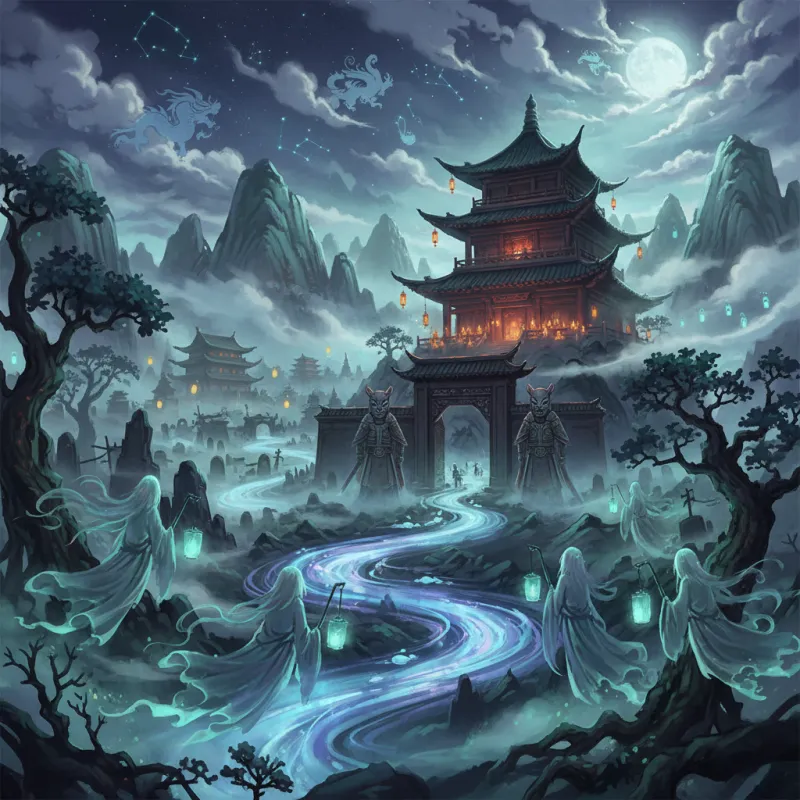
The ghost of a wronged woman stands at the crossroads at midnight, her white funeral robes billowing in windless air. She's waiting—not for revenge, though that may come—but for the proper rituals that will release her from this liminal space between worlds. This scene, repeated in countless Chinese tales across dynasties, reveals something profound: in Chinese supernatural folklore, the afterlife isn't a distant abstraction but an intricate bureaucracy where the living and dead negotiate constantly.
The Bureaucratic Underworld: Death as Administrative Process
Forget Dante's circles or the Greek Hades. The Chinese afterlife, particularly as codified during the Tang Dynasty (618-907 CE), operates like an imperial government office—complete with paperwork, judges, and appeals processes. Diyu (地狱, dìyù), often mistranslated as "hell," functions more like a processing center where souls face the Ten Courts of Hell, each presided over by a Yanluo Wang (阎罗王, Yánluó Wáng), or King of Hell.
What makes this system fascinating is its flexibility. Unlike Western concepts of eternal damnation, Chinese afterlife beliefs incorporate rehabilitation and reincarnation. The Jade Record (玉历宝钞, Yùlì Bǎochāo), a Ming Dynasty text that became wildly popular, details exactly which punishments correspond to which sins—and crucially, how long they last. Lie to your parents? Expect time on the Mountain of Knives. But eventually, you'll move through the system.
This bureaucratic model reflects Confucian values of order and hierarchy, but it also reveals something darker: the anxiety that even death won't free you from social obligations and moral accounting. The ghost stories in Pu Songling's Strange Tales from a Chinese Studio (聊斋志异, Liáozhāi Zhìyì, 1740) frequently feature spirits who return because their paperwork in the underworld got mixed up—a very human fear dressed in supernatural clothing.
Hungry Ghosts and the Economics of the Dead
The concept of egui (饿鬼, èguǐ), or hungry ghosts, represents one of the most persistent and psychologically rich elements of Chinese supernatural belief. These aren't your typical Western ghosts rattling chains—they're beings trapped in a state of perpetual craving, with needle-thin throats and bloated bellies, unable to satisfy their hunger.
The seventh lunar month, known as Ghost Month, centers around the Hungry Ghost Festival (中元节, Zhōngyuán Jié), when the gates of the underworld open and these spirits roam freely. What's remarkable is how this belief system created an entire economy: families burn joss paper (冥币, míngbì), paper houses, even paper smartphones in recent years, to ensure their ancestors have resources in the afterlife. This isn't mere superstition—it's a sophisticated system of reciprocal obligation between the living and dead.
The hungry ghost mythology also serves as social commentary. Many tales specify that these ghosts were people who died without descendants to perform rituals for them, or who were denied proper burial. In a culture that emphasized filial piety above nearly everything else, becoming a hungry ghost represented the ultimate failure of the family system. The protective rituals and talismans used during Ghost Month aren't just about fear—they're about maintaining social order across the boundary of death.
Fox Spirits and the Ambiguity of Supernatural Power
If the bureaucratic underworld represents order, fox spirits (狐狸精, húlijīng) represent chaos—or at least, ambiguity. These shape-shifting creatures, usually appearing as beautiful women, occupy a morally complex space in Chinese folklore that Western supernatural traditions rarely match.
The nine-tailed fox (九尾狐, jiǔwěihú) appears in texts as early as the Classic of Mountains and Seas (山海经, Shānhǎi Jīng, circa 4th century BCE), but her characterization shifts dramatically across dynasties. Sometimes she's a seductress who drains men's life force—the famous Daji from the Investiture of the Gods (封神演义, Fēngshén Yǎnyì) who brought down the Shang Dynasty. Other times, fox spirits are sympathetic figures seeking enlightenment, like many characters in Strange Tales who form genuine relationships with human scholars.
This ambiguity matters. Fox spirits embody anxieties about female sexuality and power, yes, but they also represent the possibility of transformation and transcendence outside official channels. Unlike the rigid hierarchy of the underworld bureaucracy, fox spirits operate in the margins, accumulating power through cultivation practices that mirror Taoist immortality techniques. They're supernatural entrepreneurs in a system dominated by inherited status.
Ancestor Worship: The Living Dead Among Us
The most fundamental aspect of Chinese supernatural belief isn't exotic at all—it's the assumption that ancestors remain active participants in family life. This isn't metaphorical. Families maintain ancestral tablets (神主牌, shénzhǔpái) in their homes, make regular offerings, and consult ancestors on major decisions through divination.
What distinguishes Chinese ancestor worship from similar practices elsewhere is its specificity and continuity. Families maintain detailed genealogies going back centuries, and the rituals aren't annual commemorations but ongoing relationships. During Qingming Festival (清明节, Qīngmíng Jié), families don't just visit graves—they sweep them, make offerings, and update the ancestors on family news. The dead are expected to stay informed.
This creates a supernatural worldview where the boundary between living and dead is permeable and constantly negotiated. Ghost stories often feature ancestors who return to warn descendants of danger or scold them for neglecting rituals. The horror in these tales isn't the ghost itself but the breakdown of proper relationships—a grandfather who must return because his grandson gambled away the family land, a mother who appears because her daughter-in-law mistreats her children.
Regional Variations: Jiangshi and Southern Ghost Traditions
While much Chinese supernatural folklore shares common elements, regional variations reveal how local conditions shape belief. The jiangshi (僵尸, jiāngshī), or hopping vampire, originates specifically from Qing Dynasty folklore in southern China and Hong Kong. These reanimated corpses, stiff from rigor mortis and hopping because their joints don't bend, reflect anxieties about bodies being transported long distances for burial—a common practice that sometimes went wrong.
The jiangshi tradition also shows how Chinese supernatural beliefs absorb and transform external influences. While often compared to Western vampires, jiangshi operate on completely different principles: they're animated by qi (气, qì) imbalance rather than blood-drinking, and they're repelled by Taoist talismans rather than crosses or garlic. The Taoist exorcism methods used against jiangshi involve restoring cosmic balance rather than destroying evil.
Southern Chinese ghost traditions also emphasize water spirits and drowned ghosts (水鬼, shuǐguǐ) who must find substitutes to take their place—a belief that reflects the region's relationship with rivers, floods, and maritime trade. These aren't universal Chinese beliefs but localized responses to specific environmental and historical conditions.
Modern Adaptations: Folklore in Contemporary Context
Chinese supernatural folklore hasn't fossilized into museum pieces—it's actively evolving. Modern Chinese horror films and novels reinterpret traditional elements for contemporary anxieties. The 2006 film "The Eye" uses the Ghost Month tradition to explore urban isolation, while novels like "Strange Tales from a Chinese Studio" get adapted into everything from video games to web series.
What's particularly interesting is how diaspora communities maintain and modify these beliefs. Chinese communities in Southeast Asia, North America, and elsewhere continue Ghost Month observances, but adapt them to local contexts—burning paper offerings in designated areas to comply with fire codes, or timing rituals around work schedules rather than lunar calendars.
The persistence of these beliefs, even among educated, cosmopolitan Chinese people who might not "believe" in literal ghosts, suggests they serve functions beyond supernatural explanation. They maintain cultural identity, provide frameworks for processing grief and obligation, and offer narrative structures for understanding misfortune and injustice. When a modern Chinese person says a place has "bad feng shui" or avoids the number four (which sounds like "death"), they're participating in a supernatural worldview that's thousands of years old—whether they frame it as superstition, tradition, or just being cautious.
The Enduring Power of the Supernatural
Chinese supernatural folklore endures because it addresses fundamental human concerns through culturally specific frameworks. The bureaucratic underworld reflects anxieties about order and justice. Hungry ghosts embody fears of being forgotten. Fox spirits represent the allure and danger of transformation. Ancestor worship maintains continuity across generations.
These aren't quaint beliefs from a pre-modern past—they're sophisticated systems for navigating uncertainty, maintaining social bonds, and finding meaning in suffering. The ghost at the crossroads is still waiting, and we're still telling her story, because the questions she represents—about obligation, justice, memory, and what we owe the dead—remain urgently relevant. Chinese supernatural folklore doesn't just reflect the past; it provides tools for understanding the present and imagining the future, one ghost story at a time.
Related Reading
- Daoist Exorcism: How Chinese Priests Fight Supernatural Evil
- How Animals Become Demons: The Yaoguai Transformation Process
- The Legend of the White Snake: A Complete Retelling
Explore Chinese Culture
- Explore ancient mythical creatures
- Explore Daoist exorcism traditions
- Explore Chinese folk beliefs and superstitions