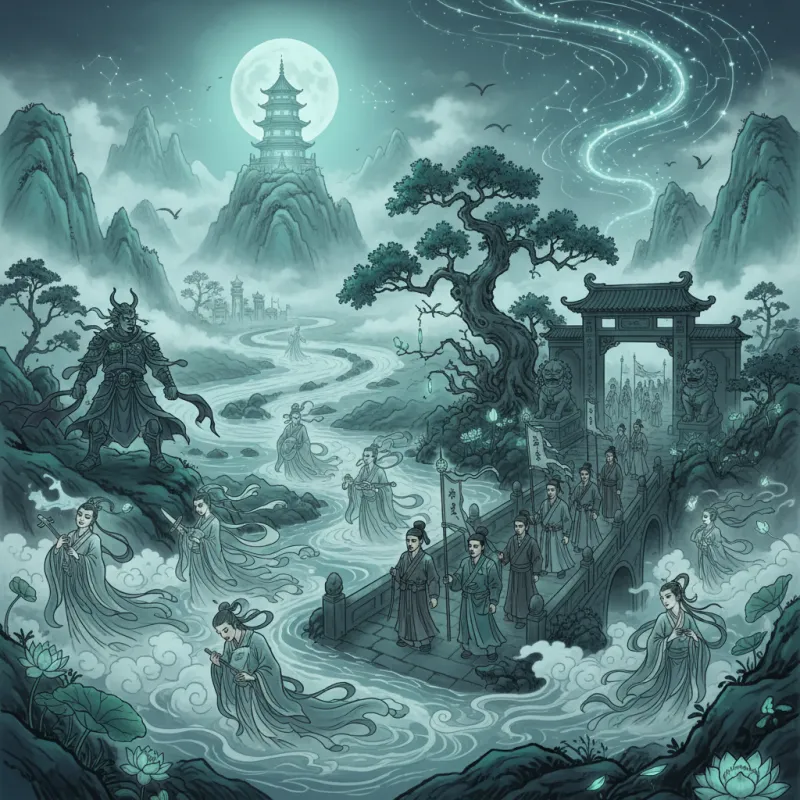
The old woman's hands trembled as she placed three sticks of incense before the ancestral tablet. "Seventh month," she whispered to her grandson. "The gates are open now." Outside, paper money spiraled into the night sky, burning offerings for the hungry dead who walked among the living. This wasn't superstition—this was survival. In Chinese supernatural tradition, the boundary between life and death has always been permeable, a thin veil that tears open completely during Ghost Month, when the deceased return to settle unfinished business with the living.
The Three Souls and Seven Spirits
Chinese afterlife beliefs operate on a radically different framework than Western concepts of a single, indivisible soul. According to Taoist and folk tradition, each person possesses three hun souls (三魂, sān hún) and seven po spirits (七魄, qī pò). The hun are ethereal, yang in nature, and ascend to heaven after death. The po are corporeal, yin-based, and remain with the body in the grave. This division explains why Chinese funerary practices are so elaborate—you're not just dealing with one entity, but ten separate spiritual components that must be properly managed.
When someone dies violently or without proper burial rites, the hun and po can become separated and confused. The hun might linger as a ghost, unable to find its way to the afterlife, while the po could reanimate the corpse as a jiangshi (僵尸, jiāngshī)—the infamous hopping vampire. This isn't Hollywood fiction; the jiangshi appears in Qing Dynasty texts as a genuine threat, a corpse driven by residual po energy, seeking to drain the life force from the living. The Taoist priest's role was to reunite these fractured spiritual components or, failing that, to bind them with yellow talismans inscribed with protective spells.
The Ten Courts of Hell
Forget Dante's nine circles—Chinese hell is a bureaucratic nightmare with ten distinct courts, each presided over by a Yama King (阎罗王, Yánluó Wáng). This system, codified during the Tang Dynasty and elaborated in texts like the "Jade Record" (玉历宝钞, Yù Lì Bǎo Chāo), treats the afterlife as an extension of imperial administration. The dead aren't simply punished; they're processed through a judicial system that would make any government clerk feel at home.
Each court specializes in specific sins. The First Court, ruled by King Qinguang, serves as intake—sorting souls and determining their ultimate destination. The Fifth Court, under King Yama himself, judges those who died unnatural deaths. The Eighth Court handles filial impiety, a crime so severe in Confucian thought that it warranted its own dedicated hell realm. Punishments are precisely calibrated to crimes: those who wasted food are forced to swallow burning coals, while corrupt officials are ground in stone mills. The specificity is striking—this isn't abstract damnation but concrete, almost legalistic retribution.
What makes this system particularly fascinating is its impermanence. Unlike Christian hell, Chinese underworld sentences have expiration dates. After serving your time—which could span multiple lifetimes—you drink Mengpo's (孟婆, Mèng Pó) amnesia soup and reincarnate, your slate wiped clean. This reflects Buddhist influence, particularly the concept of karma and cyclical rebirth, grafted onto indigenous Chinese ancestor worship. The result is a uniquely Chinese synthesis: hell as purgatory, punishment as rehabilitation, and death as bureaucratic transition rather than final judgment.
Hungry Ghosts and Restless Spirits
Not all dead reach the Ten Courts. Some become hungry ghosts (饿鬼, è guǐ), trapped in a liminal state between life and death. These aren't your garden-variety spirits—they're beings consumed by insatiable hunger, with throats as thin as needles and bellies as vast as mountains. The Buddhist "Petavatthu" describes their torment, but Chinese folk tradition makes them immediate and personal. They're your ancestors if you forget to make offerings, your neighbors if they died with grievances unresolved.
The seventh lunar month, Ghost Month (鬼月, guǐ yuè), is when these hungry ghosts are released en masse. The gates of hell swing open on the first day, and for thirty days, the living must navigate a world crowded with the dead. You don't swim during Ghost Month—water ghosts (水鬼, shuǐ guǐ) drag down the living to take their place in the cycle of reincarnation. You don't whistle at night, don't pick up money on the street, don't tap someone on the shoulder. These aren't quaint customs; they're survival protocols for a month when the supernatural becomes dangerously tangible.
The Zhongyuan Festival (中元节, Zhōngyuán Jié) on the fifteenth day marks the peak of Ghost Month. Families set out elaborate feasts for wandering spirits, burn paper houses and cars, stage operas with the front row left empty for ghostly audiences. This isn't charity—it's appeasement. Feed the hungry ghosts, and they'll leave you alone. Ignore them, and they'll make their hunger your problem. The logic is transactional, reflecting the same reciprocity that governs relationships between the living.
Fox Spirits and Shape-Shifters
Chinese supernatural folklore reserves special fascination for the huli jing (狐狸精, húli jīng)—fox spirits who can assume human form after cultivating their qi for centuries. Pu Songling's "Strange Tales from a Chinese Studio" (聊斋志异, Liáo Zhāi Zhì Yì), compiled in the 17th century, features dozens of fox spirit stories, and they're rarely simple villains. These are complex beings pursuing immortality through Taoist cultivation, sometimes helping humans, sometimes destroying them, always operating by their own inscrutable logic.
The most famous fox spirit is Daji (妲己, Dá Jǐ), who in the "Investiture of the Gods" (封神演义, Fēngshén Yǎnyì) seduces King Zhou of Shang and brings down an entire dynasty. But Pu Songling's fox spirits are different—they fall in love with scholars, bear their children, teach them poetry. They're dangerous not because they're evil but because they exist outside human moral categories. A fox spirit might save your life one day and drain your yang energy the next, not from malice but from need. They're pursuing immortality, and humans are sometimes tools, sometimes obstacles, sometimes genuine companions in that pursuit.
This ambiguity reflects Taoist influence, particularly the concept that supernatural beings aren't inherently good or evil—they're simply following their nature, cultivating their essence. The Chinese demon hierarchies include fox spirits in a complex taxonomy that defies simple moral categorization. They're not demons in the Christian sense; they're beings on their own spiritual journey, occasionally intersecting with human lives in ways both beneficial and catastrophic.
Exorcism and Spiritual Protection
When supernatural threats become too immediate, you call a Taoist priest or a Buddhist monk—specialists in managing the boundary between worlds. Their methods differ significantly. Taoist exorcists use talismans (符, fú), written spells that command spirits through the authority of celestial bureaucracy. They're essentially serving legal papers to ghosts, invoking the Jade Emperor's authority to compel obedience. Buddhist monks, by contrast, use sutras and compassion, seeking to release spirits from their suffering rather than command them.
The most powerful tool in the Taoist arsenal is the peachwood sword (桃木剑, táomù jiàn), carved from wood that naturally repels evil spirits. Combined with a bagua mirror (八卦镜, bāguà jìng) to reflect malevolent energy and glutinous rice to absorb yin essence, a skilled priest can cleanse a haunted house or bind a troublesome ghost. These aren't symbolic gestures—in the logic of Chinese supernatural folklore, they're practical technologies for manipulating spiritual energy.
The famous Maoshan sect (茅山派, Máoshān pài), founded during the Han Dynasty, specialized in ghost-catching and demon-binding. Their techniques, preserved in texts like the "Maoshan Daoist Magic" (茅山道术, Máoshān Dàoshù), treat the supernatural as a science with consistent rules and predictable outcomes. You don't pray for divine intervention; you execute the correct ritual with proper materials and precise timing. It's engineering applied to the spirit world, reflecting the same practical mindset that built the Great Wall and invented gunpowder.
Modern Persistence of Ancient Beliefs
Walk through any Chinese city during Ghost Month, and you'll see these ancient beliefs alive and adapting. Luxury paper offerings now include iPhones and sports cars, burned so ancestors can enjoy modern conveniences in the afterlife. High-rise apartments still avoid fourth floors (four sounds like death, 死, sǐ), and real estate prices reflect this supernatural economics. Young people who claim not to believe still avoid whistling at night, just in case.
The haunted locations in Chinese history remain pilgrimage sites, not just for believers but for anyone seeking connection to this deep cultural current. The Fengdu Ghost City in Chongqing, built to represent the underworld's bureaucracy, attracts millions of visitors who walk through its courts and temples, half-tourism, half-ritual. They're engaging with a worldview that predates communism, predates even imperial China—a vision of death as transformation rather than ending, of the supernatural as parallel reality rather than fantasy.
These beliefs persist because they address fundamental human anxieties about death, justice, and memory. The Ten Courts of Hell promise that evil will be punished, even if earthly justice fails. Ancestor worship ensures that death doesn't sever family bonds. Hungry ghosts remind us that neglect has consequences, that the dead still make claims on the living. In a rapidly modernizing society, these ancient frameworks provide continuity, connecting contemporary Chinese to three millennia of accumulated wisdom about navigating the boundary between worlds.
The Living Tradition
Chinese supernatural folklore isn't museum material—it's a living tradition that continues to evolve. Modern horror films like "The Eye" and "Rigor Mortis" reinterpret jiangshi and hungry ghosts for contemporary audiences, while online forums debate the proper protocols for Ghost Month in the digital age. Should you avoid posting photos at night? Can ghosts follow you through social media? These questions sound absurd until you recognize them as genuine attempts to apply ancient logic to new circumstances.
The Chinese exorcism rituals and practices have adapted too, with some Taoist priests now offering remote cleansings via video call, burning talismans and reciting spells through screens. It's easy to mock this as superstition meeting technology, but it reflects something deeper—a worldview flexible enough to incorporate change while maintaining its essential structure. The supernatural remains real, even if its manifestations shift with the times.
What makes Chinese supernatural folklore enduringly powerful is its refusal of simple answers. The dead aren't simply gone, spirits aren't simply good or evil, and death isn't simply the end. Instead, you get a complex, bureaucratic, deeply human vision of the afterlife—one where your grandmother might return as a hungry ghost if you forget her offerings, where justice delayed in life is guaranteed in death, where the boundary between worlds is always negotiable. It's a folklore that takes death seriously while refusing to let it have the final word, and that's why, three thousand years after its origins, people still burn paper money and leave the front row empty at Ghost Month operas. Just in case.
Related Reading
- Joss Paper and Spirit Money: Shopping for the Dead
- The Enigmatic Spirit-Animals of Chinese Supernatural Folklore and Afterlife Beliefs
- Nie Xiaoqian: The Ghost Romance That Conquered Cinema
Explore Chinese Culture
- Explore ancient mythical creatures
- Explore Daoist exorcism traditions
- Explore Chinese folk beliefs and superstitions