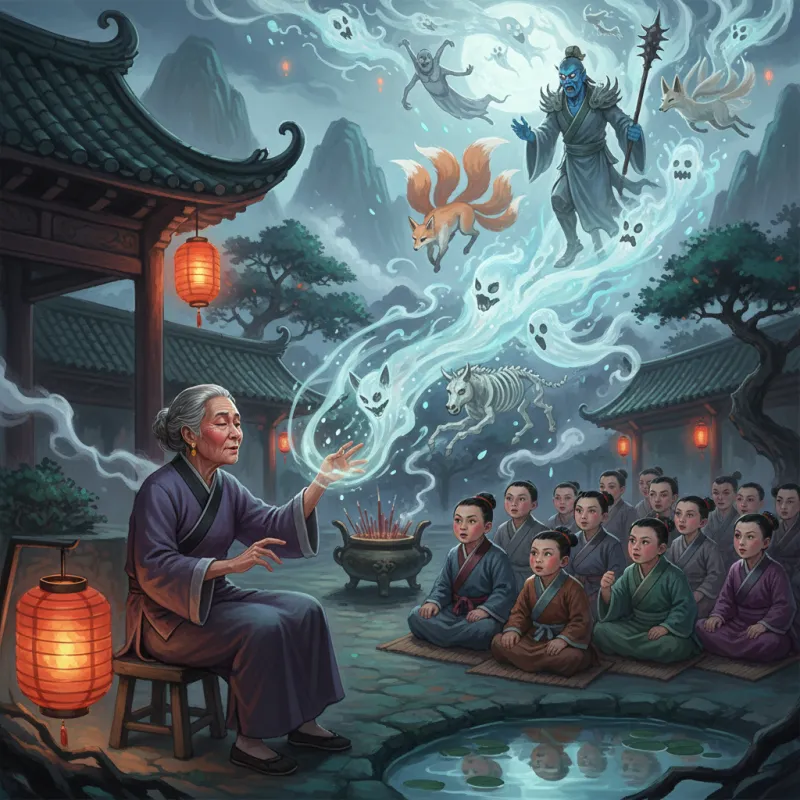
Your grandmother leans closer, her voice dropping to a whisper. "Never whistle at night," she says, eyes darting toward the darkened window. "It calls them." You're eight years old, and you don't ask who them is. You already know. Every Chinese child knows. The stories grandmothers tell aren't just entertainment—they're survival manuals for a world where the supernatural bleeds into the everyday, where a moment of carelessness can invite disaster, and where the old rules still apply even if you live in a high-rise apartment with Wi-Fi.
The Grandmother as Gatekeeper
Chinese folklore doesn't come from books. It comes from lǎolao (姥姥) and nǎinai (奶奶)—maternal and paternal grandmothers who serve as the primary transmitters of supernatural knowledge across generations. This isn't accidental. In traditional Chinese family structures, grandmothers occupied a unique position: old enough to command respect, experienced enough to have witnessed the inexplicable, and available enough (while parents worked) to spend long evenings with grandchildren when the boundary between worlds grows thin.
The grandmother's authority in folklore transmission is absolute. She doesn't cite sources or offer alternative interpretations. When she says a fox spirit can steal your soul through your shadow, that's not a metaphor—it's operational intelligence. When she warns that cutting your nails at night lets demons track you by the clippings, you don't argue. Her stories aren't presented as "once upon a time" fairy tales but as recent history: "This happened to your great-uncle's neighbor in 1987."
This oral transmission creates a folklore that's intensely local and personal. Your grandmother's stories reflect her village, her province, her specific fears and experiences. A grandmother from Fujian tells different stories than one from Heilongjiang. The supernatural threats vary by geography—water ghosts (shuǐguǐ, 水鬼) dominate in riverside communities, while mountain villages fear shānguǐ (山鬼) and wild spirits.
The Practical Supernatural
What makes grandmother stories distinct from literary folklore is their relentless practicality. These aren't abstract moral tales. They're instruction manuals with life-or-death stakes. The stories always include specific, actionable rules:
Never respond if someone calls your name three times at night. Each response weakens your sān bǎ huǒ (三把火)—the three protective flames that sit on your head and shoulders. After three responses, you're vulnerable to possession.
Don't pick up money on the street after dark. It's ghost money, left as bait. Touch it and you've accepted a contract with the dead.
If you see a funeral procession, don't count the people. You might count yourself into the procession, and then you're going where they're going.
Never stick chopsticks upright in rice. That's how you offer food to the dead. Do it carelessly and you're issuing an invitation.
These rules aren't explained—they're stated as fact. Grandmothers don't have time for the "why" when the "what" might save your life. The logic is simple: the supernatural world operates by different rules than the mundane world, and ignorance of those rules is dangerous. You don't need to understand why whistling at night attracts wandering ghosts—you just need to stop whistling.
The Cautionary Architecture
Every grandmother story follows a predictable structure: transgression, consequence, lesson. Someone breaks a rule (usually out of ignorance, greed, or disrespect), something terrible happens, and the survivors learn to follow the rules. The stories are designed to produce fear—not entertainment, but the useful kind of fear that keeps children from dangerous behavior.
A typical example: A young man stays out late gambling. Walking home after midnight, he sees a beautiful woman in white standing by the road. She asks for help finding her home. He agrees (first mistake—never help strangers after midnight). She leads him deeper into the countryside. He notices she casts no shadow (second mistake—he should have run immediately). They reach an old house. She invites him inside. He enters (third mistake—never enter a stranger's home at night). Inside, he sees a coffin. The woman climbs into it. He realizes she's a corpse, a jiāngshī (僵尸) who's been dead for decades. He runs, but she pursues him, hopping stiffly (corpses can't bend their knees). He barely escapes by reaching his doorway before dawn.
The lesson isn't subtle: Don't gamble, don't stay out late, don't talk to strangers, don't ignore warning signs, and respect the boundary between day and night. The supernatural element is just the enforcement mechanism for social rules.
Regional Variations and Local Terrors
The same basic story mutates across China's vast geography. The "woman in white by the roadside" appears everywhere, but her nature changes. In southern provinces, she's often a shuǐguǐ (水鬼)—a drowning victim who needs to drag someone else underwater to take her place in the cycle of reincarnation. In northern provinces, she might be a xuěnǚ (雪女)—a snow spirit who freezes men to death. In urban areas, she appears near construction sites, the ghost of a worker who died in an accident.
Grandmothers adapt stories to local threats. Coastal grandmothers warn about sea ghosts and drowned sailors. Mountain grandmothers describe shānmó (山魔)—mountain demons that lead travelers astray. Urban grandmothers have updated the canon: ghosts now appear in elevators (don't ride alone after midnight), in subway tunnels (don't look at the tracks too long), and in high-rise stairwells (never take the stairs past the 13th floor at night).
The adaptability is the tradition's strength. Chinese folklore isn't a fixed canon like Greek mythology. It's a living system that incorporates new fears while maintaining ancient patterns. Modern grandmothers warn about ghosts in smartphones (don't answer calls from unknown numbers at 3 AM) and spirits in online games (don't play past midnight or you might encounter a ghost player).
The Grandmother's Toolkit
Beyond stories, grandmothers transmit practical supernatural defense techniques. These aren't elaborate rituals—they're simple, everyday actions that double as spiritual protection:
Carrying glutinous rice (nuòmǐ, 糯米) in your pocket. Rice absorbs negative energy and can be thrown at pursuing spirits.
Wearing red underwear during unlucky years. Red repels evil and protects your core.
Keeping scissors under your pillow. The crossed blades form a protective symbol that cuts through supernatural threats.
Burning incense at doorways. The smoke creates a barrier that spirits can't cross.
Avoiding mirrors at night. Mirrors are portals, and at night they show what shouldn't be seen.
These techniques are presented without mysticism or ceremony. They're as practical as locking your door or looking both ways before crossing the street. Grandmothers don't frame them as "magic"—they're just what you do if you're not stupid.
The Decline and Persistence
Modern Chinese parents often dismiss grandmother stories as superstition. They roll their eyes when lǎolao warns about ghost months and unlucky numbers. They tell their children that ghosts aren't real, that it's all old-fashioned nonsense. But the children remember. Even if they don't believe, they remember.
And late at night, alone in a dark apartment, they find themselves following the rules anyway. They don't whistle. They don't stick chopsticks upright in rice. They don't pick up money on the street after dark. Because maybe grandmother was right. Maybe the old rules still apply. Maybe the supernatural world doesn't care whether you believe in it or not.
The stories persist because they're not really about ghosts. They're about respect—for elders, for tradition, for the unknown. They're about caution in a dangerous world. They're about maintaining boundaries and following rules even when you don't understand them. The supernatural element is just the delivery mechanism for deeper cultural values.
The Stories We Still Tell
Today's grandmothers are adapting again. They tell stories about ghosts in WeChat messages and spirits in online shopping apps. They warn about supernatural threats in modern contexts while maintaining the ancient patterns. The woman in white still appears by the roadside, but now she might be hitchhiking. The hungry ghost still seeks offerings, but now it might accept digital red envelopes.
The core remains unchanged: the world is more complex than it appears, the supernatural is real and dangerous, and the old rules exist for good reasons. Listen to your grandmother. She knows things you don't. She's seen things you haven't. And when she leans close and whispers a warning, you should probably listen.
Because somewhere in China right now, a grandmother is telling a story. A child is listening, eyes wide in the darkness. And the old knowledge passes from one generation to the next, ensuring that the rules are remembered, the boundaries are maintained, and the supernatural world is treated with proper respect.
Don't whistle at night. You never know who might answer.
Related Reading
- Door Gods and Protective Spirits: China's Supernatural Security System
- Exploring Chinese Supernatural Folklore: Ghosts, Spirits, and Afterlife Beliefs
- Fox Spirits: China's Most Famous Shapeshifters
- Zhong Kui: The Demon Queller Who Protects Chinese Homes
- Lady White Snake: China's Greatest Love Story
- The Enigmatic Spirit-Animals of Chinese Supernatural Folklore and Afterlife Beliefs
- Exploring Chinese Supernatural Folklore: Ghosts, Spirits, and Afterlife Beliefs
- Dream Interpretation in Chinese Culture: When the Spirit Wanders at Night
Explore Chinese Culture
- Explore ancient mythical creatures
- Explore Daoist exorcism traditions
- Explore Chinese folk beliefs and superstitions