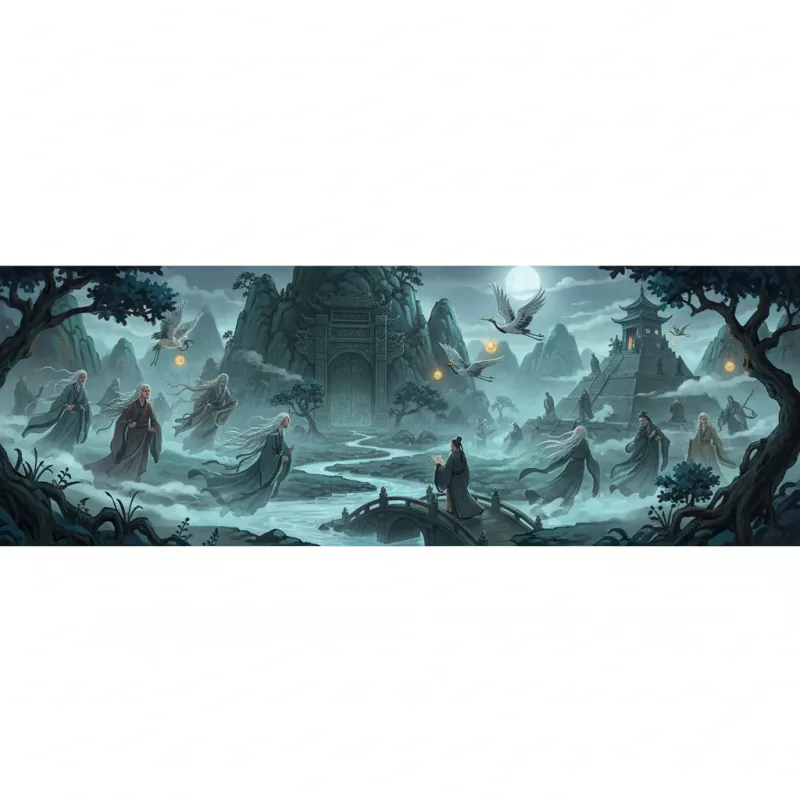
The old woman's funeral procession had barely left the village when her grandson saw her standing in the doorway of her house, wearing the same blue cotton jacket she'd been buried in. He wasn't hallucinating—half the village saw her too. This wasn't considered unusual in rural Fujian province in the 1920s. It was simply a case of 回魂 (huí hún), the "returning soul," one of dozens of supernatural phenomena that Chinese people have catalogued, categorized, and learned to navigate for millennia.
The Architecture of the Chinese Afterlife
Western pop culture loves to simplify Chinese ghost stories into creepy women with long black hair, but the actual cosmology is far more bureaucratic and fascinating. The Chinese afterlife operates like an imperial government—because that's exactly what it was modeled after. When you die, you don't just float around aimlessly. You report to 地府 (dì fǔ), the Underground Courts, where the Ten Kings of Hell review your life like celestial accountants auditing your moral balance sheet.
This system crystallized during the Tang Dynasty (618-907 CE), when Buddhist concepts of karma merged with indigenous Chinese beliefs about ancestor spirits. The result? A afterlife with eighteen levels of hell, each with specific punishments for specific sins. Liars get their tongues pulled out. Corrupt officials are ground in stone mills. It's medieval, it's visceral, and it shaped how Chinese people thought about morality for over a thousand years.
But here's what makes it distinctly Chinese: you can lawyer your way out. Burn enough paper money, hire enough monks to chant sutras, and you can literally bribe the infernal bureaucracy to reduce your sentence. The afterlife isn't about eternal damnation—it's about negotiation, family obligation, and the power of ritual to reshape reality.
Ghosts With Grievances: The 鬼 (Guǐ) Taxonomy
Not all Chinese ghosts are created equal. The word 鬼 (guǐ) covers a spectrum of entities, from harmless ancestor spirits to vengeful revenants that make Western vampires look friendly. Understanding the taxonomy matters because each type requires different handling.
厉鬼 (lì guǐ), or "fierce ghosts," are the ones you really don't want to meet. These are people who died violently, unjustly, or without proper burial rites. They're angry, they're powerful, and they won't rest until their grievances are addressed. The classic example is 窦娥 (Dòu É) from the Yuan Dynasty play "The Injustice to Dou E," whose wrongful execution caused snow to fall in summer and drought to plague the region for three years. Her story became the template for countless revenge ghost narratives in Chinese literature.
Then there are 饿鬼 (è guǐ), "hungry ghosts," beings trapped in a state of perpetual craving. They're not necessarily malevolent—just desperate. The entire Ghost Festival (中元节, Zhōng Yuán Jié) in the seventh lunar month exists to feed these wandering spirits so they don't cause trouble. I've watched families in Taiwan set out elaborate feasts on the street, complete with chopsticks and rice wine, for guests no one can see. The food disappears—or rather, its spiritual essence does—and everyone goes home satisfied that they've fulfilled their obligations to the unseen world.
The most poignant category might be 冤魂 (yuān hún), ghosts of the wronged. These spirits can't move on until justice is served, which is why Chinese ghost stories often read like supernatural detective fiction. The 16th-century collection "聊斋志异" (Liáo Zhāi Zhì Yì, "Strange Tales from a Chinese Studio") by Pu Songling is packed with these cases—ghosts who appear to scholars and officials, providing clues to solve their own murders or expose corruption.
Fox Spirits and Shape-Shifters: Beyond Human Ghosts
Chinese supernatural folklore doesn't limit itself to human spirits. 狐狸精 (hú li jīng), fox spirits, occupy a unique space in the pantheon—seductive, dangerous, but not inherently evil. These beings cultivate spiritual power over centuries, learning to take human form, usually as beautiful women. The most famous is 妲己 (Dá Jǐ), the fox spirit who possessed the concubine of the last Shang Dynasty king and helped bring down an entire dynasty through her manipulations.
But here's the nuance Western adaptations usually miss: fox spirits can also be sympathetic figures. In Pu Songling's tales, many fox spirits fall genuinely in love with human scholars, using their powers to help rather than harm. They represent the ambiguity of desire itself—alluring and potentially destructive, but also capable of transcendence. Some fox spirits even achieve immortality and become deities, like 胡三太爷 (Hú Sān Tài Yé), the Fox Immortal worshipped in northern China for bringing wealth and protection.
Other shape-shifters populate the landscape: 蛇精 (shé jīng, snake spirits), 树妖 (shù yāo, tree demons), and 石精 (shí jīng, stone spirits). The principle is consistent—anything that exists long enough can accumulate spiritual essence and gain consciousness. This animistic worldview means the supernatural isn't separate from nature; it's what nature becomes when given enough time.
Exorcism and Protection: The Daoist Arsenal
When ghosts and demons become problems, you call a 道士 (dào shì), a Daoist priest. These ritual specialists have been the supernatural pest control of China for two millennia, armed with an arsenal of techniques that blend religious authority with practical magic. The most iconic tool is the 符 (fú), a paper talisman inscribed with esoteric characters that can trap spirits, protect buildings, or even control the weather.
The classic exorcism scene involves the priest performing the 罡步 (gāng bù), the "Pace of Yu," a ritual dance that traces the pattern of the Big Dipper constellation. This isn't just theatrical—it's based on the Daoist cosmology where the priest becomes a conduit between heaven and earth, channeling celestial authority to command spirits. The priest might use a 桃木剑 (táo mù jiàn), a sword made from peach wood, which Chinese tradition holds has natural ghost-repelling properties.
But the most powerful weapon is knowledge. Daoist exorcists study texts like the "道藏" (Dào Zàng, Daoist Canon), learning the true names and hierarchies of spirits. In Chinese supernatural logic, knowing a spirit's name gives you power over it—which is why many ghosts and demons have multiple names or refuse to reveal their true identity. This concept influenced everything from Chinese demon mythology to modern horror films.
For everyday protection, ordinary people rely on simpler methods. Mirrors hung above doorways reflect evil spirits back. Glutinous rice scattered on the ground can trap ghosts (their feet stick to it—yes, really). Red paper with auspicious characters wards off malevolent forces. These practices persist today, even in modern Chinese cities, because they're woven into the cultural fabric at a level deeper than rational belief.
The Hungry Ghost Festival: When the Veil Thins
The seventh lunar month is when the gates of hell open and spirits roam freely among the living. This isn't Halloween—it's more serious, more pervasive, and lasts an entire month. The Hungry Ghost Festival (中元节, Zhōng Yuán Jié) represents Chinese supernatural belief in its most public, communal form.
During this month, you don't whistle at night (it attracts ghosts), don't swim (water ghosts will pull you under), and definitely don't pick up money on the street (it's ghost money, and taking it invites attachment). Theaters perform operas with the front row left empty for spirit guests. Families burn elaborate paper offerings—not just money, but paper houses, cars, smartphones, even paper mistresses for deceased husbands (yes, this is controversial).
The festival's origins blend Buddhist, Daoist, and folk traditions. The Buddhist story of Mulian (目连, Mù Lián) rescuing his mother from hell by making offerings to monks provided the religious framework. Daoist cosmology contributed the bureaucratic structure of the underworld. Folk practice added the local customs, the specific taboos, the neighborhood rituals that vary from region to region.
What strikes me most about the Ghost Festival is its underlying compassion. Yes, there's fear of malevolent spirits, but there's also recognition that the dead need care, that hungry ghosts are suffering beings deserving of mercy. The festival isn't about banishing the supernatural—it's about maintaining proper relationships with it, feeding the hungry, comforting the lost, and ensuring that the boundary between life and death remains permeable but manageable.
Modern Hauntings: Supernatural Folklore Today
Chinese supernatural beliefs didn't disappear with modernization—they adapted. In contemporary Taiwan, Hong Kong, and Singapore, you'll find Daoist priests performing smartphone-recorded exorcisms. Ghost stories circulate on social media. Real estate prices drop for apartments where someone died, because 凶宅 (xiōng zhái, "inauspicious houses") are still considered genuinely dangerous, not just superstitious nonsense.
The film industry has kept these traditions alive and evolving. Movies like "A Chinese Ghost Story" (1987) introduced fox spirits and Daoist swordsmen to new generations. "The Eye" (2002) explored the consequences of seeing ghosts after a cornea transplant. These aren't just entertainment—they're modern retellings of ancient anxieties about the boundary between seen and unseen worlds.
Even in mainland China, where official atheism once suppressed supernatural beliefs, there's been a resurgence. Temples are crowded again. Young people consult fortune tellers. The supernatural has proven more resilient than ideology because it addresses fundamental human concerns about death, justice, and the persistence of consciousness beyond the body.
The enduring power of Chinese supernatural folklore lies in its practicality. These aren't abstract theological concepts—they're operating instructions for navigating a world where the dead remain active participants in the lives of the living. Whether you believe in ghosts or not, understanding this system reveals how Chinese culture has grappled with mortality, morality, and the terrifying possibility that death isn't an ending but a transformation into something else entirely.
For more on specific supernatural entities, explore Chinese demon mythology or delve into ghost stories from ancient China. The rabbit hole goes deep, and the spirits are waiting.
Related Reading
- Zhong Kui: The Demon Queller Who Failed His Exams
- Joss Paper: Burning Money for the Dead
- Exploring the Multifaceted World of Chinese Supernatural Folklore and Afterlife Beliefs
Explore Chinese Culture
- Explore ancient mythical creatures
- Explore Daoist exorcism traditions
- Explore Chinese folk beliefs and superstitions