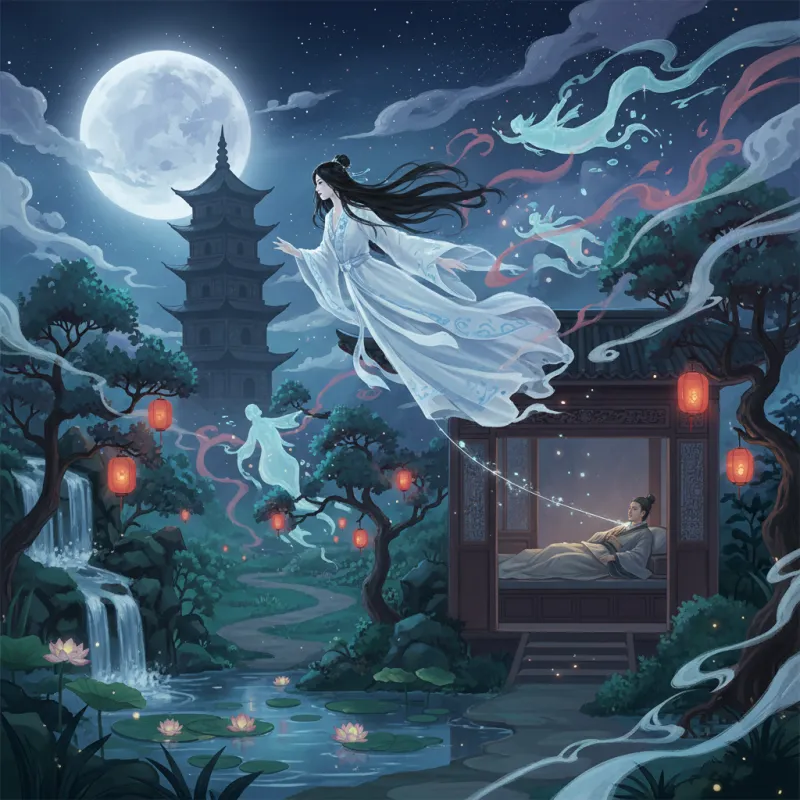
Your grandmother appears at the foot of your bed, her face pale as moonlight, wearing the burial clothes you last saw her in three years ago. She doesn't speak, but her eyes follow you with an urgency that makes your chest tight. You wake gasping, and the first thing you do isn't analyze your feelings — it's check the calendar. Because in Chinese tradition, this wasn't a dream. It was a visit. And she came to tell you something.
The Chinese approach to dreams operates on a premise that would make Freud roll over in his grave: your consciousness doesn't stay put when you sleep. While Western psychology spent the 20th century mapping the unconscious mind, Chinese folk belief has spent millennia tracking where the soul goes at night — and what it encounters when it leaves.
When the Hun Wanders: The Three Souls Theory
Chinese metaphysics doesn't give you one soul. It gives you three hun (魂, hún) and seven po (魄, pò), and they don't all stay home when you're sleeping. The hun are your ethereal souls, your consciousness and spirit. The po are your corporeal souls, tied to your physical body and base instincts. During sleep, particularly deep sleep, the hun can slip loose and wander.
This isn't poetic metaphor. In traditional Chinese medicine and Daoist practice, this is physiology. The hun travels through what's called the "dream realm" (夢境, mèngjìng), a liminal space where the living and dead, the human and supernatural, can actually meet. When you dream of your deceased grandmother, you're not processing grief — your hun has genuinely encountered her spirit. When you dream of a place you've never been, your hun may have actually traveled there.
The implications are profound. If dreams are real experiences rather than mental projections, then dream interpretation isn't psychology. It's intelligence gathering. You're not analyzing symbols; you're debriefing from a reconnaissance mission your soul conducted while your body slept.
The Zhou Dynasty Dream Bureau: When Dream Reading Was State Policy
The Chinese took dream interpretation so seriously that they bureaucratized it. The Zhou Dynasty (1046-256 BCE) maintained an official position called the zhanmeng (占夢, zhànmèng) — literally "dream diviner" — whose job was to interpret the emperor's dreams and advise on state policy accordingly. This wasn't some minor court position. The Rites of Zhou (周禮, Zhōulǐ) records that the dream interpretation office employed six officials and was considered essential to governance.
Think about that. While the emperor had advisors for military strategy, agriculture, and diplomacy, he also had a dedicated team whose sole job was to decode what his hun encountered during the night. If the emperor dreamed of a white tiger, the dream bureau would consult their texts and determine whether this portended military victory or warned of rebellion. State decisions — actual policy that affected millions — hinged on these interpretations.
The most famous dream interpretation manual from this period, the Duke of Zhou's Dream Dictionary (周公解夢, Zhōugōng Jiěmèng), is still in print today. You can buy it at any Chinese bookstore. It's been continuously used for over 2,000 years, which makes it possibly the longest-running reference book in human history. The duke himself — a historical figure from the 11th century BCE — became so associated with dreams that "meeting the Duke of Zhou" (見周公, jiàn Zhōugōng) became a euphemism for sleeping.
The Taxonomy of Supernatural Dreams
Not all dreams are created equal in Chinese tradition. The Huangdi Neijing (黃帝內經, Huángdì Nèijīng), the foundational text of Chinese medicine written around 300 BCE, categorizes dreams into several types based on their origin and significance.
Ordinary dreams (常夢, chángmèng) are just mental noise — your po souls processing the day's events, your body's organs communicating their state. If you dream about eating because you went to bed hungry, that's a common dream. No mystical significance, no message from beyond.
But then there are the spirit dreams (神夢, shénmèng). These occur when your hun encounters actual entities — ghosts, gods, demons, or other wandering souls. The distinguishing feature is clarity. Spirit dreams have a vividness, a coherence, a sense of reality that ordinary dreams lack. You remember them in detail. They feel different. Because they are different.
Prophetic dreams (預夢, yùmèng) show future events. These are considered messages from heaven or from ancestors who exist outside linear time and can see what's coming. The key is specificity. Vague anxiety about something bad happening isn't prophetic. Dreaming of your uncle's house flooding, then having it flood three days later — that's prophetic.
Warning dreams (警夢, jǐngmèng) are a subset of prophetic dreams, sent specifically to alert you to danger. If you dream of a black dog blocking your path, traditional interpretation says don't travel that day. Something is trying to stop you from walking into disaster. The supernatural guardians of Chinese folklore often communicate through warning dreams.
The Dead Don't Need Phones: Ancestor Dreams
When Chinese people dream of deceased relatives, the default assumption is contact, not symbolism. Your dead grandmother appearing in a dream isn't your psyche working through unresolved feelings. It's your grandmother, checking in. And the details matter enormously.
Did she look healthy or ill? Happy or distressed? What was she wearing? What did she say, if anything? These aren't questions for psychological analysis — they're diagnostic criteria for determining what the ancestor needs.
If a deceased relative appears looking thin, cold, or unhappy, the traditional interpretation is that they're suffering in the afterlife and need help. The living family should burn more spirit money, offer food at the grave, or commission Buddhist or Daoist rituals to ease their condition. If they appear healthy and content, they're doing well and perhaps just visiting to maintain the connection.
If they give you specific instructions — "dig under the old plum tree" or "don't let your brother sign that contract" — you're expected to follow them. There are countless folk stories of people who ignored dream warnings from ancestors and suffered for it, or who followed dream instructions and found hidden valuables or avoided disasters.
This isn't superstition to be dismissed. It's a coherent system based on the premise that death doesn't sever relationships, it just changes the communication method. The dead can't call you on the phone, but they can visit your hun while it wanders at night. Ghost encounters in Chinese tradition often begin with dreams that escalate to waking manifestations when the message isn't received.
The Dream Invasion: When Unwanted Spirits Enter
Not all spirit dreams are welcome visits from benevolent ancestors. Chinese folklore is full of accounts of malevolent entities that invade dreams — fox spirits seducing men in their sleep, hungry ghosts seeking help or revenge, demons testing the spiritually weak.
The nightmare (夢魘, mèngyǎn) in Chinese tradition isn't just a bad dream. The character 魘 specifically refers to being oppressed or suffocated by a spirit. Sleep paralysis — that terrifying state where you're conscious but can't move, often accompanied by a sense of presence or pressure on your chest — is interpreted as a ghost or demon sitting on you, pinning your po souls to your body while your hun is trapped and helpless.
Protection against dream invasion is serious business. People hang mirrors above their beds to reflect hostile spirits away. They place scissors under pillows to "cut" the connection with malevolent entities. They recite protective mantras before sleep. Buddhist and Daoist practitioners develop techniques to remain conscious and powerful even while dreaming, turning the dream realm into a battlefield where they can confront and banquish hostile forces.
The Strange Tales from a Chinese Studio (聊齋誌異, Liáozhāi Zhìyì) by Pu Songling contains dozens of stories about dream encounters with supernatural beings. In "The Painted Skin," a demon disguises itself as a beautiful woman and nearly destroys a man through repeated dream seductions. In "Nie Xiaoqian," a ghost girl is forced by a demon to seduce men in their dreams and lead them to their deaths. These aren't metaphors for temptation or psychological weakness — they're accounts of actual supernatural predation that happens in the dream realm.
Decoding the Symbolic Language: What Dreams Mean
Despite the emphasis on literal spirit contact, Chinese dream interpretation also includes extensive symbolic systems. The Duke of Zhou's Dream Dictionary contains thousands of entries correlating dream images with specific predictions.
Dreaming of teeth falling out means a relative will die — the teeth represent family members, and their loss represents death. Dreaming of snakes can mean either hidden enemies or upcoming wealth, depending on the snake's color and behavior. Dreaming of water is generally auspicious if it's clear and flowing, inauspicious if it's muddy or stagnant. Dreaming of fire can mean passion, anger, or purification depending on context.
But here's what's different from Western dream symbolism: these aren't Jungian archetypes or Freudian substitutions. They're more like a codebook, a systematic correspondence between dream images and real-world events that has been empirically observed and recorded over millennia. The logic is correlative rather than causal — certain dream images consistently precede certain events, so the appearance of the image allows prediction of the event.
Some correlations seem arbitrary to Western minds. Why should dreaming of losing teeth predict a relative's death? But in the Chinese system, both teeth and family members are part of your fundamental structure — losing either represents a breakdown of your foundational support. The connection is based on analogical thinking, the same logic that underlies Chinese medicine and feng shui.
The Modern Persistence: Why Chinese People Still Consult Dream Books
Walk into any Chinese bookstore today and you'll find multiple editions of dream interpretation guides. Download any Chinese app store and you'll find dream dictionary apps with millions of users. This isn't quaint cultural preservation — it's active practice.
My own Chinese friends, educated professionals with graduate degrees, will casually mention consulting a dream book after a particularly vivid dream. They don't necessarily believe every interpretation literally, but they don't dismiss it either. There's a pragmatic attitude: if the dream feels significant, why not check what the traditional interpretation says? What's the harm in being cautious if the dream warns of danger?
This persistence suggests something deeper than superstition. The Chinese dream interpretation tradition addresses something that Western psychology often overlooks: the human need to find meaning in the strange experiences of sleep. When you have a dream that feels important, that carries emotional weight, that seems to be telling you something — the Western response of "it's just your unconscious processing information" can feel inadequate.
The Chinese system offers something more satisfying: your dream means something specific. It came from somewhere. It's trying to tell you something. And here's a 2,000-year-old book that can help you figure out what.
Whether you believe your hun actually wanders at night or not, there's something compelling about a tradition that takes dreams seriously as experiences rather than dismissing them as mental static. In a culture that maintained an official dream interpretation bureau for centuries, that produced systematic dream dictionaries still in use today, that treats dreams of the dead as actual contact rather than wishful thinking — dreams matter. They're not just interesting. They're intelligence. And ignoring them might mean missing a warning, a message, or a visit from someone who went to considerable trouble to reach you while you slept.
Related Reading
- Ghost Press (鬼压床): The Chinese Explanation for Sleep Paralysis
- Chinese Dream Interpretation: What Your Dreams Mean in Traditional Culture
- Dream Spirits and Sleep Demons: The Supernatural World of Chinese Dreams
- Soul Travel in Chinese Belief: When Your Spirit Leaves Your Body During Sleep
- Campus Ghost Stories in China: The Haunted Dormitories and Cursed Libraries
- Pu Songling: The Failed Scholar Who Wrote China's Greatest Ghost Stories
- The Drowning Ghost (水鬼): China's Most Feared Water Spirit
Explore Chinese Culture
- Explore ancient mythical creatures
- Explore Daoist exorcism traditions
- Explore Chinese folk beliefs and superstitions