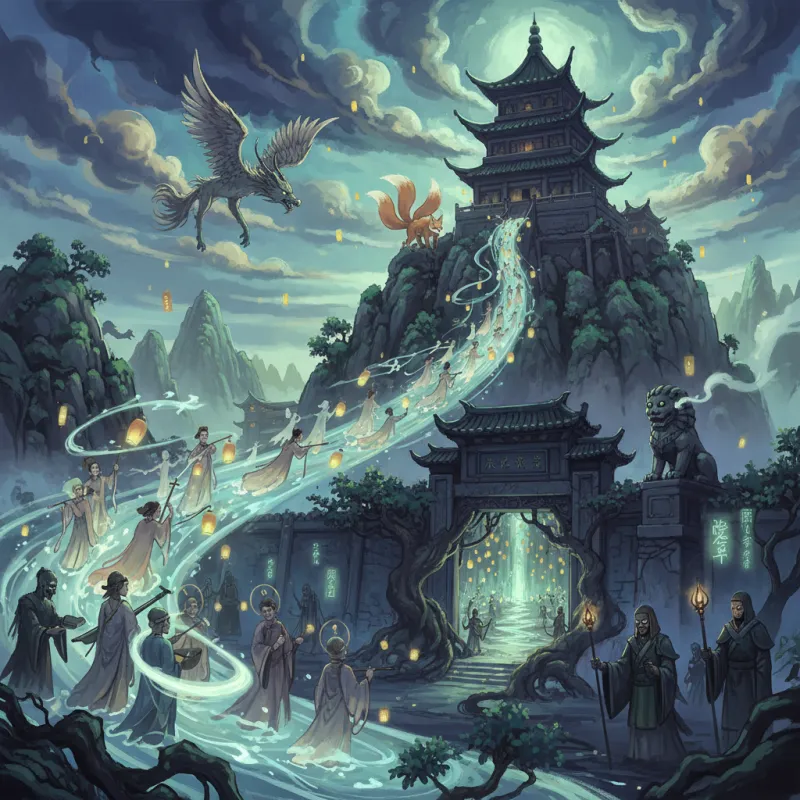
The paper money crackles and curls into ash, smoke carrying prayers to ancestors who've been dead for centuries. On street corners across China, families burn elaborate paper mansions, luxury cars, and even smartphones—currency for the afterlife economy. This isn't quaint tradition or tourist spectacle. It's the living edge of a supernatural belief system so intricate, so deeply embedded in daily life, that it makes Western ghost stories look like children's bedtime tales.
The Underworld Bureaucracy: Death as Administrative Nightmare
Forget Dante's circles or Christian judgment day. The Chinese afterlife operates like an imperial government office—complete with paperwork, bribes, and bureaucratic delays. When you die, you don't face a single god. You navigate Diyu (地狱, dìyù), a sprawling underworld with ten courts, each presided over by a Yanluo Wang (阎罗王, Yánluó Wáng)—a judge-king who reviews your life's deeds with the thoroughness of a tax auditor.
The Tang Dynasty text "Journey to the West" depicts this bureaucracy in darkly comic detail, but the concept predates it by centuries. During the Han Dynasty (206 BCE - 220 CE), tomb inscriptions already referenced the "Earth Prison" where souls faced judgment. What makes this system fascinating is its flexibility—wealthy families could literally buy their deceased relatives better treatment through offerings and rituals. The logic was simple: if earthly officials accepted bribes, why wouldn't celestial ones?
This transactional relationship with death explains why Ghost Month traditions involve such elaborate material offerings. You're not just honoring ancestors; you're funding their afterlife lifestyle and, crucially, preventing them from returning as hungry ghosts to haunt the living.
Gui and Shen: The Taxonomy of Chinese Spirits
Chinese supernatural folklore doesn't lump all spirits into one category. The distinction between gui (鬼, guǐ) and shen (神, shén) is fundamental—and it's not simply "evil" versus "good." Gui are spirits of the dead, particularly those who died violently, prematurely, or without proper burial rites. They're trapped between worlds, often resentful, always dangerous. Shen, meanwhile, are deified spirits—ancestors who've been elevated through worship, or natural forces that have gained consciousness.
But here's where it gets interesting: a gui can become a shen through sustained worship. The boundary is permeable. Guan Yu, the red-faced warrior god worshipped in temples across Asia, was a historical general who died in 220 CE. Through centuries of veneration, he transformed from ghost to god, now protecting everyone from police officers to triad members.
The 18th-century collection "Strange Tales from a Chinese Studio" (聊斋志异, Liáozhāi Zhìyì) by Pu Songling catalogs hundreds of these spirit encounters with the precision of a field biologist. Female ghosts seduce scholars. Fox spirits take human form. Wronged women return as vengeful specters. These aren't morality tales—they're case studies in supernatural taxonomy, showing how spirits operate according to specific rules and motivations.
The Three Souls and Seven Spirits: What Actually Dies?
Western philosophy debates whether humans have souls. Chinese tradition asks: which of your ten souls are we talking about? According to Daoist cosmology, each person possesses three hun (魂, hún) and seven po (魄, pò). The hun are ethereal, yang souls that ascend after death. The po are corporeal, yin souls that remain with the body and eventually dissolve into the earth.
This multiplicity explains why Chinese funeral rites are so complex. You're not just disposing of a body—you're managing a spiritual disassembly process. The hun need guidance to reach the afterlife (hence the elaborate funeral processions and paper offerings). The po need to be kept content in the grave (hence the tomb goods and regular visits). If either process fails, you get gui.
The Song Dynasty philosopher Zhu Xi (1130-1200) tried to rationalize these beliefs through Neo-Confucian metaphysics, arguing that hun and po were simply qi (气, qì)—vital energy—in different states. But folk practice ignored his intellectualizing. People knew from experience: neglect the dead, and they'll make their displeasure known through illness, bad luck, or direct haunting.
Festivals as Supernatural Maintenance
Chinese festivals aren't celebrations—they're supernatural maintenance schedules. Qingming (清明, Qīngmíng), the tomb-sweeping festival, isn't about nostalgia. It's preventive care for ancestral relationships. You clean the graves, make offerings, and essentially renew the contract between living and dead. Skip it, and you're inviting trouble.
The Zhongyuan Festival (中元节, Zhōngyuán Jié), better known as Ghost Month, takes this further. For the entire seventh lunar month, the gates of the underworld open, releasing spirits to wander the mortal realm. It's not a horror movie premise—it's an annual reality that shapes behavior. People avoid swimming (water ghosts drag down the living), postpone weddings (inauspicious), and leave the front row of seats empty at outdoor performances (reserved for ghost audiences).
What strikes me about these practices is their pragmatism. There's no hand-wringing about whether ghosts "really" exist. The attitude is: they probably do, the consequences of ignoring them are severe, and the rituals aren't that burdensome. It's risk management, not faith.
Exorcism and Spirit Negotiation: The Daoist Toolkit
When prevention fails and spirits cause problems, you call a Daoist priest—the original ghostbusters. But Chinese exorcism isn't the dramatic, confrontational affair depicted in Western media. It's more like supernatural diplomacy, with the priest acting as mediator between human and spirit realms.
The tools are specific: peachwood swords (桃木剑, táomù jiàn) to cut through spiritual barriers, yellow talismans (符, fú) inscribed with commands in celestial script, and glutinous rice to purify spaces. The 1985 film "Mr. Vampire" popularized these elements, but they're drawn from genuine Daoist practice dating back to the Tang Dynasty.
What's often misunderstood is that exorcism isn't always about banishment. Sometimes it's about negotiation—finding out what the spirit wants and facilitating resolution. A gui haunting a house might simply want proper burial rites performed. A fox spirit causing mischief might need acknowledgment and respect. The priest's job is diagnosis and treatment, not spiritual warfare.
The Ming Dynasty "Investiture of the Gods" (封神演义, Fēngshén Yǎnyì) depicts these techniques in mythologized form, but practicing Daoists today still use variations of the same methods. The continuity is remarkable—a 21st-century exorcism in Taiwan might employ rituals codified 1,500 years ago.
Modern Hauntings: Folklore in Contemporary China
You might think modernization would erode these beliefs. Instead, they've adapted. Urban legends about haunted apartment buildings follow the same logic as ancient ghost stories—spirits of those who died badly (suicide, murder, accident) linger at the death site. Real estate prices in Hong Kong and Taiwan drop measurably for units where deaths occurred. That's not superstition; it's market economics responding to supernatural concerns.
The internet has become a new medium for ghost stories, but the underlying patterns remain consistent. The "elevator game" urban legend that spread through Chinese social media in the 2010s—a ritual to access another dimension—is structurally identical to spirit-summoning rites from the Qing Dynasty. The technology changes; the supernatural logic doesn't.
What fascinates me is how these beliefs coexist with scientific education and technological advancement. Chinese engineers and doctors who'd laugh at Western astrology will still consult feng shui masters before buying property or avoid the number four (死, sǐ, sounds like "death"). It's not cognitive dissonance—it's cultural pragmatism. Why take chances with forces that might exist?
The Living and the Dead: An Ongoing Relationship
Chinese supernatural folklore isn't about the past—it's about maintaining relationships across the boundary of death. Ancestors aren't gone; they're relocated. Ghosts aren't metaphors; they're entities with agency and needs. The afterlife isn't a distant heaven; it's a parallel bureaucracy that intersects with daily life.
This worldview produces a culture where death is omnipresent but not morbid, where spirits are dangerous but manageable, where the supernatural is woven into the mundane. When you understand that burning paper money isn't symbolic but transactional, that festival offerings aren't nostalgic but necessary, that ghost stories aren't entertainment but case studies—you begin to grasp how differently Chinese culture conceptualizes the boundary between life and death.
The mystique isn't in exotic rituals or ancient texts. It's in the lived reality of a civilization that never stopped believing the dead are watching, judging, and occasionally interfering. And honestly? Given how seriously they take ancestral obligations, maybe they're onto something. After all, if you knew your descendants would be burning paper iPhones for you in the afterlife, wouldn't you want them to get the latest model?
Related Reading
- Soul Travel in Chinese Belief: When Your Spirit Leaves Your Body During Sleep
- Haunted Temples: Where Gods and Ghosts Coexist
- Zhong Kui: The Demon Queller Who Protects Chinese Homes
Explore Chinese Culture
- Explore ancient mythical creatures
- Explore Daoist exorcism traditions
- Explore Chinese folk beliefs and superstitions