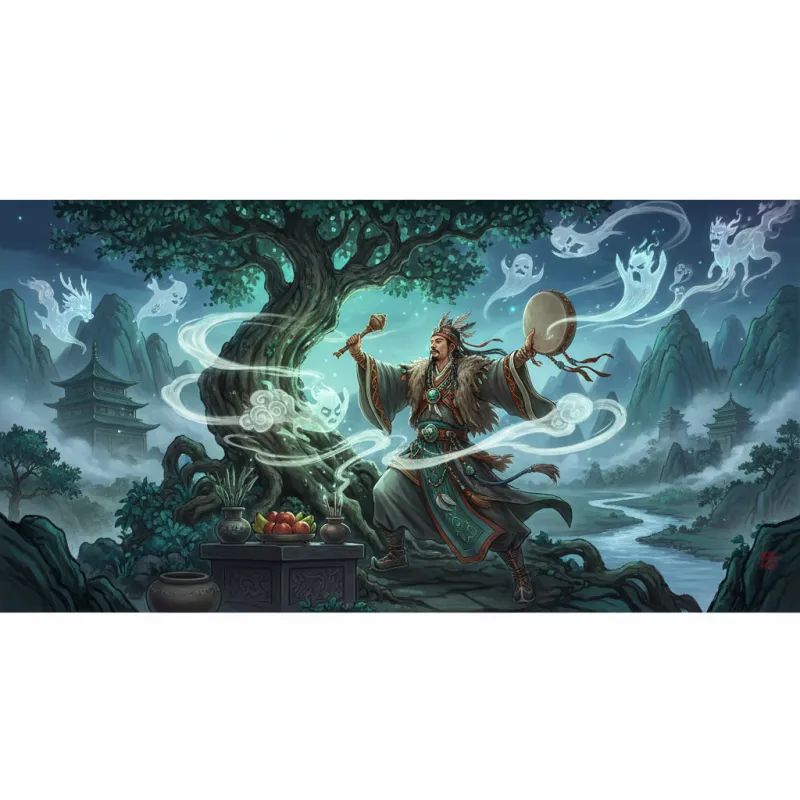
The oracle bone cracked under the heated bronze rod, and the wu leaned close to read the pattern. It was 1200 BCE, and this shaman — neither quite priest nor quite sorcerer — was about to tell the Shang king whether his ancestor spirits approved of the upcoming military campaign. The character used to write this person's title, 巫 (wū), shows a human figure with arms stretched between heaven and earth. That's not poetic metaphor. That's job description.
Before there were Daoist priests with their elaborate rituals, before Buddhist monks arrived from India, before Confucian scholars tried to rationalize everything into moral philosophy, there were the wu. They were China's original spirit workers, and their fingerprints are all over Chinese religion even today — you just have to know where to look.
The Wu in Ancient China
The archaeological evidence is unambiguous. Oracle bones from the Shang dynasty (商朝, Shāng cháo, c. 1600-1046 BCE) are covered with references to wu performing divination, exorcism, rainmaking, and spirit communication. These weren't village healers working on the margins of society. The wu were central to state power. Kings consulted them before battles. Nobles employed them to communicate with deceased ancestors. The royal court maintained entire departments of wu specialists.
The Shuowen Jiezi (說文解字), the Han dynasty dictionary compiled around 100 CE, defines wu as "those who serve the spirits and can cause them to descend through dance." That last part is crucial. The wu didn't just pray or make offerings — they entered ecstatic trance states, often through rhythmic dancing, drumming, and sometimes intoxication. In trance, their consciousness would leave their body, allowing spirits to possess them and speak through them.
The Guoyu (國語, "Discourses of the States") preserves a fascinating account from the Zhou dynasty describing how wu would "ascend and descend" between the human and spirit worlds. They were psychopomps, spirit mediums, and cosmic intermediaries all rolled into one. The text distinguishes between male wu (覡, xí) and female wu (巫, wū) — though in practice, the term wu came to cover both.
What the Wu Actually Did
Let's be specific about their functions, because "shaman" is too vague and too loaded with Siberian and Native American associations that don't quite fit.
Spirit possession and mediumship: The wu would enter trance and allow spirits — ancestors, nature deities, or other entities — to possess their bodies and speak through them. This is the core shamanic technique, and it's still practiced by spirit mediums across Chinese communities today. The continuity is remarkable.
Healing and exorcism: When someone fell ill, the wu would diagnose whether the cause was spirit intrusion, soul loss, or ancestral displeasure. They'd perform rituals to expel malevolent entities or retrieve lost soul fragments. The techniques described in texts like the Shanhaijing (山海經, "Classic of Mountains and Seas") involve everything from herbal medicine to dramatic performances designed to frighten away demons.
Divination: The wu read oracle bones, interpreted dreams, and used various techniques to discern the will of spirits and predict future events. This wasn't fortune-telling for entertainment — it was strategic intelligence gathering for matters of state and family.
Rainmaking and weather control: Multiple Zhou dynasty texts describe wu performing rain dances during droughts. The Liji (禮記, "Book of Rites") mentions exposing wu to the sun during droughts — a practice that sounds cruel until you understand it as sympathetic magic, the wu's suffering meant to move heaven to send relief.
Mediation with the dead: The wu maintained the crucial relationship between the living and the dead. They conveyed messages, negotiated with angry ghosts, and ensured that ancestor spirits received proper offerings. This function never disappeared — it just got absorbed into other religious roles.
The Confucian Suppression
Here's where it gets political. As Confucianism rose to dominance during the Han dynasty (漢朝, Hàn cháo, 206 BCE - 220 CE), the wu faced systematic marginalization. Confucian scholars were deeply uncomfortable with ecstatic trance, spirit possession, and the wu's claims to direct access to the supernatural. The Confucian worldview emphasized rationality, hierarchy, and proper ritual form. Shamanic ecstasy was too wild, too unpredictable, too threatening to social order.
The Lunyu (論語, "Analects") records Confucius himself saying, "Respect ghosts and spirits, but keep them at a distance." That's not atheism — it's a deliberate policy of creating bureaucratic distance between humans and the spirit world. Instead of shamans who could be possessed by any spirit, Confucianism promoted ritualists who performed standardized ceremonies at prescribed times. Control over chaos.
By the Han dynasty, official histories were describing wu with barely concealed contempt. The Hanshu (漢書, "Book of Han") portrays them as superstitious frauds preying on the ignorant. Male wu (xí) largely disappeared from the historical record, while female wu were increasingly associated with witchcraft and sexual impropriety. The word wugu (巫蠱, "shamanic poison") came to mean a specific type of black magic involving cursing through spirit manipulation.
But here's the thing: suppression isn't elimination. The wu didn't disappear. They went underground, merged with other traditions, and adapted.
The Wu's Descendants
Walk into a Daoist temple today and watch the priests perform a ritual. Notice the rhythmic movements, the mudras, the invocation of spirits, the claims to channel divine power. That's wu technique dressed in Daoist robes. Early Daoism absorbed enormous amounts of shamanic practice. The Zhuangzi (莊子) describes Daoist adepts achieving trance states and spirit journeys that sound remarkably like shamanic techniques. The fangshi (方士, "masters of methods") who practiced esoteric arts during the Han dynasty were essentially wu operating under a new name.
In southern China and among ethnic minorities, the wu tradition survived more openly. The Miao, Yao, and other groups maintained shamanic practices that the Han majority had officially abandoned. The dongji (童乩, tóngjī) or spirit mediums of Fujian and Taiwan are direct descendants of the ancient wu, still entering trance and allowing gods to possess them during temple festivals.
Even in mainstream Chinese religion, the wu's influence persists. The practice of asking ancestors for guidance, the belief that spirits can possess the living, the use of mediums to communicate with the dead — these are all shamanic concepts that survived Confucian disapproval because they met real psychological and social needs.
The Wu in Chinese Horror
Chinese ghost stories and supernatural fiction are saturated with shamanic themes, even when they don't explicitly mention wu. The idea that spirits can possess the living, that souls can leave bodies and wander, that certain people have the ability to see and communicate with the dead — these are all shamanic concepts.
Strange Tales from a Chinese Studio (聊齋誌異, Liáozhāi Zhìyì) by Pu Songling features numerous stories involving spirit mediums, exorcists, and people with shamanic abilities. The scholar who can see ghosts, the Daoist who expels demons, the woman possessed by a fox spirit — these are variations on shamanic themes. Pu Songling was writing in the Qing dynasty, but he was drawing on a tradition thousands of years old.
The horror comes from the same place that made Confucians uncomfortable: the permeability of boundaries. If spirits can possess bodies, if the dead can return, if consciousness can leave the flesh and wander in spirit realms, then the neat categories that make us feel safe — living/dead, human/spirit, self/other — become dangerously unstable. That's terrifying. It's also the foundation of Chinese supernatural belief.
Why the Wu Matter Now
You might think ancient shamans are just historical curiosities, but understanding the wu is essential for understanding Chinese religion and culture. The shamanic worldview — that spirits are real, that they interact with humans, that certain people can mediate between worlds — never went away. It just got repackaged.
When you see a spirit medium in Singapore channeling a deity during a festival, that's wu practice. When someone consults a Daoist priest about a haunting, that's wu practice with Daoist branding. When families make offerings to ancestors and expect them to provide protection and guidance, that's shamanic reciprocity.
The wu were suppressed but never eliminated because they addressed something fundamental: the human need to maintain relationships with the dead, to make sense of suffering and misfortune, to feel that there's someone who can negotiate with the powers beyond human control. Confucianism offered ethics and social order. Buddhism offered salvation and philosophy. Daoism offered immortality and cosmic harmony. But when your child was sick or your crops were failing or you needed to know if your dead grandmother approved of your marriage, you needed someone who could actually talk to the spirits.
That was the wu's job. In many ways, it still is.
Related Reading
- Spirit Writing: Fuji Divination and Messages from the Gods
- The Tongji: Spirit Mediums of Southeast Asia's Chinese Communities
- Modern Spirit Mediums in Taiwan: Where Gods Still Talk Through People
- Spirit Mediums in Chinese Culture: The Living Who Speak for the Dead
- Exploring the Depths of Chinese Supernatural Folklore: Ghosts, Spirits, and Afterlife Beliefs
- Exploring Chinese Supernatural Folklore: Ghosts, Spirits, and Afterlife Beliefs
- Chinese Horror Literature: From Liaozhai to Modern Thrillers
Explore Chinese Culture
- Explore ancient mythical creatures
- Explore Daoist exorcism traditions
- Explore Chinese folk beliefs and superstitions