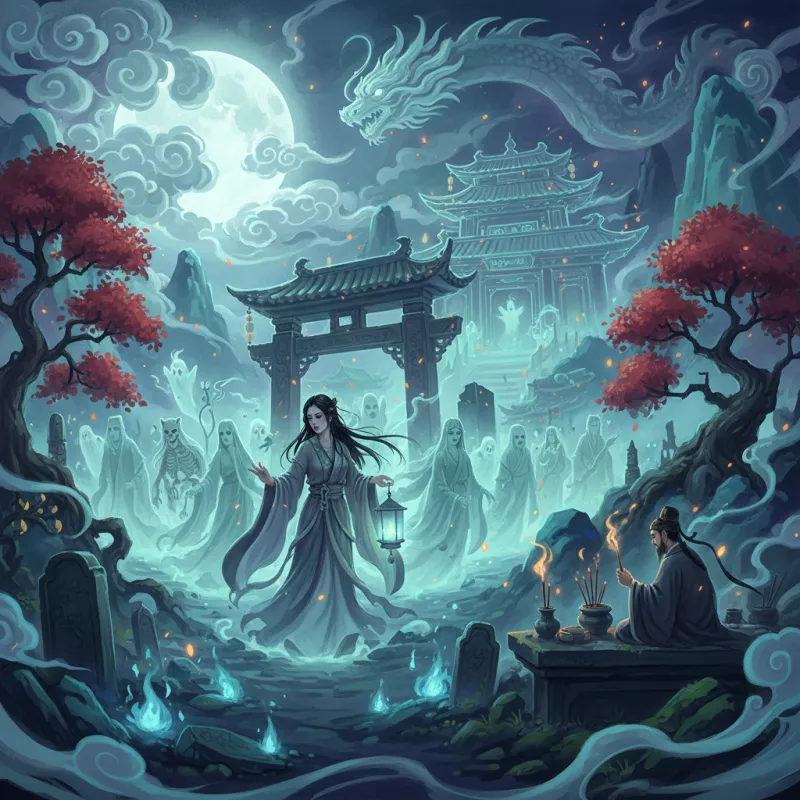
The old woman's funeral procession had barely left the village when her grandson saw her standing in the doorway of her house, wearing the same blue cotton jacket she'd been buried in that morning. This wasn't madness or grief-induced hallucination—in traditional Chinese understanding, this was perfectly normal. The hun soul had departed for the afterlife, but the po soul still lingered, attached to the physical world it had inhabited for seventy-three years. What Westerners dismiss as ghost stories, the Chinese recognized as documented observations of a complex metaphysical reality.
The Architecture of the Chinese Soul
Unlike the Western concept of a single, indivisible soul, Chinese metaphysics describes human consciousness as a composite structure. The hun (魂) represents the ethereal, yang aspect—intellectual, spiritual, ascending. The po (魄) embodies the corporeal, yin aspect—physical, earthbound, descending. At death, these components separate. The hun travels to the underworld for judgment, while the po remains with the corpse, gradually dissipating as the body decays.
This isn't abstract philosophy. The hun-po division explains why Chinese funerary practices are so elaborate. You're not just honoring the dead—you're managing a metaphysical transition. The po needs time to detach from physical existence, which is why the body must be treated with specific rituals. Disturb this process, and you get a jiang shi (僵屍), a hopping corpse that's neither fully dead nor alive, its po trapped in a decaying shell. The Qing Dynasty saw numerous documented cases, particularly in Xiangxi, where corpse herders allegedly transported bodies back to their ancestral homes for proper burial.
The Bureaucracy of the Dead
Chinese afterlife isn't heaven or hell—it's a government office. Diyu (地獄), the underworld, operates like an imperial administration with ten courts, each presided over by a Yama King who judges specific transgressions. King Qinguang handles the first court, sorting souls and determining their path. King Chujiang oversees the second, punishing thieves and corrupt officials. By the tenth court, King Zhuanlun manages reincarnation itself, deciding whether you return as human, animal, or hungry ghost.
This bureaucratic model reflects Chinese political reality. The afterlife mirrors earthly governance because, in Chinese cosmology, there's no fundamental distinction between the two. The living and dead exist in parallel administrative systems. You can bribe underworld officials with paper money burned at funerals. You can appeal judgments through proper channels. The Jade Record (玉曆), a Ming Dynasty text, provides detailed descriptions of each court's jurisdiction and punishments—a legal code for the dead.
What happens if you die far from home, without proper burial rites? You become a hungry ghost (餓鬼, egui), trapped between worlds during the Ghost Month. These aren't malevolent demons by nature—they're bureaucratic casualties, souls without proper documentation. The Ghost Festival on the fifteenth day of the seventh lunar month temporarily opens the gates, allowing these administrative errors to receive offerings from the living.
Gui: The Spectrum of Ghostly Existence
The Chinese term gui (鬼) encompasses far more than the English "ghost." It's a taxonomic category including everything from vengeful spirits to ancestral presences. A yuan gui (冤鬼) is a wronged ghost seeking justice—think of Dou E from the Yuan Dynasty play The Injustice to Dou E, whose execution caused snow in summer and drought for three years. A li gui (厲鬼) is actively malevolent, often created through violent death or improper burial.
But not all gui are threatening. Ancestral spirits, properly venerated, become protective household presences. The distinction isn't between good and evil ghosts—it's between satisfied and unsatisfied dead. A gui becomes dangerous when its needs aren't met: no descendants to make offerings, no proper burial, unresolved grievances from life. The famous Qing Dynasty collection Strange Tales from a Chinese Studio by Pu Songling presents gui as complex individuals with motivations, desires, and moral ambiguity. The ghost Nie Xiaoqian isn't inherently evil—she's trapped in servitude to a tree demon, forced to seduce men against her will.
Shen and the Divine Bureaucracy
While gui represent the dead, shen (神) encompasses deities, spirits, and divine forces. The boundary between these categories is surprisingly permeable. Guan Yu, a Three Kingdoms general who died in 220 CE, became Guan Di, a god of war and righteousness, through centuries of veneration. Mazu began as Lin Moniang, a Song Dynasty woman who died saving sailors, and evolved into the Empress of Heaven. In Chinese cosmology, exceptional humans can achieve divine status through merit, popular devotion, or imperial decree.
This creates a supernatural hierarchy more complex than Western angelology. At the top sit the Three Pure Ones of Taoism or the celestial Buddhas. Below them, a vast bureaucracy of specialized deities manages everything from smallpox to literature. City gods (城隍, chenghuang) govern urban areas, reporting to higher authorities about local affairs. Even fox spirits can achieve divine status through cultivation, as documented in countless zhiguai (志怪) tales.
The Living Dead: Jiang Shi and Corporeal Spirits
The jiang shi represents Chinese horror's most distinctive contribution to world folklore. Unlike Western zombies, which are mindless, or vampires, which are sophisticated predators, jiang shi occupy an uncanny middle ground. They're corpses animated by residual po energy, hopping because rigor mortis has stiffened their legs, arms outstretched, dressed in Qing Dynasty official robes.
The specificity matters. Jiang shi lore peaked during the Qing Dynasty, particularly in remote regions where bodies needed transport over long distances. Corpse herders allegedly used Taoist magic to animate bodies, leading them home in nighttime processions. Whether these accounts describe actual practices, misidentified medical conditions, or pure folklore remains debated, but the cultural anxiety is clear: improper death rites create monsters.
Protection against jiang shi reveals Chinese metaphysical logic. They're repelled by chicken blood (yang energy), glutinous rice (absorbs yin), and yellow paper talismans inscribed with Taoist formulas. They can't cross running water or climb stairs. These aren't arbitrary rules—they're applications of yin-yang theory and five-element cosmology. A jiang shi is excessive yin energy in physical form, so yang substances naturally counteract it.
Hungry Ghosts and the Economics of the Afterlife
The preta or hungry ghost (餓鬼, egui) embodies Buddhist influence on Chinese supernatural beliefs. These beings suffer from insatiable hunger and thirst, their tiny mouths and enormous bellies making consumption impossible. They're not demons but pitiable creatures trapped by karmic consequences—greed, gluttony, or stinginess in life manifests as eternal deprivation in death.
The Ghost Festival (中元節, Zhongyuan Jie) addresses this suffering through organized charity for the dead. Families make offerings not just to their ancestors but to all wandering spirits. Temples hold elaborate ceremonies, Buddhist monks chant sutras, and communities stage operas for ghostly audiences. This isn't superstition—it's social welfare extended beyond mortality's boundary.
The paper offerings burned during these festivals reveal sophisticated economic thinking. Hell Bank Notes, paper houses, cars, and even smartphones are consumed by fire, their essence transferring to the spirit world. This practice assumes the afterlife operates on similar principles to earthly existence: the dead need resources, and the living can provide them through ritual transformation. It's metaphysical remittance, maintaining economic ties across the death boundary.
Modern Persistence and Transformation
These beliefs haven't vanished into modernity—they've adapted. Contemporary Chinese horror films like The Eye and Rigor Mortis reframe traditional gui and jiang shi for urban audiences. The Ghost Festival continues in Taiwan, Hong Kong, and overseas Chinese communities, though offerings now include paper credit cards and designer handbags. Ancestral veneration persists even among educated, secular Chinese, suggesting these practices fulfill psychological and social needs beyond literal belief.
The enduring power of Chinese supernatural folklore lies in its systematic coherence. It's not a collection of random superstitions but an integrated worldview addressing fundamental questions: What happens after death? How do we maintain relationships with the deceased? What obligations do the living owe the dead? The answers—bureaucratic afterlife, composite souls, ritual transformation—might seem exotic, but they're logical extensions of Chinese philosophical and social principles.
When that grandson saw his grandmother in the doorway, he wasn't witnessing a violation of natural law. He was observing the po soul's gradual departure, a process his culture had documented and theorized about for millennia. Whether you believe in literal hun and po or see them as metaphors for grief and memory, the framework offers something Western ghost stories often lack: a comprehensive explanation of why the dead linger, what they want, and how the living should respond.
Related Reading
- Daoist Exorcism: How Chinese Priests Fight Supernatural Evil
- Spirit Writing: Fuji Divination and Messages from the Gods
- Joss Paper: Burning Money for the Dead
Explore Chinese Culture
- Explore ancient mythical creatures
- Explore Daoist exorcism traditions
- Explore Chinese folk beliefs and superstitions