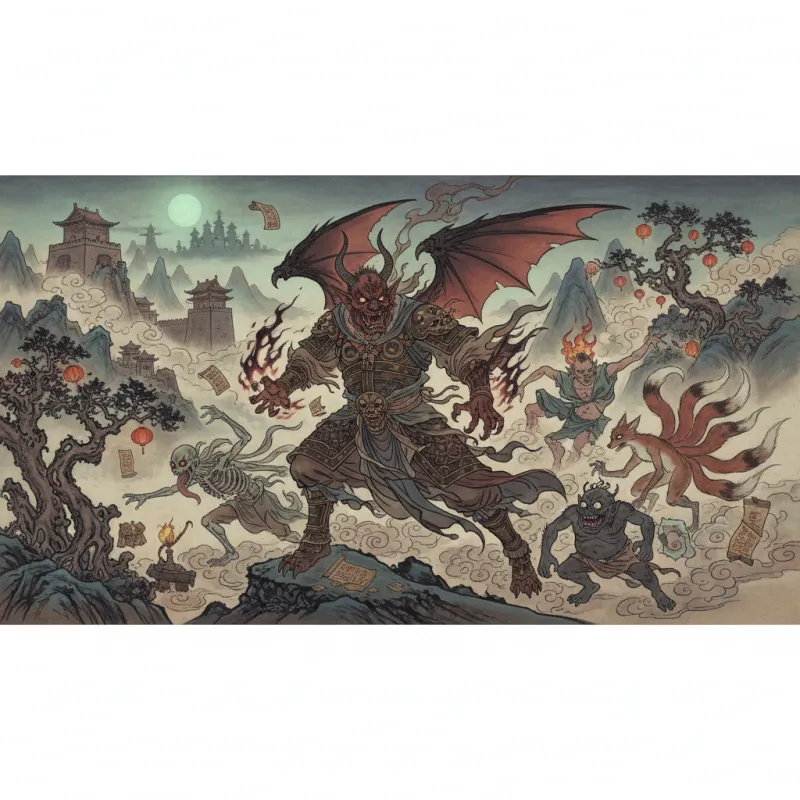
The old Daoist priest in Journey to the West can tell at a glance whether Sun Wukong faces a yao, a mo, or a gui — and his survival depends on knowing the difference. Western translations flatten these distinctions into "demon" or "monster," but Chinese supernatural taxonomy operates with the precision of a field guide. Each category of malevolent being has its own origin story, its own weaknesses, and its own relationship to the cosmic order. Misidentify a fox spirit as a hungry ghost, and your exorcism ritual becomes worse than useless.
The Five Categories of Chinese Supernatural Evil
Chinese demonology recognizes five primary classifications, each with distinct characteristics that determine how they're confronted. This isn't academic hairsplitting — it's practical knowledge that separates effective exorcists from corpses.
Yao (妖, yāo) are beings that began as ordinary animals, plants, or objects and cultivated supernatural power over centuries. The classic example is the fox spirit (狐妖, húyāo) that appears throughout Chinese literature, from the Liaozhai Zhiyi (Strange Tales from a Chinese Studio) to modern horror films. A tree that has absorbed spiritual energy for five hundred years becomes a tree yao. A stone that has witnessed human civilization for millennia develops consciousness. Yao aren't inherently evil — they're simply non-human intelligences with their own agendas. Some seduce scholars and drain their life force. Others fall genuinely in love with humans and protect them. The white snake Bai Suzhen from The Legend of the White Snake is a yao who becomes more virtuous than most humans.
Mo (魔, mó) represent corruption itself — beings or humans who have been twisted by negative energy or forbidden cultivation practices. Unlike yao, mo are genuinely malicious. They feed on human suffering and actively engineer catastrophes. The term "heart demon" (心魔, xīnmó) describes the internal psychological corruption that can transform a righteous cultivator into a mo. In The Investiture of the Gods, the fox spirit Daji becomes a mo when she allows herself to be possessed by a malevolent force and orchestrates the fall of the Shang Dynasty through systematic cruelty. The distinction matters: a yao might be reasoned with or redirected, but a mo must be destroyed or sealed.
Gui (鬼, guǐ) are the spirits of dead humans who haven't moved on to their next incarnation. Western translations call them "ghosts," but gui are more varied and dangerous than Victorian phantoms. A person who dies violently, unjustly, or without proper burial rites becomes a gui. The hungry ghost (饿鬼, èguǐ) starves eternally because no one makes offerings for it. The vengeful ghost (厉鬼, lìguǐ) hunts those responsible for its death. During the Ghost Month, gui walk freely among the living — which is why you'll see Taiwanese families leaving elaborate meals on their doorsteps in the seventh lunar month. For more on these restless dead, see Chinese Ghosts: Types and Characteristics.
Jing (精, jīng) occupy an ambiguous space between yao and nature spirits. While yao cultivate power deliberately, jing are beings that spontaneously develop consciousness through accumulated spiritual energy. The ginseng spirit that appears in Journey to the West is a jing — it didn't choose to become supernatural, but ten thousand years of growth in sacred soil gave it sentience. Mountain jing, water jing, and stone jing appear throughout Chinese folklore, usually as neutral forces that become dangerous only when disturbed or disrespected.
Guai (怪, guài) is the catch-all category for supernatural beings that don't fit elsewhere — monsters, anomalies, and things that shouldn't exist. The term literally means "strange" or "weird." A two-headed snake is a guai. A house where gravity works sideways is haunted by guai energy. These beings often result from cosmic imbalances, failed experiments, or tears in the fabric of reality itself.
The Cultivation Hierarchy
What makes Chinese demonology particularly sophisticated is its recognition that supernatural beings exist on a spectrum of power and cultivation. A fox that has lived for one hundred years is a minor nuisance. A fox that has cultivated for one thousand years can challenge celestial immortals. The Fengshen Yanyi (Investiture of the Gods) describes nine-tailed fox spirits whose power rivals that of gods — not because they're inherently more evil, but because they've had millennia to refine their abilities.
This cultivation framework means that the same category of being can range from trivial to apocalyptic. A newly formed tree yao might only be able to whisper in the wind. A tree yao that has stood for three thousand years can trap entire armies in illusions and reshape the landscape. Chinese exorcists must assess not just what type of entity they face, but how long it has been cultivating.
The concept of "crossing the tribulation" (渡劫, dùjié) adds another layer. When a yao or jing reaches certain thresholds of power, Heaven itself tests them with lightning tribulations. Survive, and they ascend to a higher state of being. Fail, and they're destroyed. This creates a natural selection pressure — the ancient supernatural beings that still exist are, by definition, the ones powerful and cunning enough to have survived multiple heavenly tribulations.
Why the Taxonomy Matters
These distinctions aren't just folklore trivia — they determine the appropriate response to supernatural threats. You don't exorcise a yao the same way you banish a gui. Daoist talismans that work perfectly against hungry ghosts might only annoy a powerful mo. The Maoshan tradition of exorcism, which originated during the Han Dynasty, developed different ritual protocols for each category of being.
Consider the difference in approach: A gui can be appeased through proper burial rites and offerings. Its grievance is usually specific and resolvable. A mo, however, cannot be appeased — it must be sealed, destroyed, or converted through overwhelming spiritual force. Attempting to negotiate with a mo is like trying to reason with cancer. Meanwhile, a yao might actually be open to negotiation, especially if you can offer it something it wants more than whatever mischief it's currently causing.
The Buddhist monk Xuanzang in Journey to the West demonstrates this practical taxonomy constantly. When he encounters yao, he often tries conversion first — many of his demon opponents eventually become his disciples. When he faces mo, he relies on Sun Wukong's violence. When gui appear, he performs merit-transfer rituals. The novel works as a demonological field manual precisely because it shows these different approaches in action.
Regional Variations and Syncretism
Chinese demonology isn't monolithic — it varies significantly by region and religious tradition. Southern Chinese folklore emphasizes water-based supernatural beings like the shuigui (水鬼, water ghost) that drowns swimmers to take their place. Northern traditions focus more on mountain spirits and fox yao. Tibetan Buddhist influences introduced the concept of luocha (罗刹, rākṣasa), flesh-eating demons borrowed from Indian mythology but adapted to Chinese cosmology.
The syncretic nature of Chinese religion means that Daoist, Buddhist, and folk traditions all contribute to the taxonomy. Daoism contributed the concept of yao and the cultivation framework. Buddhism introduced the idea of demons as manifestations of karmic consequences and internal delusions. Folk religion added countless local spirits and monsters that don't fit neatly into either system. For more on how these traditions intersect, see Daoist Exorcism Methods.
Modern Interpretations
Contemporary Chinese horror films and novels still use this traditional taxonomy, though often with modern twists. The 2020 film The Yin-Yang Master features a protagonist who must correctly identify supernatural beings to defeat them — get the category wrong, and your magic fails. Online cultivation novels (xiūxiān xiǎoshuō) have popularized these concepts among younger generations, though often with video game-like systematization that would make traditional scholars wince.
The taxonomy also appears in Chinese medicine and psychology. "Heart demons" remain a common way to discuss mental health issues, acknowledging that internal psychological struggles can be as dangerous as external supernatural threats. The concept of "demonic qi" (魔气, móqì) describes the spiritual pollution that accumulates in places where violence or suffering occurred — a framework that Western psychology might call "trauma" but Chinese tradition treats as a tangible, measurable force.
The Cosmic Order
Ultimately, Chinese demonology reflects a worldview where supernatural beings aren't aberrations but natural parts of a complex cosmic ecosystem. Yao, mo, gui, jing, and guai all have their places in the order of things. Even the most malevolent mo serves a function — testing humanity, punishing the wicked, or maintaining cosmic balance through destruction.
This is why Chinese supernatural fiction rarely ends with the complete eradication of demons. Instead, powerful beings are sealed, converted, or incorporated into the celestial bureaucracy. The Investiture of the Gods concludes not with the destruction of all demons, but with their assignment to official positions in the heavenly administration. Even evil has its role to play in maintaining the Dao.
Understanding this taxonomy means recognizing that "demon" is a translation that obscures more than it reveals. Chinese supernatural beings exist in a sophisticated classification system that acknowledges different origins, different natures, and different relationships to humanity. The old Daoist priest knows this. The question is whether you'll learn it before you need it.
Related Reading
- Exploring the Dark Realms: Chinese Demons and Their Significance in Folklore
- Unveiling the Shadows: A Journey Through Chinese Supernatural Folklore of Ghosts and Spirits
- The Nine-Tailed Fox: From Demon to Deity
- Daoist Exorcism: The Art of Banishing Spirits in Chinese Culture
- Jiangshi: The Chinese Hopping Vampire
- Exploring the Depths of Chinese Supernatural Folklore: Ghosts, Spirits, and Afterlife Beliefs
- Chinese Campus Ghost Stories: The Haunted Universities
- What is Liaozhai Zhiyi? A Guide to China's Greatest Ghost Stories
Explore Chinese Culture
- Explore ancient mythical creatures
- Explore Daoist exorcism traditions
- Explore Chinese folk beliefs and superstitions