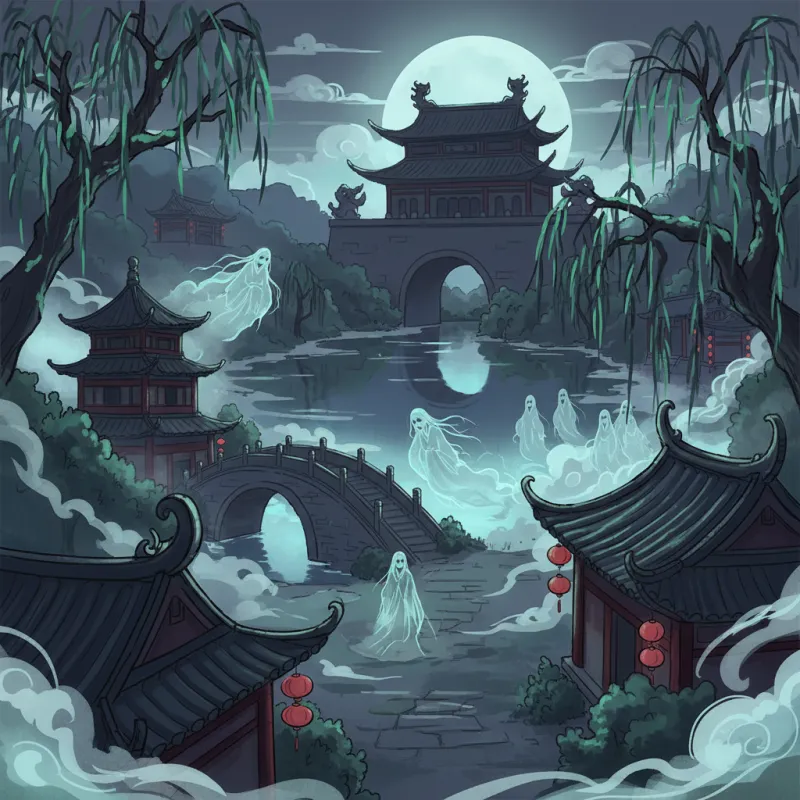
The library's fourth floor doesn't exist on the elevator panel, but students swear they've been there. At Beijing Normal University, pressing the button between three and five during exam season supposedly takes you to a phantom study hall where a girl in a 1980s school uniform sits at the same desk every night, her textbook open to a page of calculus problems she'll never solve. She died there, they say, during the gaokao preparation that broke her mind before it could break her future.
Chinese university campuses are supernatural pressure cookers, and the ghosts they produce tell us more about the living than the dead. These aren't the elegant fox spirits of classical literature or the vengeful 厉鬼 (lìguǐ, malevolent ghosts) from ancient folklore. Campus ghosts are distinctly modern creatures, born from academic anxiety, dormitory claustrophobia, and the specific terror of being eighteen years old and three hundred miles from home for the first time.
The Architecture of Fear
Chinese university ghost stories cluster around specific locations with mathematical precision. Libraries, especially their upper floors, dominate the landscape. Tsinghua University's old library supposedly houses the spirit of a graduate student who hanged himself after his thesis was rejected three times. Students report seeing him in the stacks after midnight, methodically pulling books and replacing them in the wrong order — a petty haunting that feels authentically academic.
Dormitory buildings run a close second, particularly those built on former execution grounds or graveyards. At Nanjing University, the infamous Building 7 was constructed over a mass grave from the Taiping Rebellion (1850-1864). Students claim that room 404 — note the double dose of the death-associated number four (四, sì) — experiences temperature drops of ten degrees Celsius even in summer. The university officially attributes this to "ventilation issues," which is administrator-speak for "we're not discussing this."
Swimming pools occupy a special category of campus dread. Nearly every university with a pool has a drowning ghost, usually a student who died during mandatory swimming tests. At Wuhan University, the pool allegedly claims one life per decade, always in the deep end, always during the week before final exams. The pattern is so established that students now avoid swimming during that period, which means the ghost story has achieved what safety regulations could not: behavioral modification through supernatural terror.
The Gaokao Ghost Phenomenon
The most distinctly Chinese element of campus ghost stories is their connection to academic pressure. Unlike Western college ghost stories, which often involve romantic tragedy or violent crime, Chinese campus ghosts frequently died from studying. They're casualties of the 高考 (gāokǎo, national college entrance examination) system, a test so consequential it can determine your entire life trajectory in a single nine-hour period.
At Fudan University in Shanghai, students speak of the "Library Ghost Girl" who appears during finals week, always sitting in the same corner of the reading room, surrounded by towers of textbooks. She's described as wearing a school uniform from the 1990s, her face pale and expressionless, occasionally looking up from her books to stare at living students with what witnesses describe as "hungry eyes." The implication is clear: she studied herself to death and hasn't realized she can stop.
These academic ghosts serve a psychological function. They externalize the very real fear that studying can kill you — and in a system where students regularly pull all-nighters for weeks, where mental health resources are scarce, and where academic failure carries profound social shame, this fear isn't entirely irrational. The ghost becomes a warning and a companion: "This could happen to you, but at least you're not alone in your suffering."
Dormitory Hauntings and Social Control
Chinese university dormitories are uniquely positioned to generate ghost stories. Most students live in cramped rooms with six to eight roommates, under strict regulations that include mandatory lights-out times (usually 11 PM), limited bathroom facilities, and rules against overnight guests. This environment breeds both intimacy and tension, and ghost stories become a way to negotiate both.
The "Bathroom Mirror Ghost" appears at dozens of campuses with only minor variations. The standard version: if you look in the dormitory bathroom mirror at exactly 2:22 AM (the number two, 二, èr, repeated, which sounds like 饿, è, meaning hungry), you'll see a face behind your own. At some schools, it's a girl who drowned herself after a breakup. At others, it's a student who died in a fire. The specifics matter less than the function: the story enforces the lights-out rule by making late-night bathroom trips terrifying.
Similarly, stories about ghosts that knock on dormitory doors in specific patterns serve to explain away the creaks and sounds of old buildings while simultaneously creating a shared language of fear. At Peking University, three knocks followed by silence supposedly means a ghost is testing whether anyone will answer. Four knocks means death is coming. The number four (四, sì) again, homophonous with death (死, sǐ), doing heavy lifting in the Chinese supernatural imagination.
The Role of Campus Geography
Chinese universities often occupy land with complicated histories, and ghost stories map directly onto this geography. Many campuses were built on former execution grounds, graveyards, or battlefields — not because administrators are deliberately courting the supernatural, but because rapidly expanding cities needed space, and nobody wanted to live on death-associated land except institutions that could afford it.
Sun Yat-sen University in Guangzhou is built partially on the site of the former Lingnan University, which itself was constructed over a Qing Dynasty execution ground. The campus's East Lake supposedly contains the bodies of executed criminals, and students report seeing figures walking on the water's surface during foggy mornings. The university's response has been to install better lighting around the lake, which is either a practical safety measure or an acknowledgment that ghosts prefer darkness.
At Xiamen University, the famous Lover's Valley (情人谷, qíngrén gǔ) is said to be haunted by couples who died in suicide pacts after their relationships were forbidden by parents or circumstances. The valley's romantic reputation coexists uneasily with its supernatural one, creating a space that's simultaneously a popular date spot and a location students avoid after dark. This duality is very Chinese: the same location can be auspicious and inauspicious depending on context, time, and intention.
Modern Technology and Ancient Fears
Contemporary campus ghost stories have adapted to include modern technology, creating hybrid hauntings that blend traditional 鬼 (guǐ) with smartphones and social media. At several universities, students report receiving WeChat messages from accounts belonging to deceased classmates, usually simple messages like "I'm still here" or "Don't forget me." These stories spread rapidly through social media, achieving viral status in ways that traditional oral ghost stories never could.
The "Elevator Ghost" phenomenon has evolved with building technology. Older stories involved ghosts appearing in elevator mirrors or causing elevators to stop at non-existent floors. Newer versions involve elevator security cameras capturing figures that weren't visible to passengers, or elevator call buttons being pressed from inside empty cars. At Zhejiang University, a viral video supposedly showed a girl entering an elevator alone, then footage from inside showing her conversing with empty space before the elevator plummeted three floors. The university claimed mechanical failure; students knew better.
These technological hauntings reflect anxieties about surveillance, privacy, and the way modern campus life is increasingly mediated through screens and sensors. If cameras can see what we can't, what else are we missing? The ghost becomes a glitch in the system, a reminder that not everything can be rationalized or controlled.
The Social Function of Campus Ghosts
Campus ghost stories serve multiple social functions beyond simple entertainment. They create shared identity among students, providing common reference points and inside knowledge that separates insiders from outsiders. Knowing which buildings to avoid, which mirrors not to look into, which numbers carry danger — this knowledge marks you as part of the community.
They also provide a vocabulary for discussing mental health and academic pressure without directly addressing these stigmatized topics. When students talk about the ghost who studied herself to death, they're really talking about their own exhaustion and fear. When they share stories about dormitory hauntings, they're negotiating the challenges of communal living and loss of privacy. The ghost story becomes a safe container for unsafe feelings.
Moreover, these stories represent a form of resistance against institutional authority. Universities can control curriculum, dormitory rules, and campus access, but they can't control the stories students tell. Ghost stories are student-owned narrative space, and they often implicitly critique the systems that create the conditions for these hauntings: academic pressure, inadequate mental health support, overcrowded living conditions, and the general disregard for student wellbeing in favor of institutional prestige.
The Persistence of Belief
What's remarkable about Chinese campus ghost stories isn't their existence — every culture has ghost stories — but their persistence among educated young people who theoretically should be skeptical. These are students studying engineering, medicine, and science, yet they avoid certain buildings, refuse to look in mirrors at specific times, and genuinely believe their campuses are haunted.
This persistence suggests that ghost stories fulfill needs that rational education doesn't address. They provide explanations for the inexplicable feelings of dread and anxiety that accompany high-pressure academic environments. They create community through shared fear. They offer a sense that there's more to existence than grades and career prospects, even if that "more" is terrifying.
The stories also connect students to deeper currents of Chinese supernatural tradition, even as they adapt these traditions to contemporary contexts. The campus ghost is a modern iteration of the 冤鬼 (yuānguǐ, wronged ghost) who died unjustly and seeks acknowledgment. The difference is that the injustice isn't murder or betrayal, but a system that values achievement over wellbeing, that measures worth in test scores, and that treats students as production units rather than human beings.
Every semester, new students arrive on campus and learn the ghost stories from their seniors. Every year, the stories evolve slightly, incorporating new details, new technologies, new anxieties. The ghosts remain, not because they're real in any objective sense, but because they're true in a deeper way: they represent the very real costs of China's educational system, the very real pressures students face, and the very real need for stories that acknowledge suffering even when institutions won't.
The fourth floor of the library still doesn't appear on the elevator panel. But students keep pressing the button between three and five, hoping and fearing in equal measure that this time, the doors will open onto that phantom study hall where the girl in the 1980s uniform sits, forever solving problems that have no solution, forever studying for a test she'll never take. She's waiting there, they say, not to scare the living but to remind them: you're not alone in this. Even the dead understand what it means to be crushed by expectations.
Related Reading
- Exploring Chinese Supernatural Folklore: Ghosts, Spirits, and Afterlife Beliefs Unveiled
- Chinese Urban Legends: The Ghost Stories Your Taxi Driver Tells
- Chinese Urban Legends That Went Viral: From Elevator Ghosts to Cursed Phone Numbers
- Ghosts of the Beijing Subway: Urban Legends Underground
- Exploring the Depths of Chinese Supernatural Folklore: Ghosts, Spirits, and Afterlife Beliefs
- The Most Famous Chinese Ghost Stories: Tales That Have Haunted a Civilization
- How to Avoid Punishment in Chinese Hell: Loopholes, Bribes, and Good Behavior
Explore Chinese Culture
- Explore ancient mythical creatures
- Explore Daoist exorcism traditions
- Explore Chinese folk beliefs and superstitions