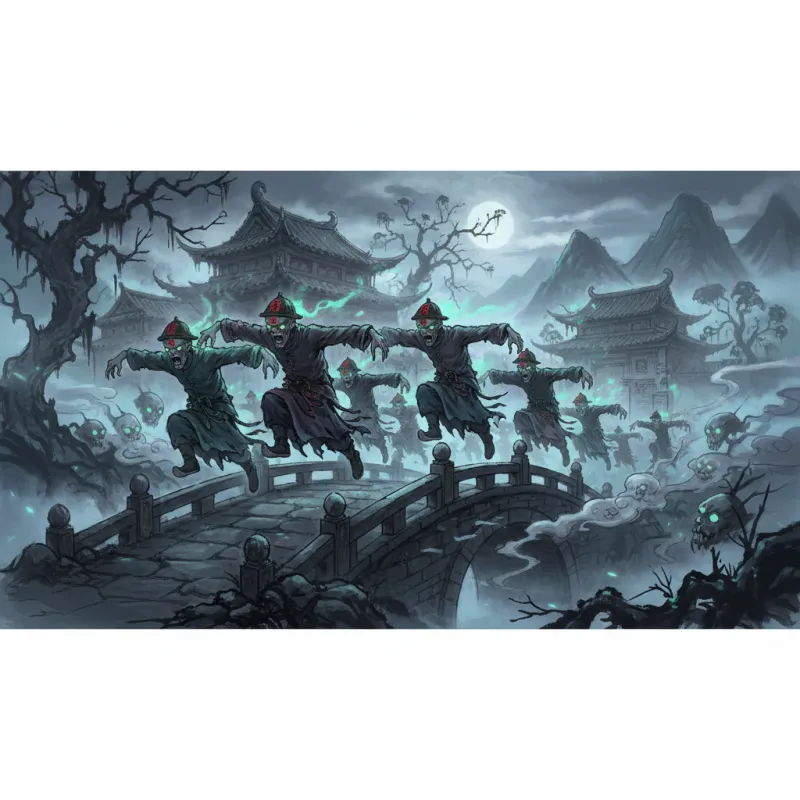
Picture this: a corpse in a Qing Dynasty official's robe, arms stretched straight out like a sleepwalker, bouncing through the moonlit streets with the mechanical rhythm of a wind-up toy. Its face is pale green, fingernails grown long and black, a yellow paper talisman plastered across its forehead. It doesn't walk. It hops. And somehow, that hopping — that absurd, stiff-legged bounce — is more terrifying than any elegant vampire's glide could ever be.
Welcome to the world of the jiangshi (僵尸, jiāngshī), literally "stiff corpse." This is China's answer to the vampire, and it plays by completely different rules.
The Qi Thief: What Makes a Jiangshi Different
Western vampires want your blood. The jiangshi wants something far more fundamental: your qi (气, qì) — the vital life force that flows through every living thing in Chinese cosmology. This isn't just a semantic difference. Blood is physical, replaceable, medical. Qi is your essence, your animation, the thing that separates the living from the dead. When a jiangshi drains your qi, it's not just feeding — it's stealing the very thing that makes you alive.
The jiangshi doesn't bite necks or seduce victims. It locates prey by sensing the breath of the living, then lunges with outstretched arms, absorbing qi through proximity or direct contact. Some accounts describe victims found with no visible wounds, simply dead, their faces frozen in expressions of terror, their bodies cold and depleted. The qi has been sucked out like air from a balloon.
This reflects a fundamentally different understanding of death and undeath. In Chinese thought, the body contains two souls: the hun (魂, hún), the ethereal soul that ascends to heaven, and the po (魄, pò), the corporeal soul tied to the physical body. When someone dies improperly — through violence, suicide, or without proper burial rites — the po may refuse to depart. It clings to the corpse, animating it into a jiangshi. The hun is gone; what remains is pure animal instinct and hunger.
How to Create a Hopping Corpse
Not every corpse becomes a jiangshi. The transformation requires specific conditions, and Chinese folklore is remarkably precise about them. The most common origin story involves a corpse that fails to decompose properly. In the humid climate of southern China, bodies should decay quickly. When they don't — when rigor mortis persists unnaturally long — it's a sign that the po soul has become trapped.
Violent or untimely death is a major risk factor. Someone who dies by murder, suicide, hanging, or drowning is particularly susceptible. So is anyone who dies far from home, which is why the corpse walkers (赶尸匠, gǎnshījiàng) of Xiangxi became such a fixture of jiangshi lore. These professional corpse herders would transport bodies back to their ancestral homes for proper burial, traveling only at night, ringing bells to warn the living away. The corpses would "walk" behind them — or so the stories claim. Whether this practice was real or exaggerated, it fed directly into jiangshi mythology.
A cat jumping over a corpse can trigger the transformation. The animal's yang energy supposedly jolts the po soul into reanimation. Exposure to moonlight, particularly during a full moon, is another catalyst. Some texts mention that a corpse left unburied during a thunderstorm might be struck by lightning and rise as a jiangshi — a detail that suggests these creatures are as much products of cosmic imbalance as supernatural evil.
The most disturbing origin? A living person can be transformed into a jiangshi through black magic. Sorcerers in the Maoshan (茅山, Máoshān) tradition — practitioners of Daoist magic — were said to know rituals that could bind a person's po soul to their body before death, ensuring they would rise as a controllable undead servant. This makes the jiangshi not just a monster, but a potential weapon.
The Hopping Gait: Why They Move Like That
Let's address the obvious question: why do they hop?
The practical answer is rigor mortis. A corpse in full rigor mortis has stiff, locked joints. It can't bend at the knees or elbows. The only way to move is to hop, using the whole body as a rigid lever. This is the explanation you'll find in most folklore collections, and it makes a certain grotesque sense.
But there's a deeper, more unsettling reason. The jiangshi's hop is a perversion of the natural order. Living things move fluidly, with grace and intention. The jiangshi moves mechanically, like a puppet jerked by invisible strings. That hop — that rhythmic, relentless bounce — is a visual reminder that this thing is not alive. It's animated, but not living. It's a corpse pretending to move.
The hop also serves a narrative function. It makes the jiangshi simultaneously comic and terrifying. In Hong Kong horror-comedies of the 1980s and 90s, the hop became a source of slapstick humor. But in darker tales, that same hop becomes hypnotic, nightmarish. Imagine hearing it in the dark: thump... thump... thump... Getting closer. Never stopping. Never tiring.
Stopping the Hopping Dead
If you encounter a jiangshi, you have options — but you need to know the rules.
The most famous defense is the yellow paper talisman (符, fú). These are strips of yellow paper inscribed with Daoist spells, usually written in red or black ink. Slap one on the jiangshi's forehead, and it freezes instantly, the magic binding the po soul in place. This is why jiangshi in popular culture are often depicted with talismans already stuck to their heads — someone tried to stop them, and it worked. For a while.
Holding your breath can make you invisible to a jiangshi. Since they track prey by sensing breath and qi, stopping your breathing cuts off their ability to detect you. This is harder than it sounds when a corpse is hopping toward you, arms outstretched, but it's a technique mentioned repeatedly in folklore. Some stories describe people hiding underwater or behind sealed doors, desperately holding their breath while the jiangshi searches for them.
Sticky rice is a surprisingly effective weapon. Throw it at a jiangshi, and it burns like acid. The rice, particularly glutinous rice (糯米, nuòmǐ), is considered pure and yang-aligned, the opposite of the yin-corrupted corpse. Some Daoist priests carry pouches of sticky rice specifically for jiangshi encounters. It won't destroy the creature, but it can drive it back or create an opening to apply a talisman.
Mirrors repel jiangshi because they can't bear to see their own reflection — a reminder of what they've become. A peachwood sword (桃木剑, táomù jiàn), a traditional Daoist ritual weapon, can strike them down. Vinegar, black dog blood, and the urine of a virgin boy are all mentioned in various texts as substances that weaken or repel the undead.
But the only permanent solution is proper burial. The jiangshi exists because the po soul is trapped in the corpse. Give the body a proper funeral, with all the correct rites, and the po will finally depart. The corpse will collapse, truly dead at last. This is why Daoist priests in jiangshi stories are often shown performing elaborate burial ceremonies — they're not just disposing of a monster, they're releasing a trapped soul.
From Folklore to Film: The Jiangshi in Popular Culture
The jiangshi exploded into popular consciousness through Hong Kong cinema in the 1980s. The 1985 film Mr. Vampire (僵尸先生, Jiāngshī Xiānsheng) turned the jiangshi into a cultural phenomenon, blending horror, comedy, and martial arts into something uniquely entertaining. The film's depiction — Qing Dynasty robes, yellow talisman, stiff-armed hopping — became the definitive visual template.
What made Mr. Vampire work was its tone. It took the jiangshi seriously enough to be scary, but not so seriously that it couldn't laugh at the absurdity of a hopping corpse. The film spawned countless sequels and imitators, creating an entire subgenre of jiangshi cinema. These films established many of the "rules" that modern audiences associate with jiangshi, even though some of these rules were invented for cinematic effect rather than drawn from folklore.
The jiangshi has appeared in video games (Sleeping Dogs, League of Legends), anime (Touhou Project), and Western media attempting to incorporate Chinese supernatural elements. But the creature works best in its original cultural context, where the rules of qi, yin-yang balance, and Daoist magic are understood intuitively.
Interestingly, the jiangshi has become less prominent in contemporary Chinese horror, which has shifted toward psychological terror and urban legends. But the creature remains iconic, a symbol of Chinese horror's unique flavor — less Gothic romance, more cosmic imbalance and ritual magic.
The Philosophy Behind the Horror
The jiangshi isn't just a monster. It's a manifestation of Chinese anxieties about death, burial, and the proper order of things.
In Chinese culture, dying away from home is a tragedy. The soul belongs with the ancestors, in the family burial ground. A corpse stranded far from home is a soul in limbo, unable to rest. The jiangshi embodies this fear — it's literally a body trying to get home, animated by the desperate po soul that refuses to accept its displacement.
The emphasis on proper burial rites reflects Confucian values of filial piety and ancestor worship. Neglecting these rites doesn't just dishonor the dead; it creates supernatural consequences. The jiangshi is what happens when society fails in its obligations to the deceased. It's a walking reminder that death requires ritual, respect, and community participation.
The creature also reflects Daoist cosmology's concern with balance. Life is yang; death is yin. A living person has both in balance. A jiangshi is pure yin — cold, stiff, lifeless — animated by trapped energy that should have dissipated. It's an imbalance made flesh, a violation of natural law. This is why Daoist priests are the primary jiangshi hunters in folklore; they're not just fighting monsters, they're restoring cosmic order.
Compare this to Western vampires, which often carry themes of seduction, immortality, and forbidden desire. The vampire is Romantic, even tragic. The jiangshi is never tragic. It's a mistake, an accident, a failure of proper procedure. There's no romance in a hopping corpse. There's only the grim necessity of fixing what went wrong.
Meeting the Jiangshi Today
Modern China has largely moved past traditional burial practices, but the jiangshi persists in cultural memory. You'll find jiangshi imagery in video games, comics, and Halloween costumes. The creature has become a symbol of Chinese horror, recognizable even to audiences who know nothing about qi or Daoist magic.
But the deeper anxieties remain. What happens to the dead who aren't properly honored? What becomes of those who die far from home, in accidents or violence? The jiangshi may be folklore, but the questions it asks are timeless.
If you want to understand Chinese supernatural horror, you need to understand the jiangshi. Not because it's the scariest creature in the pantheon — fox spirits and hungry ghosts have their own terrors — but because it reveals how Chinese culture thinks about death, the soul, and the consequences of cosmic imbalance.
And if you ever find yourself in a dark alley and hear that distinctive thump... thump... thump... getting closer? Hold your breath. Find some sticky rice. And pray you remember where you put that yellow talisman.
Because the jiangshi doesn't stop. It doesn't tire. It just hops, and hops, and hops, until it finds what it's looking for.
Related Reading
- Demons of Journey to the West: The Most Creative Monsters in Chinese Fiction
- Types of Chinese Demons: A Field Guide to Supernatural Beings
- Exploring the Dark Realms: Chinese Demons and Their Significance in Folklore
- Unveiling the Shadows: A Journey Through Chinese Supernatural Folklore of Ghosts and Spirits
- Jiangshi: The Chinese Hopping Vampire
- 10 Famous Fox Spirit Stories That Defined Chinese Supernatural Fiction
- Chinese Ghost Beliefs: A Complete Guide to the Spirit World
- Diyu: The Chinese Underworld and Its Ten Courts of Hell
Explore Chinese Culture
- Explore ancient mythical creatures
- Explore Daoist exorcism traditions
- Explore Chinese folk beliefs and superstitions