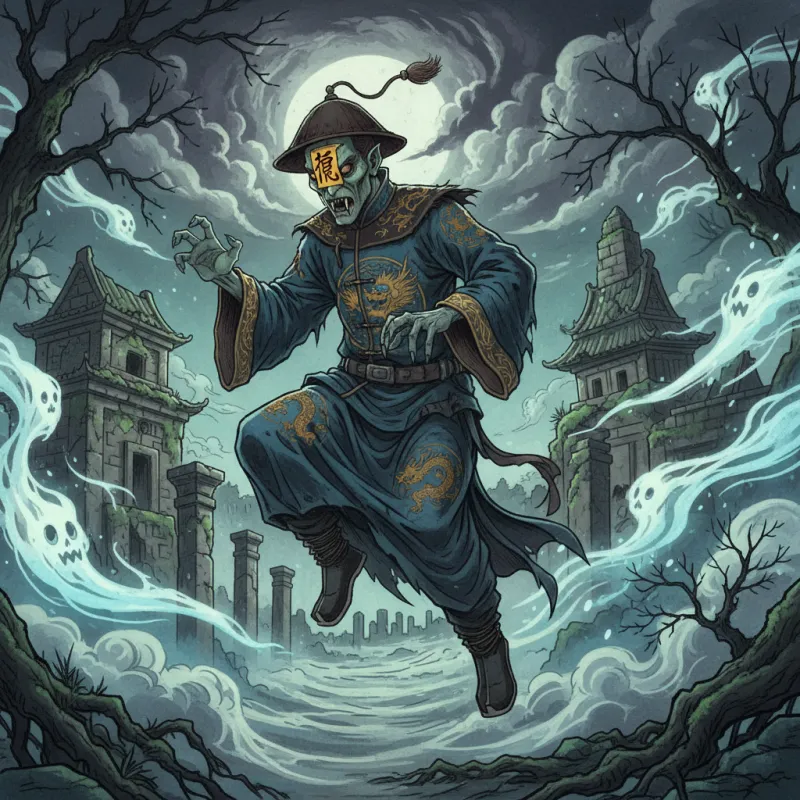
A corpse lurches through the moonlit forest, arms outstretched, legs locked together in a grotesque hop. Its skin has turned a sickly greenish-white, and a yellow paper talisman flutters from its forehead—the only thing keeping it from draining the life force from every living soul it encounters. This is the jiangshi (僵尸, jiāngshī), China's hopping vampire, and it's far stranger than any Western bloodsucker you've encountered.
The Stiff Corpse That Refuses to Lie Down
The word jiangshi literally means "stiff corpse"—jiang (僵) for rigid, shi (尸) for corpse. Unlike Dracula's suave aristocrat or the modern zombie's mindless shambling, the jiangshi moves in a distinctive hopping motion because rigor mortis has locked its limbs. It's a detail that sounds almost comical until you imagine that rigid, relentless thing bouncing toward you in the dark, arms extended like a sleepwalker, sensing your breath and the qi (气, qì) flowing through your body.
These creatures emerged prominently during the Qing Dynasty (1644-1912), though whispers of reanimated corpses appear in earlier texts. The jiangshi legend likely grew from a practical concern: what happened when someone died far from home? In imperial China, families went to extraordinary lengths to return their dead to ancestral burial grounds. Professional corpse drivers—yes, that was a real occupation—would transport bodies across vast distances. Some claimed they used Taoist magic to make the corpses walk at night, hopping along mountain paths. Whether this was true or merely a cover for nighttime smuggling operations, the image seared itself into the cultural imagination.
Anatomy of the Undead
A jiangshi doesn't just look dead—it looks wrong. The skin takes on a greenish-white pallor, sometimes covered in white hair or mold from decomposition. The body remains in whatever clothes it died in, often the official robes of Qing Dynasty bureaucrats, which is why so many jiangshi in films wear those distinctive garments. The arms stretch forward permanently, and the creature moves by hopping because its legs won't bend.
But here's what makes the jiangshi truly terrifying: it hunts by sensing the breath and life energy of the living. It can't see well—some accounts say it's completely blind—but it will track you by the sound of your breathing and the warmth of your qi. The traditional defense? Hold your breath and stand absolutely still. Easy to say, much harder to do when a hopping corpse is inches from your face.
The jiangshi feeds differently than Western vampires. Rather than drinking blood, it absorbs qi, the vital life force that flows through all living things. Some versions drain it through touch, others through breath. The victim doesn't just die—they wither, their life essence sucked away until they become a dried husk. And in the cruelest twist, those killed by a jiangshi often rise as jiangshi themselves, creating a cascade of undead that can devastate entire villages.
The Taoist Solution
Enter the Taoist priest, the jiangshi's natural enemy. These masters of spiritual warfare don't rely on crosses or holy water—they use paper talismans inscribed with powerful characters, peachwood swords, sticky rice, and the blood of a black dog. The most iconic defense is the yellow paper talisman (符, fú) plastered on the jiangshi's forehead. This seal temporarily paralyzes the creature, stopping it mid-hop like a supernatural pause button.
The Taoist arsenal reveals deep connections to Chinese cosmology and folk religion. Sticky rice isn't just food—it's considered pure and capable of absorbing negative energy. Peachwood has been used to ward off evil spirits since ancient times. A rooster's crow represents yang energy, the life force that opposes the yin death energy of the jiangshi. These aren't random superstitions but part of a coherent system of belief about how the universe operates, how yin and yang must balance, and what happens when that balance breaks.
The most elaborate rituals involve returning the jiangshi to proper rest. A skilled Taoist priest might perform ceremonies to settle the restless spirit, burn offerings to appease it, or guide it back to its grave. Sometimes the only solution is complete destruction—burning the body until nothing remains. The jiangshi represents not just physical danger but spiritual disorder, a violation of the natural cycle of death and rebirth that must be corrected.
From Folklore to Pop Culture Phenomenon
The jiangshi exploded into popular consciousness through Hong Kong cinema in the 1980s. Films like "Mr. Vampire" (1985) transformed the creature from pure horror into comedy-horror, with bumbling Taoist priests, slapstick kung fu fights, and jiangshi that were as funny as they were frightening. These movies established the visual language we associate with jiangshi today: the hopping movement, the Qing Dynasty robes, the yellow talismans, the Taoist priest with his wooden sword and bag of tricks.
But the cinematic jiangshi often softens the folklore's darker edges. Traditional tales emphasize the tragedy—these are people who died badly, far from home, unable to rest. They're victims as much as monsters, caught between worlds because proper funeral rites weren't performed or because they died with overwhelming resentment. Some stories feature jiangshi who retain fragments of their former selves, recognizing family members or returning to their old homes, adding a melancholy dimension to the horror.
The jiangshi shares conceptual space with other Chinese supernatural entities. Like the hungry ghost, it represents what happens when death goes wrong, when the proper rituals aren't observed. But while hungry ghosts are driven by insatiable desire, jiangshi are more mechanical, more purely predatory. They're closer to the corpse demons that possess dead bodies, though jiangshi are the original body reanimated rather than a spirit wearing a corpse like a suit.
Why the Jiangshi Still Matters
In an age of international horror, the jiangshi remains distinctly Chinese. It embodies specific cultural anxieties about death, burial, and ancestral obligations. The importance of being buried in your ancestral homeland, the need for proper funeral rites, the belief that the dead maintain connections to the living—these aren't universal concerns. They're rooted in Chinese philosophy, religion, and social structure.
The jiangshi also reflects attitudes toward authority and social order. Many traditional tales feature corrupt officials or cruel landlords who become jiangshi, their earthly sins preventing them from resting peacefully. The creature becomes a form of cosmic justice, a warning that abuse of power has consequences that extend beyond death. The Taoist priest, meanwhile, represents spiritual authority that transcends secular power—the one person who can control what the emperor's soldiers cannot.
Modern interpretations continue to evolve the legend. Video games, novels, and comics reimagine the jiangshi for new audiences, sometimes making them sympathetic characters or exploring what it means to be trapped between life and death. But the core image persists: that hopping figure with outstretched arms, that yellow talisman, that sense of something fundamentally wrong with the natural order.
Encountering the Hopping Dead
Traditional wisdom offers clear advice for jiangshi encounters. Hold your breath—they track the living by sensing breath and qi. Don't run—you can't outpace their supernatural hop, and movement attracts attention. If you have sticky rice, throw it; if you have a Taoist talisman, slap it on the creature's forehead; if you have neither, pray that dawn comes quickly, because jiangshi cannot abide sunlight.
But perhaps the best defense is prevention. Honor your ancestors, perform proper funeral rites, don't die far from home if you can help it, and if you must transport a corpse, hire a reputable corpse driver—preferably one who doesn't actually make the bodies hop. Because once someone becomes a jiangshi, saving them becomes exponentially harder than preventing the transformation in the first place.
The jiangshi endures in Chinese folklore because it speaks to primal fears about death and what comes after. It's not just a monster—it's a cautionary tale about respecting the dead, maintaining proper rituals, and understanding that some boundaries shouldn't be crossed. When you see that stiff figure hopping through the darkness, arms outstretched and talisman fluttering, you're not just seeing a vampire. You're seeing centuries of belief about death, duty, and the thin line between the living and the dead.
Related Reading
- Yaoguai: A Classification of Chinese Monsters
- Daoist Exorcism: The Art of Banishing Spirits in Chinese Culture
- Jiangshi: The Hopping Vampires of Chinese Horror
- Types of Chinese Demons: A Field Guide to Supernatural Beings
- Unveiling the Shadows: A Journey Through Chinese Supernatural Folklore of Ghosts and Spirits
- Haunted Temples: Where Gods and Ghosts Coexist
- Daoist Exorcism Rituals Explained: How to Kick Out a Demon the Chinese Way
- Unraveling the Mystique of Chinese Supernatural Folklore and Afterlife Beliefs
Explore Chinese Culture
- Explore ancient mythical creatures
- Explore Daoist exorcism traditions
- Explore Chinese folk beliefs and superstitions