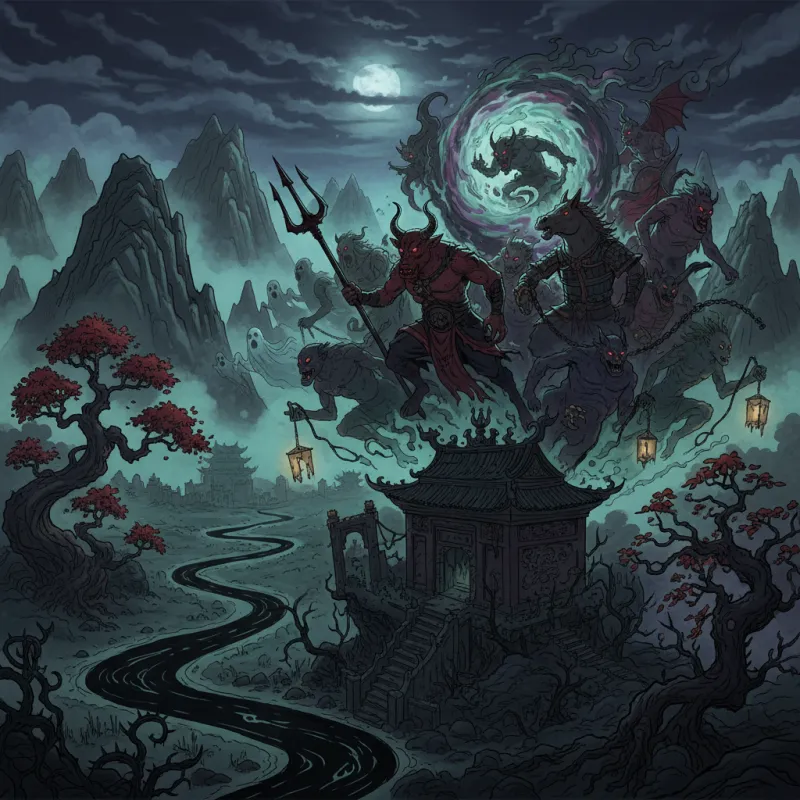
The night watchman's lantern flickered as something brushed past him in the temple courtyard—too cold to be wind, too deliberate to be chance. In that moment between heartbeats, he understood what generations of Chinese storytellers have known: demons aren't just monsters lurking in folklore. They're mirrors held up to human nature, showing us what happens when desire, rage, or ambition breaks free from moral constraints.
The Taxonomy of Darkness: Understanding Gui and Yao
Chinese demonology doesn't use a single catch-all term the way Western traditions do. Instead, it distinguishes between gui (鬼, guǐ)—spirits of the dead who've become malevolent—and yao (妖, yāo)—creatures or objects that have gained supernatural powers through absorbing energy over centuries. This distinction matters because it reveals how Chinese culture views the source of evil: not as an external force, but as a corruption of what once was natural.
The mogui (魔鬼, móguǐ), often translated as "demon," represents a third category influenced heavily by Buddhist concepts that arrived during the Han dynasty. These beings embody pure malevolence, existing to obstruct enlightenment and spread suffering. Unlike gui, who might have legitimate grievances from their mortal lives, mogui are irredeemable—which is precisely why they appear so frequently in tales warning against moral transgression.
The Classic Rogues' Gallery: Demons You Should Know
Jiangshi (僵尸, jiāngshī), the hopping corpse, might be the most recognizable Chinese demon in popular culture, but it's actually a relatively recent addition to the pantheon—most stories date from the Qing dynasty (1644-1912). What makes jiangshi fascinating is their rigid adherence to rules: they hop because rigor mortis has locked their joints, they're repelled by their own reflection, and a simple yellow talisman can freeze them in place. This isn't random superstition; it's a systematic logic that reflects Daoist principles about qi flow and spiritual energy.
The fox spirit or huli jing (狐狸精, húlijīng) occupies a more ambiguous space. After cultivating power for a thousand years, a fox can assume human form—usually that of a beautiful woman. But here's where Chinese demonology gets interesting: fox spirits aren't inherently evil. Stories from "Strange Tales from a Chinese Studio" (聊斋志异, Liáozhāi Zhìyì) by Pu Songling show them as lovers, tricksters, and sometimes even moral teachers. The real demon isn't the fox—it's the human weakness it exposes.
Then there's the nian (年兽, niánshòu), the New Year beast whose legend gave birth to one of China's most important festivals. According to tradition, this creature emerged once yearly to devour crops and villagers until someone discovered it feared the color red, loud noises, and fire. The entire Spring Festival celebration—red decorations, firecrackers, lanterns—is essentially a massive demon-repelling ritual that's been practiced for over two millennia.
Buddhist Demons and the Architecture of Hell
When Buddhism arrived in China during the first century CE, it brought an entire cosmology of demons that Chinese culture absorbed and transformed. The yecha (夜叉, yèchā), derived from the Sanskrit yaksha, became enforcers in the Chinese underworld bureaucracy. Unlike Western demons who rebel against divine order, yecha work within it—they're civil servants of the afterlife, punishing souls according to strict karmic accounting.
This bureaucratic approach to demonology reaches its apex in the Diyu (地狱, dìyù), the Chinese hell. It's not a single pit of torment but an elaborate system of eighteen levels, each administering specific punishments for specific sins. The demons here—ox-headed and horse-faced guards (牛头马面, niútóu mǎmiàn)—aren't sadists. They're administrators ensuring cosmic justice. This reflects a deeply Confucian worldview: even in hell, there's hierarchy, procedure, and paperwork.
The novel "Journey to the West" (西游记, Xīyóujì) showcases this Buddhist-Daoist fusion brilliantly. The demons Sun Wukong battles aren't random monsters—many are fallen celestial beings, animals who've cultivated power, or manifestations of the pilgrims' own spiritual obstacles. When the monk Tripitaka faces demons, he's not just fighting external threats; he's confronting his own doubts, desires, and delusions. For more on how these supernatural beings interact with human society, see Chinese Ghost Culture and Beliefs.
Demons as Social Commentary
Here's what Western audiences often miss: Chinese demon stories are rarely just scary tales. They're pointed social criticism wrapped in supernatural packaging. During the Ming dynasty (1368-1644), when censorship made direct political commentary dangerous, writers used demon narratives to critique corruption, abuse of power, and social injustice.
Take the painted skin demon (画皮, huàpí) from Pu Songling's collection. A beautiful woman is revealed to be a demon wearing a human skin like a costume, painting it fresh each night. On the surface, it's a horror story. Dig deeper, and it's a commentary on superficial beauty, deceptive appearances, and the danger of judging by looks alone—themes that resonated in a society where arranged marriages and social facades were the norm.
The drought demon or hanba (旱魃, hànbá) provides another example. This creature brings devastating droughts wherever it walks, withering crops and drying wells. But hanba legends surge during periods of actual drought and famine, giving people a tangible enemy to blame when the real culprits—government mismanagement, hoarding by the wealthy, or simple bad luck—were too complex or dangerous to confront directly.
Exorcism and Protection: The Practical Response
Chinese culture didn't just tell demon stories—it developed elaborate systems for dealing with demonic threats. The Daoist priest or fangshi (方士, fāngshì) became specialists in demon management, using talismans, ritual swords, and complex ceremonies to banish malevolent entities. These weren't abstract spiritual exercises; they were practical services people paid for, like hiring a plumber to fix a leak.
The peach wood sword (桃木剑, táomù jiàn) remains one of the most iconic demon-fighting tools. Peach wood supposedly contains yang energy that repels yin-heavy entities like ghosts and demons. But notice the logic: demons aren't defeated by pure faith or divine intervention—they're countered by understanding natural principles and applying the right materials. It's almost scientific in its approach. For deeper insights into protective practices, explore Chinese Exorcism Rituals and Practices.
Door gods (门神, ménshén) represent another practical defense. These painted or carved figures of fierce warriors guard entrances, preventing demons from entering homes. The tradition dates back to the Tang dynasty, when Emperor Taizong, plagued by nightmares of demons, had his generals Qin Shubao and Yuchi Gong stand guard outside his bedroom. When this worked, he had their portraits painted on the doors—and a tradition was born.
The Modern Evolution of Chinese Demons
Chinese demons haven't remained frozen in ancient texts. They've evolved with each generation, absorbing new fears and reflecting contemporary anxieties. During the Republican era (1912-1949), demon stories began incorporating elements of Western horror and science fiction. The jiangshi, for instance, gained vampire-like qualities in 1980s Hong Kong cinema, creating a hybrid creature that felt both traditional and modern.
Contemporary Chinese horror films and literature continue this evolution. Demons now haunt apartment buildings instead of mountain temples, possess smartphones instead of mirrors, and navigate urban landscapes rather than rural villages. Yet the core remains: these entities still represent human fears, moral failures, and the consequences of breaking cosmic or social order.
What's particularly interesting is how Chinese demon lore has influenced global pop culture. Video games, anime, and Western fantasy literature increasingly draw on Chinese demonology, often mixing it with other traditions in ways that would baffle traditional scholars but create compelling new mythologies. The qilin (麒麟, qílín), traditionally a benevolent creature, sometimes appears as a demon in Western adaptations—a reminder that cultural translation is never simple.
Why Chinese Demons Still Matter
Understanding Chinese demons isn't just academic exercise or cultural tourism. These stories encode thousands of years of philosophical thought about good and evil, order and chaos, individual responsibility and cosmic justice. They show us a worldview where demons aren't external invaders but natural parts of existence—dangerous, yes, but also comprehensible and manageable through knowledge and proper conduct.
The Chinese approach to demons is ultimately pragmatic. You don't need to be a saint to survive demonic encounters; you need to be smart, prepared, and respectful of the rules governing supernatural interactions. Wear red during New Year, don't whistle at night, respect your ancestors, and keep your moral accounts balanced. Follow these principles, and even in a world full of demons, you'll probably be fine.
That night watchman in the temple courtyard? He knew what to do. He didn't panic or pray desperately. He simply pulled out a peach wood charm, recited the proper formula, and continued his rounds. Because in Chinese folklore, demons are terrifying—but they're also predictable. And predictable threats can be managed, which might be the most comforting thought of all in an uncertain world.
Related Reading
- Chinese Demons: A Taxonomy of Evil in Chinese Mythology
- Jiangshi: The Chinese Hopping Vampire
- Daoist Exorcism: The Art of Banishing Spirits in Chinese Culture
- Unveiling the Shadows: A Journey Through Chinese Supernatural Folklore of Ghosts and Spirits
- Jiangshi: The Hopping Vampires of Chinese Horror
- Mengpo Soup: The Drink That Erases Memory
- Painted Skin: The Most Terrifying Story in Chinese Literature
- Ghost Marriage: When the Dead Need a Spouse
Explore Chinese Culture
- Explore ancient mythical creatures
- Explore Daoist exorcism traditions
- Explore Chinese folk beliefs and superstitions