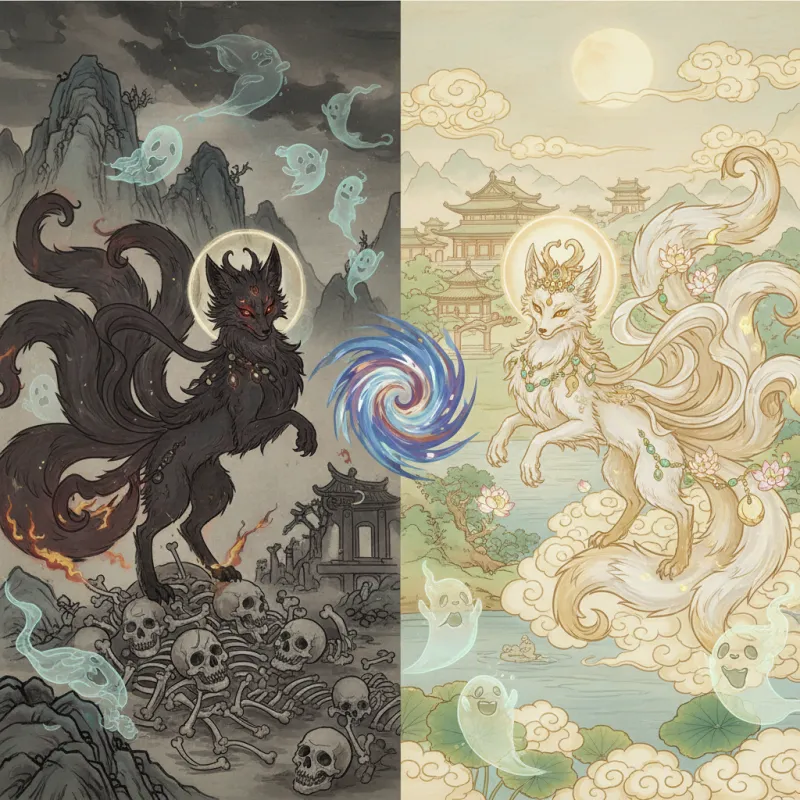
A white fox with nine flowing tails appears in the Classic of Mountains and Seas (Shanhaijing, 山海海经), written sometime between the 4th and 1st centuries BCE, and the text describes it as an auspicious omen. Fast forward a thousand years, and that same creature has become one of Chinese folklore's most notorious seductresses, blamed for toppling dynasties and devouring human hearts. How did a symbol of good fortune transform into a demon so feared that exorcists developed entire rituals specifically to combat fox possession?
The Auspicious Beginning: Fox Spirits in Ancient China
The nine-tailed fox's story begins not in horror, but in hope. The Shanhaijing describes the creature dwelling in the Qingqiu hills, its appearance signaling peace and prosperity for the realm. During the Han Dynasty (206 BCE - 220 CE), the nine-tailed fox (jiǔwěihú, 九尾狐) was explicitly associated with fertility, abundant harvests, and the mandate of heaven. Scholars interpreted its nine tails as representing the nine provinces of China united under virtuous rule.
This positive reputation held for centuries. Early Daoist texts treated fox spirits (húxiān, 狐仙) as potential allies in cultivation practices, beings who had achieved partial immortality through absorbing cosmic energies. The foxes were shape-shifters, yes, but their transformations were seen as evidence of spiritual advancement rather than demonic deception. A fox that could take human form had supposedly cultivated for hundreds of years, making it closer to an immortal than a monster.
But something shifted during the Tang Dynasty (618-907 CE). The stories grew darker.
The Transformation: When Foxes Became Femme Fatales
By the Tang Dynasty, fox spirit tales had taken a decidedly sinister turn. The Extensive Records of the Taiping Era (Taiping Guangji, 太平广记), compiled in 978 CE, contains hundreds of fox spirit stories, and most follow a disturbing pattern: a beautiful woman appears, seduces a scholar or official, and slowly drains his life force through sexual encounters until he dies, withered and exhausted.
What changed? The answer lies partly in Buddhism's growing influence and its emphasis on desire as the root of suffering. Fox spirits became convenient metaphors for sexual temptation and the dangers of unchecked lust. The nine-tailed fox specifically became associated with yāojīng (妖精) — demons who cultivated through stealing human essence rather than through righteous practice.
The most infamous example appears in the 16th-century novel Investiture of the Gods (Fengshen Yanyi, 封神演义). Here, a thousand-year-old nine-tailed fox spirit possesses Daji, the consort of King Zhou of Shang, and orchestrates the dynasty's downfall through increasingly depraved acts of cruelty. She invents torture devices, demands human sacrifices, and manipulates the king into ignoring his duties. When finally defeated by the immortal Jiang Ziya, the fox spirit's true form is revealed — a creature of pure malevolence that had been feeding on human suffering for centuries.
This portrayal stuck. Daji became the archetypal fox demon, and her story was retold, adapted, and referenced in countless works. The nine-tailed fox had completed its transformation from auspicious omen to cautionary tale about feminine wiles and demonic possession.
Fox Cultivation: The Path from Animal to Immortal
Despite their demonic reputation, fox spirits occupied a unique position in Chinese supernatural taxonomy. Unlike hungry ghosts who were trapped in their tormented state, or jiangshi who were merely reanimated corpses, fox spirits were actively pursuing transcendence. They were cultivators, following a path parallel to human Daoist practitioners.
The process, as described in Qing Dynasty (1644-1912) texts, required centuries of dedication. A fox would absorb moonlight, practice breathing exercises, and study human behavior. After 50 years, it could speak. After 100 years, it could take human form, though imperfectly — the tail might remain, or the shadow might reveal the true shape. After 1,000 years, a fox could become a celestial fox (tiānhú, 天狐), essentially an immortal being.
This cultivation framework created moral ambiguity. Was a fox spirit evil for stealing human essence to fuel its transformation, or was it simply following its nature, like a tiger hunting prey? Qing Dynasty scholar Ji Yun, in his collection Random Notes from the Cottage of Close Scrutiny (Yuewei Caotang Biji, 阅微草堂笔记), presents fox spirits as morally complex beings — some virtuous, some wicked, most somewhere in between. He describes encounters where fox spirits help humans, repay kindness, and even fall genuinely in love.
Regional Variations: The Fox Cult of Northern China
While literati in southern China wrote cautionary tales about fox demons, something different was happening in the north. By the Qing Dynasty, fox spirit worship had become a widespread folk practice, particularly in Hebei, Shandong, and Manchuria. Families built small shrines (húxiān táng, 狐仙堂) in their homes, making offerings to fox spirits in exchange for protection, prosperity, and healing.
This "fox cult" treated fox spirits not as demons to be exorcised but as local deities to be propitiated. The spirits were believed to possess shamans, deliver oracles, and cure illnesses. Some families claimed to have hereditary relationships with specific fox spirits that had protected their lineage for generations. The practice was so common that Qing officials periodically attempted to suppress it, viewing it as heterodox and potentially subversive.
The northern fox cult reveals how the nine-tailed fox mythology fractured along class and regional lines. Elite scholars wrote stories about seductive fox demons destroying men's lives, while common people were lighting incense and asking fox spirits to bless their marriages and businesses. The same creature existed simultaneously as demon and deity, depending on who was telling the story.
Modern Interpretations: Reclaiming the Fox Spirit
Contemporary Chinese and East Asian popular culture has embraced the nine-tailed fox with renewed enthusiasm, but often with a revisionist twist. Korean dramas like "My Girlfriend is a Gumiho" and Chinese series like "The Journey of Flower" present fox spirits as sympathetic protagonists, often victims of prejudice rather than villains. The emphasis shifts from the danger they pose to the tragedy of their existence — immortal beings who fall in love with mortals, knowing the relationship is doomed.
This rehabilitation mirrors broader cultural shifts. Feminist scholars have pointed out that the demonization of fox spirits coincided with increasing restrictions on women's autonomy during the Song Dynasty (960-1279 CE) and later periods. The fox demon who seduces and destroys men can be read as a projection of male anxieties about female sexuality and power. By reclaiming the fox spirit as a symbol of independence and transformation, modern retellings challenge those patriarchal narratives.
Japanese culture's kitsune (derived from the same mythological roots) underwent a similar evolution, with Inari fox spirits becoming beloved protective deities. The nine-tailed fox's journey from demon to deity isn't just ancient history — it's an ongoing process of cultural negotiation and reinterpretation.
The Exorcist's Perspective: Combating Fox Possession
Despite modern romanticization, traditional Chinese exorcism manuals took fox possession deadly seriously. The symptoms were distinctive: the victim would exhibit sudden personality changes, speak in a different voice, display knowledge they shouldn't possess, and often develop an insatiable appetite or sexual desire. Unlike possession by vengeful spirits, fox possession was characterized by cunning and manipulation rather than raw rage.
Daoist exorcists developed specific techniques for fox cases. The Ritual of the Thunder Bureau (Leiting Fa, 雷霆法) invoked celestial generals who specialized in subduing animal spirits. Talismans featuring the character for "thunder" (léi, 雷) were particularly effective, as fox spirits supposedly feared thunder above all else. Some exorcists used mirrors, believing that fox spirits couldn't maintain their human disguise when confronted with their reflection.
The most elaborate rituals involved creating a "fox trap" — a ritual space where the spirit would be lured, bound, and either expelled or destroyed. These ceremonies could last for days and required multiple practitioners. The exorcist would negotiate with the fox spirit, sometimes offering it a path to legitimate cultivation if it agreed to leave the victim. Not all fox possessions ended in violence; some ended in bargains.
The Enduring Mystery: Why the Fox?
Why did Chinese culture fixate on foxes specifically as shape-shifting demons? Wolves, tigers, and snakes all appear in folklore, but none achieved the fox's cultural prominence. The answer may lie in the fox's liminal nature — it lives at the boundary between wilderness and civilization, neither fully wild nor domesticated. Foxes were commonly seen near villages and cities, scavenging and adapting to human presence, making them familiar yet unknowable.
Their behavior also seemed uncanny. Foxes are intelligent, solitary, and active at twilight — the boundary time between day and night. They were observed sitting upright, seemingly meditating, which fueled beliefs about their cultivation practices. Their eerie cries at night sounded almost human. Everything about foxes suggested a creature that existed between categories, and Chinese cosmology has always been particularly attentive to boundary-crossers and liminal beings.
The nine-tailed fox, then, represents the ultimate boundary-crosser: between animal and human, demon and deity, destruction and salvation. Its mythology endures because it speaks to fundamental questions about transformation, identity, and the possibility of transcendence. In a culture that values cultivation and self-improvement, the fox spirit's thousand-year journey from animal to immortal resonates as both warning and aspiration — a reminder that the path to enlightenment is long, dangerous, and never quite what it seems.
Related Reading
- Chinese Demons: A Taxonomy of Evil in Chinese Mythology
- Jiangshi: The Chinese Hopping Vampire
- Demons of Journey to the West: The Most Creative Monsters in Chinese Fiction
- Yaoguai: A Classification of Chinese Monsters
- Jiangshi: The Hopping Vampires of Chinese Horror
- The Enigmatic Spirit-Animals of Chinese Supernatural Folklore and Afterlife Beliefs
- Unraveling the Mystique of Chinese Supernatural Folklore and Afterlife Beliefs
- Exploring the Multifaceted World of Chinese Supernatural Folklore and Afterlife Beliefs
Explore Chinese Culture
- Explore ancient mythical creatures
- Explore Daoist exorcism traditions
- Explore Chinese folk beliefs and superstitions