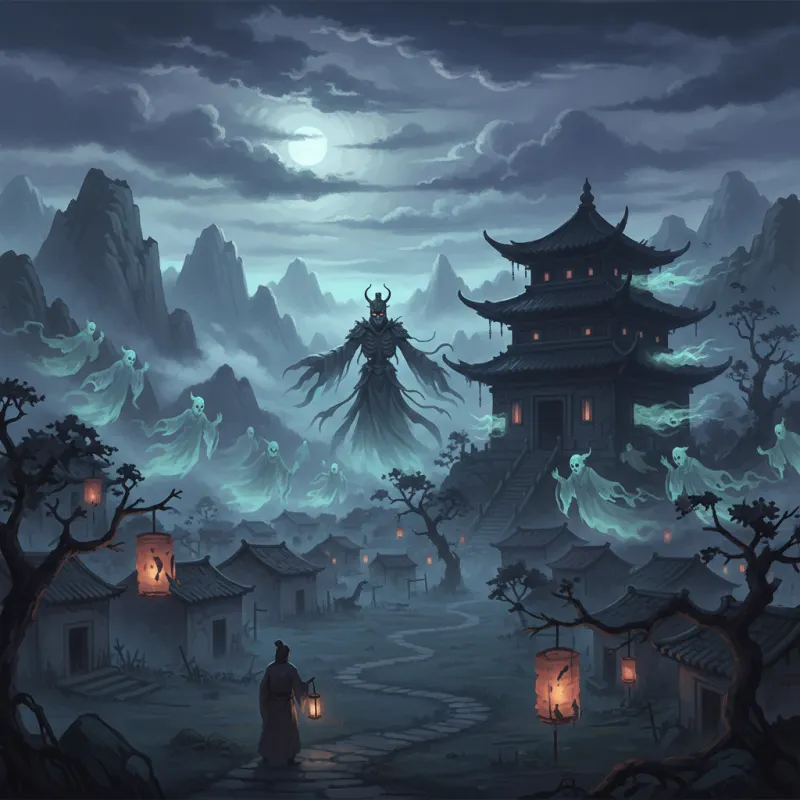
The old woman's fingers trembled as she placed three sticks of incense before the ancestral altar, whispering urgently to spirits only she could see. Her grandson watched from the doorway, caught between two worlds—the rational modernity of his smartphone and the ancient certainty in his grandmother's voice. This scene plays out across China even today, a living testament to supernatural beliefs that have survived dynasties, revolutions, and the relentless march of progress. Chinese ghost lore isn't just folklore gathering dust in academic journals; it's a breathing tradition that has shaped how millions understand death, morality, and the invisible forces that walk beside us.
The Architecture of the Spirit World
Chinese cosmology doesn't simply divide existence into "living" and "dead." Instead, it constructs an elaborate bureaucracy of the afterlife that mirrors earthly government with unsettling precision. The realm of spirits operates under Yanluo Wang (閻羅王, Yánluó Wáng), the King of Hell, who presides over ten courts of judgment, each specializing in particular sins. This isn't the fire-and-brimstone eternity of Western tradition—it's a processing system where souls are evaluated, punished proportionally, and eventually recycled back into the world of the living through reincarnation.
What makes this system fascinating is its fundamental assumption: the dead still need money, food, and bureaucratic paperwork. During Qingming Festival (清明節, Qīngmíng Jié) and Ghost Month, families burn elaborate paper offerings—not just money, but paper iPhones, luxury cars, and even paper mistresses for deceased patriarchs. This practice reveals a core belief that death doesn't fundamentally change human nature or needs. The dead remain entangled with the living, capable of blessing or cursing their descendants based on how well they're maintained.
Gui: When the Dead Refuse to Rest
The Chinese ghost, or gui (鬼, guǐ), is fundamentally different from its Western counterpart. While Western ghosts often haunt because of unfinished business or trauma, gui exist in a more complex moral landscape. A person becomes a gui when they die violently, prematurely, or without proper burial rites—but also when their descendants fail to perform ancestral worship. This creates a reciprocal obligation: the living must care for the dead, or risk their wrath.
The most feared category is the yuangui (冤鬼, yuānguǐ), or "wronged ghost," someone who died unjustly and seeks vengeance. These spirits appear throughout classical literature, from the Strange Tales from a Chinese Studio (聊齋誌異, Liáozhāi Zhìyì) by Pu Songling in the 17th century to modern horror films. Unlike the transparent, sheet-wearing specters of Western imagination, Chinese ghosts often appear disturbingly corporeal—beautiful women who seduce men to death, or pale figures whose feet don't touch the ground, the only sign of their supernatural nature.
The hungry ghost, or egui (餓鬼, èguǐ), represents another category entirely. These are beings trapped in a state of perpetual craving, with needle-thin throats and bloated bellies, unable to satisfy their hunger. They're not evil so much as pitiable, suffering the consequences of greed or gluttony in life. The entire Ghost Month (鬼月, Guǐ Yuè), the seventh lunar month, is dedicated to feeding these desperate spirits, lest they cause mischief or harm to the living.
Fox Spirits and the Seduction of Boundaries
If gui represent the human dead, then the huli jing (狐狸精, húli jīng), or fox spirit, embodies something more ambiguous—a creature that exists between animal and human, between nature and civilization. Fox spirits can cultivate themselves over centuries, gaining the ability to transform into beautiful women (occasionally men) who seduce scholars and drain their yang essence. Yet they're not simply villains. In Pu Songling's tales, fox spirits often display more loyalty and genuine affection than human women, challenging Confucian assumptions about the superiority of human relationships.
The fox spirit's ambiguity reflects deeper anxieties about female sexuality and power in traditional Chinese society. These creatures are almost always depicted as female when interacting with humans, and their danger lies in their ability to blur boundaries—between human and animal, between proper wife and seductress, between the domestic sphere and the wild. Some fox spirits seek to become human through accumulating virtue, while others revel in their supernatural nature. The most famous, Daji (妲己, Dájǐ) from the Investiture of the Gods (封神演義, Fēngshén Yǎnyì), possessed the concubine of the last Shang Dynasty emperor and orchestrated the dynasty's collapse through her cruel innovations in torture and debauchery.
Jiangshi: The Hopping Dead
Perhaps no Chinese supernatural creature has captured modern imagination quite like the jiangshi (僵屍, jiāngshī), the "stiff corpse" that hops because rigor mortis has locked its joints. These creatures emerged from Qing Dynasty folklore and exploded into popular culture through 1980s Hong Kong cinema. Unlike Western zombies driven by mindless hunger, jiangshi follow specific rules: they're repelled by their own reflection, by chicken blood, by sticky rice, and most famously, by yellow Taoist talismans pasted on their foreheads.
The jiangshi represents anxieties about improper burial and the failure of filial piety. These creatures typically arise when a corpse is reanimated through dark magic or when someone dies far from home and their body must be transported back for burial. Taoist priests developed elaborate rituals for "corpse driving" (趕屍, gǎnshī), supposedly guiding the dead to hop home at night, hidden from living eyes. Whether this practice ever truly existed or was always folklore is debated, but it speaks to the profound importance of being buried in one's ancestral land.
The Exorcist's Toolkit
Confronting Chinese supernatural entities requires specialized knowledge that blends religious practice, folk magic, and bureaucratic procedure. The Taoist priest, or daoshi (道士, dàoshì), serves as the primary supernatural troubleshooter, armed with an arsenal of tools and techniques. The peachwood sword (桃木劍, táomù jiàn) can strike spirits without harming the living. Yellow talismans inscribed with vermillion ink contain written commands that compel obedience from ghosts and demons. Mirrors reflect supernatural creatures' true forms, while glutinous rice absorbs negative energy.
But the most powerful weapon is knowledge of the supernatural bureaucracy itself. A skilled exorcist doesn't simply banish spirits—they file complaints with celestial officials, invoke the authority of higher deities, and essentially lawyer their way through the spirit world. This legalistic approach to the supernatural appears throughout Chinese ghost stories, where clever protagonists often escape danger by citing obscure regulations or appealing to higher authorities in the afterlife's chain of command. It's a uniquely Chinese approach that assumes even chaos must follow proper procedure.
The relationship between exorcist and spirit isn't always antagonistic. Many tales feature negotiations, where spirits explain their grievances and exorcists help resolve the underlying injustice. A ghost haunting a household might simply need their murderer exposed, or require their descendants to perform neglected rituals. This problem-solving approach treats supernatural encounters as puzzles to be solved rather than evil to be destroyed, reflecting Confucian emphasis on harmony and proper relationships even extending beyond death.
Living Traditions in Modern China
Walk through any Chinese city today and you'll find these ancient beliefs adapting to modern life. Apartment buildings skip the fourth floor because "four" (四, sì) sounds like "death" (死, sǐ). Families still burn paper offerings, though now they might include paper credit cards and paper stock certificates. Ghost Month still sees reduced business activity, with many avoiding major purchases, surgeries, or weddings during this inauspicious period.
The Communist Party's official atheism has paradoxically preserved these traditions by pushing them into the private sphere, where they've remained largely unchanged. Young people who claim not to believe in ghosts still avoid whistling at night (it attracts spirits) and refuse to stick chopsticks upright in rice (it resembles incense offerings to the dead). These practices persist not as conscious religious observance but as cultural muscle memory, habits so deeply ingrained they've become invisible.
Modern Chinese horror films and literature continue mining these traditional beliefs, often with sophisticated psychological depth. Films like "The Eye" and "Rigor Mortis" don't simply use ghosts for jump scares—they explore how supernatural beliefs reflect contemporary anxieties about urbanization, family breakdown, and the loss of traditional values. The gui of modern cinema often represents not ancient evil but modern alienation, the sense that rapid change has severed connections between living and dead, past and present.
The Enduring Shadow
Chinese supernatural folklore endures because it addresses fundamental human concerns that transcend culture and era: What happens after death? How do we maintain connections with those we've lost? What obligations do we owe to the past? These aren't questions that modernity has answered satisfactorily, which is why even educated, urban Chinese maintain practices their rational minds might question.
The genius of Chinese ghost lore lies in its practicality. It doesn't demand blind faith but offers a transactional relationship with the supernatural—perform the proper rituals, maintain the correct relationships, and you'll be protected. Break the rules, neglect your duties, and face consequences. This framework has proven remarkably durable, adapting to Buddhism, surviving Confucian rationalism, and persisting through Communist materialism. The shadows remain, waiting patiently for those who remember to look.
For those interested in exploring related topics, consider reading about Chinese demon hierarchies and classifications or the role of Taoist exorcism in traditional Chinese society. The supernatural world of Chinese folklore is vast, interconnected, and endlessly fascinating—much like the culture that created it.
Related Reading
- Demons of Journey to the West: The Most Creative Monsters in Chinese Fiction
- Jiangshi: The Chinese Hopping Vampire
- The Nine-Tailed Fox: From Demon to Deity
- Yaoguai: A Classification of Chinese Monsters
- Types of Chinese Demons: A Field Guide to Supernatural Beings
- Modern Spirit Mediums in Taiwan: Where Gods Still Talk Through People
- The Underworld Courts: How Chinese Hell Judges the Dead
- Taoist Exorcism: Methods of Spirit Removal
Explore Chinese Culture
- Explore ancient mythical creatures
- Explore Daoist exorcism traditions
- Explore Chinese folk beliefs and superstitions