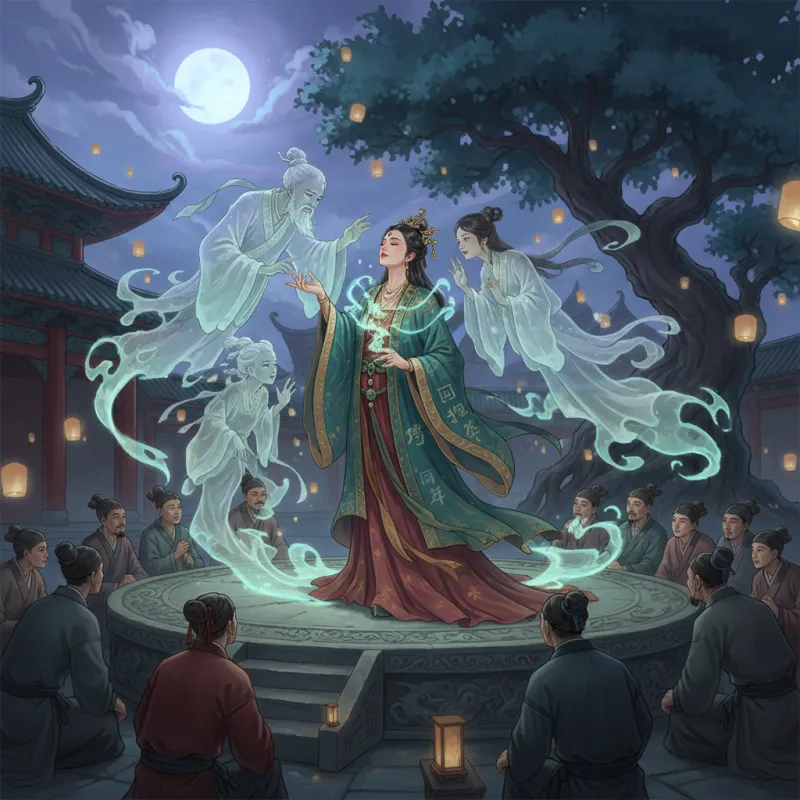
The woman's eyes roll back until only the whites show. Her body jerks once, twice, then goes rigid. When she speaks again, the voice is different — deeper, rougher, speaking in a dialect she doesn't know when conscious. Her husband is back, she tells the weeping daughter across the table. He has something to say about the inheritance.
This is Tuesday afternoon in a temple in Singapore. Wednesday will bring more sessions in Taipei. Thursday, perhaps Los Angeles or Vancouver. Wherever Chinese communities gather, spirit mediums — known as jitong (乩童), tangki, or simply wu (巫) — continue a practice that predates Confucius by a thousand years.
The Ancient Lineage of the Wu
Oracle bones don't lie. The earliest Chinese writing we possess — questions carved into turtle shells and ox scapulae during the Shang Dynasty (1600-1046 BCE) — records consultations with the dead. But someone had to ask those questions, and someone had to interpret the cracks that appeared when the bones were heated. Those someones were the wu, shamans who straddled the boundary between the living world and whatever lay beyond.
The character 巫 itself is revealing. In its oldest forms, it depicts a figure with arms outstretched, connecting heaven and earth. Some scholars see dancing. Others see a body in trance. Both interpretations work. The wu were performers, yes, but performers of a specific function: channeling spirits, ancestors, and gods into their own flesh.
By the Zhou Dynasty (1046-256 BCE), the wu had become institutionalized. The Zhouli (周禮), a text describing Zhou governmental structure, lists official positions for male and female spirit mediums. They performed rainmaking rituals, exorcisms, and ancestral consultations. They were, in effect, civil servants of the supernatural.
Then Confucius happened. The great sage had little patience for spirit mediums, preferring ritual propriety to ecstatic trance. "Respect ghosts and spirits," he advised, "but keep them at a distance." His followers took this further, and by the Han Dynasty (206 BCE-220 CE), elite Chinese culture had largely turned away from shamanic practices. The wu didn't disappear — they just moved to the margins, to rural villages and folk temples, where they've remained ever since.
The Mechanics of Channeling
Watch a spirit medium work and you'll see why Confucian scholars found the practice unsettling. There's nothing orderly about it. The medium — often but not always male, despite the feminine associations of the character 巫 — begins by preparing the space. Incense, offerings of food and spirit money, perhaps some ritual implements. A sword, a spiked ball, a palanquin chair.
Then comes the invitation. The medium calls the spirit, sometimes through chanting, sometimes through self-mortification. In southern Chinese and Southeast Asian traditions, mediums in full trance will pierce their cheeks with skewers, cut their tongues with swords, or strike themselves with spiked clubs. The blood is real. The pain, they say, is not — or rather, it belongs to the body, and the body is temporarily vacated.
What happens next depends on who shows up. Sometimes it's an ancestor with specific advice for descendants. Sometimes it's a deity — the Third Prince (Santaizi, 三太子), the Monkey King (Sun Wukong, 孫悟空), or Guan Gong (關公), the deified general — who speaks through the medium to address community concerns. The voice changes. The posture changes. A 60-year-old grandmother might suddenly move with the swagger of a warrior god.
The medium in trance typically doesn't remember what was said. That's what the assistants are for — interpreters who translate the often-garbled spirit speech, record the messages, and ensure the medium doesn't injure themselves too severely. It's a team effort, this business of channeling the dead.
Regional Variations and Modern Practice
Spirit mediumship isn't monolithic. A tangki in Singapore operates differently from a jitong in Taiwan, who differs from a wu in rural Fujian. The southern traditions, influenced by centuries of maritime trade and cultural mixing, tend toward the dramatic — elaborate costumes, violent self-mortification, public performances during temple festivals. Northern traditions are often quieter, more private, closer to the ancient shamanic roots.
In Taiwan, where folk religion thrives despite decades of modernization, spirit mediums remain integrated into community life. They're consulted for everything from business decisions to marriage compatibility to locating lost objects. Some temples have resident mediums who hold regular office hours. Yes, office hours. You can book an appointment, show up at the scheduled time, and have your consultation with the dead as routinely as seeing a dentist.
The practice has followed Chinese diaspora communities worldwide. In Malaysia and Singapore, tangki perform during the Nine Emperor Gods Festival, their bodies pierced and bleeding as they parade through streets lined with devotees. In San Francisco's Chinatown, quieter consultations happen in temple back rooms. The forms adapt, but the function persists.
Technology has changed some aspects. Mediums advertise on social media. Consultations happen over video calls. But you can't Zoom a trance state, not really. The physical presence matters — the incense smoke, the altar, the medium's body as a vessel. Some things resist digitization.
Skepticism and Belief
Let's address the obvious question: Is it real? Are these mediums actually channeling spirits, or is it performance, delusion, or fraud?
The skeptical explanation is straightforward. Trance states are well-documented psychological phenomena. Dissociation, suggestibility, cultural conditioning — these can produce altered consciousness without requiring supernatural intervention. The medium believes they're channeling spirits, the clients believe it, and the shared belief creates a powerful psychological experience. Add in some cold reading techniques (the medium picks up cues from the client's questions and body language) and you have a complete naturalistic explanation.
But here's what the skeptical explanation struggles with: the specificity. Mediums sometimes relay information they couldn't have known — names, dates, details about deceased family members that the client never mentioned. Coincidence? Shrewd observation? Perhaps. But it happens often enough to give even skeptics pause.
The anthropologist's answer is more nuanced: It doesn't matter. What matters is that spirit mediumship serves a function. It provides comfort to the grieving, guidance to the uncertain, and a sense of connection to ancestors and tradition. It's a form of Chinese folk religion that addresses psychological and social needs that official religions often neglect.
From inside the tradition, the question of "real or fake" misses the point entirely. Of course it's real. The spirits are present, the ancestors speak, the gods descend. This isn't metaphor or symbol — it's lived experience, validated by centuries of practice and millions of consultations.
The Spirit Medium in Literature and Film
Chinese supernatural fiction has always known what to do with spirit mediums. They appear in Strange Tales from a Chinese Studio (Liaozhai Zhiyi, 聊齋誌異), Pu Songling's 18th-century collection of ghost stories, usually as minor characters who confirm that yes, that beautiful woman is actually a fox spirit, or no, that's definitely your dead uncle causing trouble.
In modern horror cinema, spirit mediums serve a similar function. They're the experts who explain what's happening, the ones who know the rituals and can potentially fix the supernatural problem. Think of the medium in The Eye (2002) who helps the protagonist understand her ghost-seeing cornea transplant, or the various tangki and Taoist priests who appear in Southeast Asian horror films to battle demons and malevolent spirits.
But the most interesting portrayals show the cost of mediumship. Being a vessel for spirits isn't glamorous. It's physically demanding, socially marginal, and often hereditary — passed down through families who didn't necessarily choose this path. The medium in Incantation (2022) carries the weight of forbidden knowledge and ritual responsibility. This feels truer to the actual practice than the wise, all-knowing mystic stereotype.
The Future of an Ancient Practice
Will spirit mediums still exist in another hundred years? The smart money says yes. Modernization hasn't killed the practice — if anything, the dislocations of modern life create more need for connection to ancestors and tradition. Chinese communities in diaspora often maintain folk religious practices more vigorously than communities in mainland China, where decades of official atheism disrupted but didn't destroy these traditions.
The form will continue evolving. Already, younger mediums are adapting the practice, sometimes toning down the self-mortification, sometimes incorporating elements from other spiritual traditions. Some frame their work in psychological terms, talking about channeling as accessing the collective unconscious rather than literal spirit possession. Others double down on tradition, insisting that the old ways must be preserved exactly.
What seems certain is that as long as people have questions for the dead, someone will offer to ask them. The technology of spirit mediumship — the trance, the channeling, the message from beyond — has proven remarkably durable across three millennia. It survived the Confucian scholars, the Communist revolution, and the internet age. It'll probably survive whatever comes next.
The woman's eyes flutter open. She's back in her own body, exhausted, with no memory of what her mouth just said. But the daughter across the table is crying, this time with relief. She got her answer. Her father's voice, speaking through a stranger's throat, told her what she needed to hear.
Tuesday afternoon in Singapore. The dead are still talking. The living are still listening. And the mediums, as always, stand between.
Related Reading
- Shamanism in Chinese Folk Religion: The Original Spirit Workers
- Spirit Writing: Fuji Divination and Messages from the Gods
- The Tongji: Spirit Mediums of Southeast Asia's Chinese Communities
- Modern Spirit Mediums in Taiwan: Where Gods Still Talk Through People
- The Chinese Afterlife Is a Bureaucracy (And That Tells You Everything)
- The Most Haunted Temples in China: Ghost Stories from Sacred Ground
- River Gods and Water Deities in Chinese Mythology
Explore Chinese Culture
- Explore ancient mythical creatures
- Explore Daoist exorcism traditions
- Explore Chinese folk beliefs and superstitions