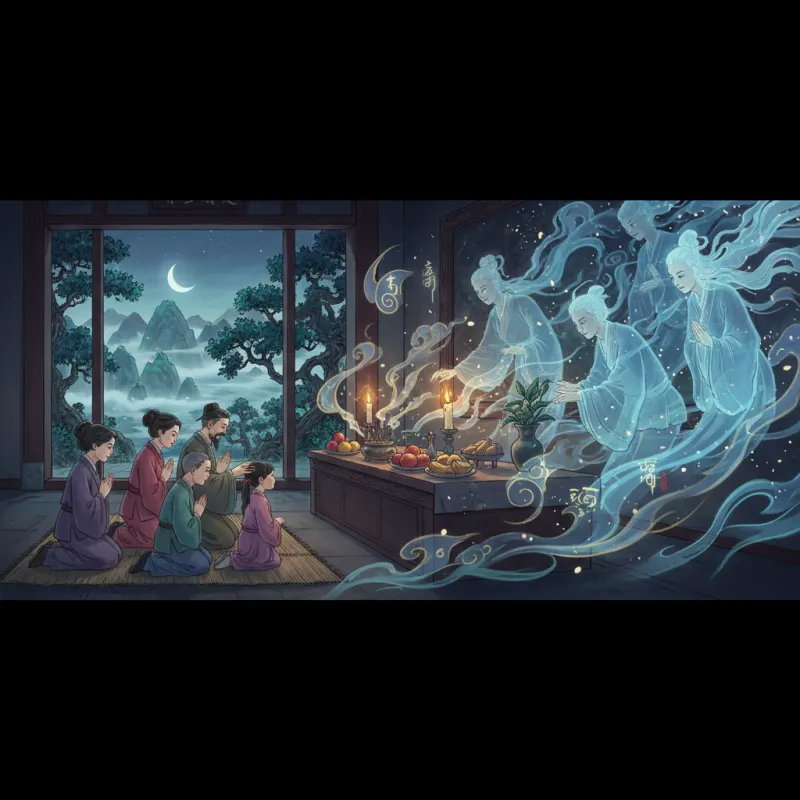
Your grandmother has been dead for fifteen years, but she still expects her favorite dishes on her birthday. Miss the offering, and don't be surprised when your business deal falls through next week. In Chinese tradition, death doesn't sever family obligations — it transforms them into a contract that binds the living and the dead in mutual dependence.
The Underworld Is Just Another Bureaucracy
When someone dies in Chinese cosmology, they don't vanish into abstract eternity. They relocate to 阴间 (yīnjiān, the underworld), where they face the same needs they had in life: hunger, thirst, money troubles, and bureaucratic red tape. The Ten Courts of Hell process souls like a celestial DMV, complete with judges, clerks, and endless paperwork. Your ancestors need you to send them resources — and in return, they're expected to pull strings on your behalf from the other side.
This isn't poetry. It's a transaction. Ancestor worship (祭祖, jìzǔ) operates on the principle of reciprocal obligation that defines Chinese social relationships. You feed them, they protect you. You burn paper money for them, they ensure your crops don't fail. Neglect them, and they become 饿鬼 (èguǐ, hungry ghosts) — resentful, starving spirits who cause misfortune for the living. The Hungry Ghost Festival exists precisely because the Chinese understand that neglected dead are dangerous dead.
Oracle bone inscriptions from the Shang Dynasty (1600–1046 BCE) prove this practice predates written Chinese history. Kings didn't just honor their ancestors — they consulted them on military strategy, asked permission before major decisions, and blamed them when things went wrong. The bones were heated until they cracked, and diviners read the ancestors' responses in the fracture patterns. Three millennia later, families still ask ancestors for lottery numbers and business advice, though now they use incense smoke and divination blocks instead of tortoise shells.
The Altar Is a Portal, Not a Memorial
Walk into any traditional Chinese home and you'll find the ancestor altar (神龛, shénkān) — usually positioned in the main hall, facing the entrance. This isn't decorative. It's functional infrastructure. The altar maintains an open channel between worlds, marked by incense smoke that carries prayers upward and ancestral blessings downward.
The tablets (牌位, páiwèi) aren't symbolic representations. They are the ancestors, or at least their temporary dwelling places when they visit. Each tablet bears the deceased's name, birth and death dates, and sometimes their photograph. During offerings, the family announces each dish aloud, inviting specific ancestors to eat. The food sits until the incense burns down — the time required for spirits to consume the essence (气, qì) of the meal. Afterward, the living eat the physical remains. Nothing is wasted in this economy.
Offerings follow strict hierarchies. The most recent dead receive the most attention, especially during the first three years when their souls are considered unstable and potentially dangerous. Older ancestors get less frequent offerings but more respect. Some families maintain records going back ten or fifteen generations, though most focus on the three or four most recent. The very ancient ancestors merge into a collective category of "all our honored dead," receiving group offerings rather than individual attention.
Qingming Festival: The Annual Audit
清明节 (Qīngmíng Jié, Tomb Sweeping Day) in early April is when the contract gets renewed. Families travel to ancestral graves, clean the tombstones, pull weeds, and present elaborate offerings. This isn't optional. Skipping Qingming signals to your ancestors — and your living relatives — that you've abandoned your responsibilities.
The ritual follows a precise sequence. First, clean the grave site. Neglected graves suggest neglected ancestors, which reflects poorly on the entire family line. Second, present food offerings: whole chickens, fish, fruit, rice wine. Third, burn paper goods: hell money (冥币, míngbì), paper houses, paper cars, even paper smartphones in recent years. The logic is straightforward — whatever burns in this world materializes in the next. Fourth, kowtow three times. Fifth, set off firecrackers to scare away malevolent spirits who might steal the offerings.
Some families bring entire feasts to the graveyard, complete with portable stoves to cook fresh food on-site. Others hire professional mourners to wail dramatically, demonstrating the family's grief to any watching spirits. The most important element is presence. Your physical body at the grave proves you haven't forgotten. The dead notice who shows up and who doesn't.
Paper Money and the Afterlife Economy
The practice of burning paper offerings (烧纸, shāozhǐ) reveals the materialist core of Chinese ancestor worship. The underworld operates on the same economic principles as the living world — you need money to bribe officials, buy food, and maintain social status. Families burn stacks of hell money in denominations that would make hyperinflation economists weep: billion-dollar notes are common, trillion-dollar notes available for the especially devoted.
But currency is just the beginning. Specialty shops sell paper versions of everything: mansions with multiple floors, luxury cars with drivers, designer handbags, credit cards, even mistresses and servants. One shop in Hong Kong offers paper iPhones, complete with paper chargers and paper AirPods. The assumption is that the afterlife mirrors contemporary life, just on a different plane of existence.
Critics call this superstition. Practitioners call it insurance. Why risk your ancestors suffering in poverty when a few dollars of paper goods guarantees their comfort? The Ghost Month traditions extend this logic to all wandering spirits, not just family members, recognizing that the boundary between the living and dead is permeable and requires constant maintenance.
When Ancestors Become Angry
Neglected ancestors don't suffer in silence. They send messages: persistent illness, financial troubles, nightmares, accidents. Chinese families experiencing a run of bad luck often consult a spirit medium (灵媒, língméi) or fortune teller to determine which ancestor feels slighted and what offering will appease them.
The most dangerous situation is when an ancestor dies violently or prematurely — murder, suicide, accident, or death in childbirth. These souls become 冤魂 (yuānhún, wronged spirits) who cannot rest until their grievances are addressed. They're not evil, just stuck. They need their descendants to perform specific rituals, burn specific offerings, or even solve the circumstances of their death before they can move on to reincarnation.
Some families discover they've been making offerings to the wrong ancestors for generations. A spirit medium might reveal that Great-Grandfather's tablet has the wrong death date, or that a forgotten aunt who died young has been causing problems because no one remembers to include her in offerings. The solution is always the same: correct the error, make amends, restore the proper relationship.
The Filial Piety That Never Ends
Ancestor worship is the ultimate expression of 孝 (xiào, filial piety) — the Confucian virtue that defines proper family relationships. But unlike Western concepts of honoring parents, xiào doesn't end at death. It intensifies. The living owe the dead everything: their existence, their family name, their social position. This debt can never be fully repaid, only serviced through regular offerings and proper ritual.
This creates a chain of obligation stretching backward through time. You serve your parents and grandparents, who served their parents and grandparents, in an unbroken line back to the mythical founders of your clan. Break the chain, and you don't just dishonor your immediate family — you betray every ancestor who maintained the tradition before you.
Modern Chinese people, even those who consider themselves secular or Christian, often maintain some form of ancestor worship. They might not believe their grandmother's spirit literally eats the offerings, but they perform the rituals anyway. The practice has become cultural identity as much as religious belief. To abandon ancestor worship is to declare yourself not-Chinese, to cut yourself off from the family tree.
The Dead Are Better Connected Than the Living
Here's what makes ancestor worship more than superstition: it works as a social technology. Families that maintain strong ancestor worship traditions tend to have stronger kinship networks, better intergenerational wealth transfer, and more robust mutual aid systems. The rituals force families to gather regularly, maintain genealogical records, and coordinate resources across generations.
The ancestors serve as neutral arbiters in family disputes. When living relatives disagree about property division or business decisions, they can appeal to "what the ancestors would want" — a face-saving way to negotiate without direct confrontation. The dead become diplomatic tools for the living.
And sometimes, people report genuine experiences: dreams where deceased relatives offer advice, sudden intuitions that prevent disasters, coincidences too precise to dismiss. Whether these are actual ancestral interventions or psychological phenomena doesn't matter to practitioners. The system functions either way.
Keeping the Contract Current
Ancestor worship adapts to modern life while maintaining its core logic. Families separated by migration use video calls to coordinate offerings across time zones. Some burn digital representations of paper goods, uploading images to websites that promise to transmit them to the underworld. Others maintain virtual ancestor altars on their phones, complete with digital incense and prayer counters.
The practice persists because it addresses a fundamental human need: the desire to maintain relationships with the dead. Western cultures struggle with this, treating death as absolute severance and grief as something to "get over." Chinese culture offers an alternative — the dead remain present, active, and engaged. They attend family dinners, witness marriages, meet new grandchildren. They're not gone. They're just in another room, waiting for you to remember them.
Your ancestors are watching. Have you fed them lately?
Related Reading
- Chinese Funerals: A Complete Guide to Death Customs and Rituals
- Qingming Festival: When China Visits Its Dead
- Unveiling Chinese Supernatural Folklore: Ghosts, Spirits, and Afterlife Beliefs
- Joss Paper: Burning Money for the Dead
- Chinese Death Customs That Surprise Westerners
- Daoist Exorcism Rituals Explained: How to Kick Out a Demon the Chinese Way
- Unveiling the Mysteries of Chinese Supernatural Folklore: Ghosts and Afterlife Beliefs
- Cursed Objects in Chinese Folklore: Things You Should Never Touch
Explore Chinese Culture
- Explore ancient mythical creatures
- Explore Daoist exorcism traditions
- Explore Chinese folk beliefs and superstitions