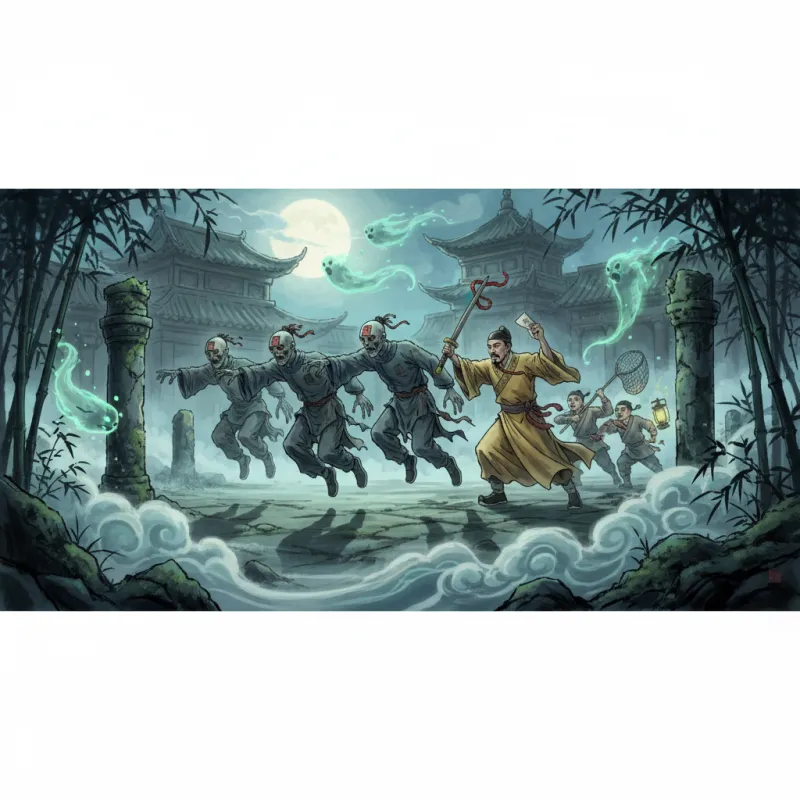
Picture this: a corpse in a Qing dynasty official's robe, arms stretched stiff in front of its body, bouncing toward you in the moonlight like some unholy pogo stick. It can't bend its knees. It can't turn its head. But it's fast, relentless, and hungry for your life force. This is the jiangshi (僵尸, jiāngshī) — China's hopping vampire — and for two glorious decades, it dominated Hong Kong cinema like no other monster before or since.
The Corpse That Couldn't Bend
The jiangshi isn't your typical vampire. Forget the suave European aristocrat in a cape. This creature is rigor mortis given malevolent purpose. The character 僵 (jiāng) literally means "stiff" or "rigid," and that's the jiangshi's defining trait: a reanimated corpse so inflexible it can only move by hopping. Arms outstretched, dressed in the formal robes of a Qing official (usually with that distinctive round hat), it pursues victims with single-minded determination.
What makes the jiangshi terrifying isn't fangs or superhuman strength — it's the wrongness of it. A human body moving in a way human bodies shouldn't move. The folklore origins trace back to rural China, where corpse carriers (赶尸人, gǎnshīrén) allegedly transported bodies back to their ancestral homes for proper burial. These corpse herders would travel at night, ringing bells, while the bodies "hopped" behind them in formation. Whether this practice was real or exaggerated folklore is debatable, but the image stuck: the dead, moving stiffly through the darkness, going home.
The jiangshi feeds on qi (气, qì) — life force or vital energy — which it typically absorbs through breath rather than blood. Get too close and it'll inhale your essence, leaving you a withered husk. Some versions drain through touch. The creature is blind, tracking victims by sensing their breath, which is why holding your breath is a common defense in jiangshi stories. It's also why Taoist priests use yellow paper talismans (符, fú) inscribed with spells — slap one on the jiangshi's forehead and it freezes, its qi disrupted.
Mr. Vampire and the Birth of a Genre
Hong Kong's jiangshi craze didn't emerge from ancient folklore alone. It exploded in 1985 with a single film: Mr. Vampire (僵尸先生, Jiāngshī Xiānsheng), directed by Ricky Lau. This wasn't the first jiangshi film — that honor goes to The Vampire (1936) — but Mr. Vampire perfected the formula: equal parts horror, comedy, martial arts, and Taoist mysticism.
The plot is wonderfully absurd. A Taoist priest (played by Lam Ching-ying, who became the face of the genre) runs a funeral business. When he's hired to relocate a wealthy man's father's grave, they discover the corpse has become a jiangshi. Chaos ensues. The priest's bumbling assistants get into trouble. There's a romance subplot with a female ghost. Someone gets bitten and starts transforming. And through it all, jiangshi hop menacingly through the frame while the priest battles them with sticky rice (which draws out corpse poison), chicken blood (which repels evil), and those yellow paper talismans.
Mr. Vampire was a massive hit, spawning four official sequels and countless imitators. By the late 1980s, Hong Kong was producing dozens of jiangshi films annually. The genre became a playground for Hong Kong's unique cinematic sensibilities: slapstick comedy, wire-fu action, supernatural horror, and that distinctly Cantonese irreverence toward tradition. You'd get genuine scares followed immediately by pratfalls. A tense exorcism ritual interrupted by someone's pants falling down.
What made these films work was their internal logic. The jiangshi had rules. They couldn't cross lines of sticky rice. They froze when you held your breath. Mirrors confused them. A rooster's crow could stop them. These weren't arbitrary — they drew from actual Taoist folk practices and Chinese funeral customs. The films took their supernatural elements seriously even while playing them for laughs, creating a tone that Western horror rarely attempted: you could be scared and amused simultaneously without either emotion undercutting the other.
The Taoist Priest as Action Hero
Lam Ching-ying's character in Mr. Vampire — the stern, skilled Taoist priest — became the archetype for the genre. He wasn't a scholar or a monk. He was a working-class exorcist, part funeral director, part martial artist, part spiritual warrior. He wore traditional robes but moved like a kung fu master. He performed elaborate rituals with absolute seriousness while his assistants bungled everything around him.
This character type tapped into something deep in Hong Kong culture: respect for traditional knowledge combined with modern skepticism. The priest represented old wisdom that still worked in the contemporary world. His methods looked ridiculous — hopping around, throwing rice, waving swords — but they were effective. In an era when Hong Kong was rapidly modernizing, these films suggested that traditional practices still had power, even if that power looked absurd to modern eyes.
The priest's relationship with his assistants also mattered. They were usually young, foolish, and skeptical of the old ways — until a jiangshi started chasing them. Then suddenly those ancient rituals didn't seem so silly. This dynamic played out in film after film: modernity encountering tradition, skepticism meeting belief, and discovering that maybe grandpa's superstitions weren't entirely wrong. For more on how Taoist practices intersect with supernatural defense, see Chinese Exorcism Rituals and Taoist Magic.
Why Hopping? The Genius of Constraint
The jiangshi's hopping movement seems like a limitation, but it's actually brilliant design. Constraint breeds creativity. Because the jiangshi can't bend, every scene requires choreography. How does it navigate stairs? How does it chase someone through a narrow corridor? How do you fight something that moves in unpredictable bounces?
Hong Kong filmmakers turned these limitations into spectacle. Jiangshi would hop in formation, creating an army of synchronized corpses. They'd bounce off walls, ricochet around corners, leap impossible distances. The stiffness made them both comical and unsettling — they moved wrong, and that wrongness was amplified by the hopping. A slow zombie shuffle is creepy. A rapid, bouncing corpse is nightmare fuel.
The hopping also created unique fight choreography. You couldn't just punch a jiangshi — it would hop away. You had to time your attacks, predict its bounces, use its rigidity against it. Battles became elaborate dances, with priests and jiangshi bouncing around each other in increasingly absurd patterns. Wire work made these sequences even more spectacular, with fighters and monsters defying gravity in ways that felt magical rather than merely cinematic.
And there's something primal about the hopping. It's how children move when they're pretending to be monsters. It's unnatural but recognizable. The jiangshi taps into that childhood fear of things that move wrong — the way a spider's skitter or a bird's hop can trigger instinctive revulsion. The jiangshi is that feeling amplified: a human-shaped thing moving in a distinctly inhuman way.
The Genre's Golden Age and Decline
Between 1985 and 1992, Hong Kong produced over 100 jiangshi films. Every studio wanted their own Mr. Vampire. The genre spawned subgenres: jiangshi comedies, jiangshi action films, jiangshi romances, even jiangshi children's films. Sammo Hung directed Encounters of the Spooky Kind (1980), which predated Mr. Vampire and mixed jiangshi with black magic. Ricky Lau made Mr. Vampire II (1986) and Mr. Vampire III (1987), each weirder than the last.
The films got increasingly elaborate. Magic Cop (1990) featured a mainland Chinese cop using Taoist magic in modern Hong Kong. Vampire vs. Vampire (1989) pitted Chinese jiangshi against Western vampires in a supernatural culture clash. Crazy Safari (1991) sent a jiangshi to Africa, because why not? The genre was eating itself, remixing its own tropes, pushing boundaries until nothing was off-limits.
But by the mid-1990s, the jiangshi craze was over. Audiences moved on. Hong Kong cinema itself was changing, shifting toward heroic bloodshed films and romantic comedies. The handover to China loomed, bringing uncertainty. The jiangshi, with its Qing dynasty robes and traditional Taoist rituals, felt like a relic of a Hong Kong that was disappearing.
Lam Ching-ying died in 1997, the same year Hong Kong returned to Chinese sovereignty. It felt symbolic. The genre's greatest icon gone, the era ended. Jiangshi films became nostalgia, something older Hong Kongers remembered fondly but younger audiences had never experienced. For a look at how other Chinese supernatural creatures have fared in modern media, check out The Fox Spirit in Chinese Horror and Romance.
The Jiangshi's Modern Resurrection
The jiangshi never truly died — it just went dormant. In recent years, it's been hopping back into popular culture, though often in altered forms. Video games discovered the jiangshi: Sleeping Dogs featured them, League of Legends has jiangshi-inspired characters, and indie games like 9 Monkeys of Shaolin include them as enemies. The visual is too striking to ignore: that stiff-armed hop, those Qing robes, the yellow talisman on the forehead.
Anime and manga embraced the jiangshi too, particularly in Japan where Chinese supernatural folklore has always been popular. Touhou Project features Yoshika Miyako, a jiangshi character. Darkstalkers has Hsien-Ko, a jiangshi fighter. These adaptations often sexualize or cutify the creature — a far cry from the rotting corpses of Hong Kong cinema — but they keep the core visual language intact.
Western media has been slower to adopt the jiangshi, though it's appearing more frequently. Diablo III includes jiangshi enemies. Avatar: The Last Airbender drew inspiration from jiangshi for certain spirit creatures. As Western audiences become more familiar with Asian horror beyond J-horror, the jiangshi is finding new fans who appreciate its unique blend of horror and absurdity.
The most interesting modern jiangshi content comes from Asian creators revisiting the genre with contemporary sensibilities. Films like Rigor Mortis (2013) took the jiangshi deadly seriously, stripping away the comedy for pure horror. It was a love letter to the old films but also a deconstruction, asking what happens when you remove the laughs and focus on the existential dread of a corpse that won't stay dead. The result was beautiful, terrifying, and deeply melancholic — a jiangshi film for the art house crowd.
Why the Jiangshi Matters
The jiangshi represents something rare in horror: a monster that's culturally specific yet universally understandable. You don't need to know Chinese folklore to find a hopping corpse unsettling. But if you do know the folklore — the funeral practices, the Taoist cosmology, the rural traditions — the jiangshi becomes richer, more meaningful.
It's also a monster that refuses to take itself too seriously. Western horror often treats its creatures with reverence. The vampire is sexy and tragic. The zombie is a metaphor for consumerism or disease. The jiangshi is just... a hopping corpse. It's ridiculous. And that ridiculousness is liberating. It allows for tonal flexibility that most horror monsters can't achieve.
The jiangshi films of Hong Kong's golden age captured a specific moment: a city caught between tradition and modernity, East and West, colonial past and uncertain future. The jiangshi, dressed in Qing dynasty robes but hopping through 1980s Hong Kong, embodied that tension. It was the past refusing to stay buried, literally. And the Taoist priests fighting them represented the old knowledge that still had value, even in a rapidly changing world.
Today, as Hong Kong's unique culture faces new pressures, the jiangshi feels relevant again. It's a reminder of what made Hong Kong cinema special: the willingness to mix high and low, horror and comedy, tradition and innovation. The jiangshi hopped through Hong Kong's golden age, and maybe, just maybe, it'll hop through whatever comes next. For more on Chinese supernatural creatures that have shaped horror fiction, explore The Hungry Ghost Festival and Chinese Ghost Lore.
Related Reading
- The Best Chinese Horror Films: A Genre Guide — Cnspirit Perspective
- Chinese Internet Ghost Stories: The Creepypasta of the East — Cnspirit Perspective
- Chinese Horror Literature: From Liaozhai to Modern Thrillers
- Chinese Horror Novels and Web Fiction: A Reading Guide
- River Gods and Water Deities in Chinese Mythology
- Snake Spirits and the Legend of the White Snake
- Temple Legends: The Ghost Stories That Live in China's Sacred Spaces
Explore Chinese Culture
- Explore ancient mythical creatures
- Explore Daoist exorcism traditions
- Explore Chinese folk beliefs and superstitions