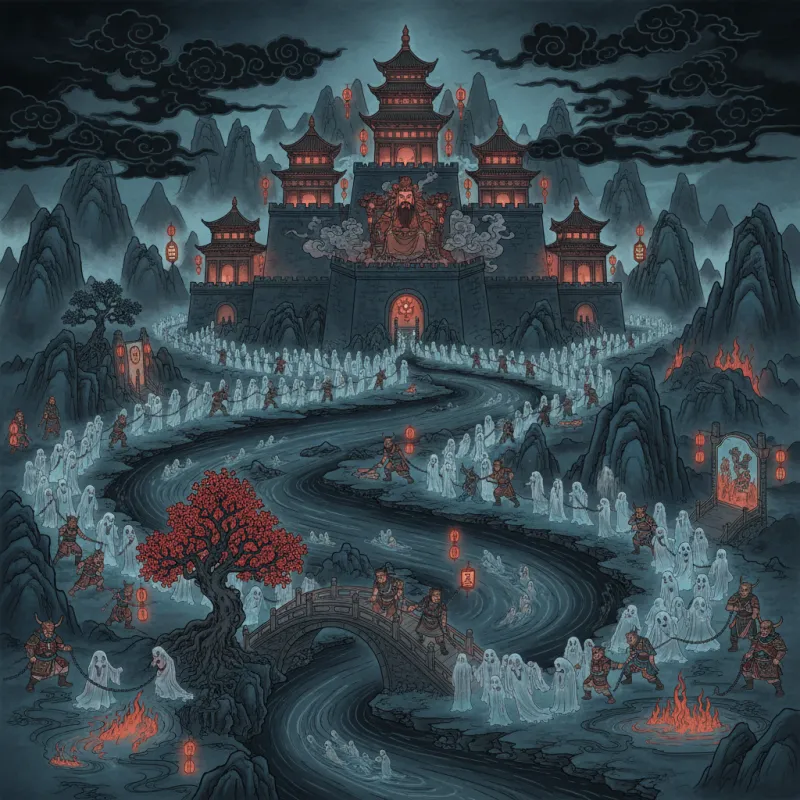
You die. Your soul separates from your body, and before you can even process what's happening, two guards with the heads of oxen and horses grab you by the arms. They're not gentle. You're dragged through a gate made of bones and iron, and suddenly you're standing in what looks like an ancient Chinese government office—complete with bureaucrats, filing systems, and a judge sitting behind a massive desk. Welcome to Diyu (地狱, Dìyù), the Chinese underworld, where your afterlife is processed like a tax audit.
Hell as Bureaucracy
Forget fire and brimstone. The Chinese underworld operates like the imperial civil service, because of course it does—why would death be any less bureaucratic than life? Diyu isn't about eternal damnation; it's a temporary correctional facility where souls are judged, punished for specific infractions, and then sent back into the cycle of reincarnation. The whole system was formalized during the Tang Dynasty (618-907 CE), when Buddhist concepts of karma merged with traditional Chinese ancestor worship and Daoist cosmology.
The genius of this system is its specificity. You're not damned for being "bad"—you're punished for concrete violations. Lied to your parents? There's a court for that. Cheated on your taxes? Different court. Murdered someone? That's Court Five, and King Yanluo (阎罗王, Yánluó Wáng) himself will handle your case. Every sin has its corresponding punishment, every punishment has its duration, and when you've served your time, you're released back into the world—though probably not as a human.
The Ten Courts of Hell
The journey through Diyu follows a strict progression through ten courts, each presided over by a Yanluo King (阎罗王, Yánluó Wáng). These aren't demons—they're judges, appointed by the Jade Emperor himself to maintain cosmic order. Think of them as the Supreme Court of the afterlife, except there are ten of them and they all specialize in different types of moral failure.
First Court: King Qinguang (秦广王, Qínguǎng Wáng) handles intake. Every soul passes through here first for initial judgment. If you lived a genuinely virtuous life—rare, but it happens—you skip the rest of the courts entirely and head straight to reincarnation, possibly even as a human again. Everyone else gets sorted based on their sins and sent to the appropriate courts. King Qinguang also maintains the Terrace for Viewing One's Home (望乡台, Wàngxiāng Tái), where souls can look back at their families one last time before proceeding. It's as heartbreaking as it sounds.
Second Court: King Chujiang (楚江王, Chǔjiāng Wáng) specializes in dishonesty—corrupt officials, fraudulent merchants, doctors who overcharged patients, lawyers who twisted the law. The punishments here involve freezing pools and mountains of knives. Medieval Chinese hell really committed to the physical torture metaphor.
Third Court: King Songdi (宋帝王, Sòngdì Wáng) handles crimes against family and social order: disrespect to elders, ingratitude, causing family discord. In a Confucian society, these weren't minor infractions—they were attacks on the fundamental structure of civilization. Punishments include having your heart ripped out (it grows back, don't worry) and being hung upside down.
Fourth Court: King Wuguan (五官王, Wǔguān Wáng) deals with economic crimes—tax evasion, hoarding during famines, refusing to pay debts. There's a special punishment for landlords who exploited tenants: being crushed under a stone roller. The Chinese afterlife has strong opinions about economic justice.
Fifth Court: King Yanluo (阎罗王, Yánluó Wáng) is the big one. He's the chief judge, the one most people think of when they imagine Chinese hell. Originally borrowed from the Hindu deity Yama, King Yanluo handles the worst offenses: murder, arson, abortion (traditional Chinese morality, remember), and causing others to commit suicide. His court features the Mirror of Retribution (孽镜台, Nièjìng Tái), which shows you every sin you committed in life. You can't lie, you can't make excuses—the mirror shows everything. The punishments here are appropriately severe: being sawed in half, having your tongue pulled out, being ground in a mortar.
Sixth through Tenth Courts handle increasingly specific violations. King Biancheng (卞城王, Biànchéng Wáng) of the Sixth Court punishes sacrilege and blasphemy. King Taishan (泰山王, Tàishān Wáng) of the Seventh Court deals with violations of graves and desecration of corpses—a serious crime in a culture that venerates ancestors. King Dushi (都市王, Dūshì Wáng) of the Eighth Court handles filial impiety. King Pingdeng (平等王, Píngděng Wáng) of the Ninth Court catches anyone who slipped through the previous courts. And finally, King Zhuanlun (转轮王, Zhuǎnlún Wáng) of the Tenth Court operates the Wheel of Reincarnation (轮回, Lúnhuí), determining what you'll be reborn as based on your karmic balance.
The Punishments Are Oddly Specific
The tortures of Diyu are described in excruciating detail in texts like the Jade Record (玉历, Yùlì) and depicted in temple murals across East Asia. We're talking about eighteen levels of punishment, each designed for specific sins. There's the Mountain of Knives for those who killed animals unnecessarily. The Forest of Swords for those who incited violence. The Pool of Blood for women who died in childbirth (yes, really—traditional Chinese culture had complicated views on female pollution). The Tongue-Ripping Hell for liars and gossips. The Ice Hell for those who were cold-hearted in life.
What's fascinating is how these punishments reflect social anxieties of imperial China. There are specific hells for corrupt officials, bad teachers, plagiarists, and people who wasted food. The afterlife enforces the moral code that society couldn't always maintain in life. It's cosmic justice as social control—and it worked. For centuries, these vivid descriptions of hell kept people in line more effectively than any legal code.
Getting Out: The Loopholes
Here's where it gets interesting: Diyu has loopholes. You can reduce your sentence through the intervention of living relatives who perform rituals, burn offerings, and commission Buddhist ceremonies on your behalf. The seventh month of the lunar calendar is Ghost Month (鬼月, Guǐ Yuè), when the gates of hell open and souls can temporarily return to the living world—if they've earned the privilege. Families burn paper money, paper houses, even paper iPhones to provide for their deceased relatives in the underworld.
There's also the possibility of divine intervention. Bodhisattvas like Guanyin occasionally descend into hell to rescue souls, and certain powerful deities can petition for reduced sentences. The Journey to the West features a famous scene where the Tang Emperor dies, goes to hell, and gets his sentence reduced because his minister bribes the judges with melons and pumpkins. Even in death, connections matter.
Why This Matters
The Chinese underworld isn't just religious mythology—it's a complete moral philosophy expressed through bureaucratic metaphor. It tells us that actions have consequences, that justice exists even if we don't see it in life, and that redemption is always possible through the efforts of those who love us. Unlike the eternal hell of Abrahamic religions, Diyu offers something more pragmatic: punishment proportional to crime, a defined sentence, and eventual release back into the cycle of existence.
This system also reveals deep cultural values: the importance of family, the sanctity of social order, the belief that even the afterlife should operate according to rational principles. When modern Chinese people say they don't believe in hell, they often mean they don't believe in the literal courts and torture chambers—but the underlying moral framework still shapes how they think about right and wrong, debt and obligation, justice and mercy.
The next time you visit a Chinese temple and see those terrifying murals of demons torturing souls, remember: it's not about scaring you into submission. It's about reminding you that every action matters, every relationship has weight, and even in death, there's a system—bureaucratic, specific, and ultimately fair. Just make sure you file your paperwork correctly.
Related Reading
- The Wheel of Reincarnation: How the Chinese Afterlife Recycles Souls
- The Afterlife in Chinese Culture: A Traveler's Guide to the Underworld
- Exploring Chinese Beliefs in the Afterlife: Ghosts, Spirits, and Folklore
- The Chinese Afterlife Is a Bureaucracy (And That Tells You Everything)
- Exploring the Mystical Realm of Chinese Ghosts and Afterlife Beliefs
- Temple Legends: The Ghost Stories That Live in China's Sacred Spaces
- Ox-Head and Horse-Face: The Messengers of Hell
- Unveiling the Mysteries of Chinese Supernatural Folklore: Ghosts, Spirits, and Afterlife Beliefs
Explore Chinese Culture
- Explore ancient mythical creatures
- Explore Daoist exorcism traditions
- Explore Chinese folk beliefs and superstitions