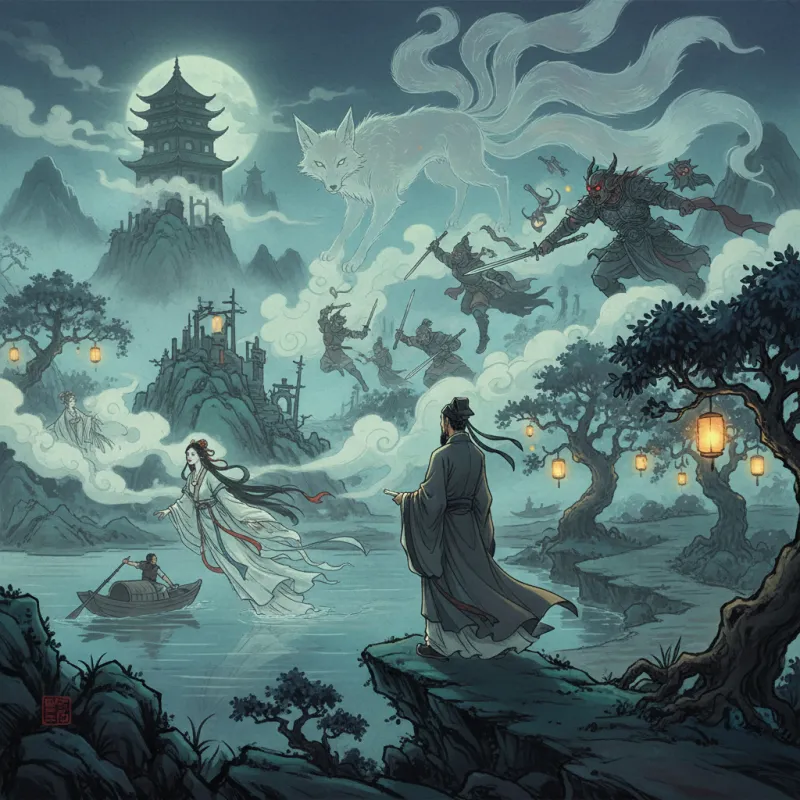
Picture this: A scholar peels back a bedroom door at midnight and watches in horror as his beautiful houseguest removes her face like a coat, revealing the rotting corpse beneath. She hangs the skin—still dripping—on a hook and begins painting fresh features onto it with a brush. This isn't some modern horror film. It's a 300-year-old Chinese story that's more visceral and psychologically complex than anything Hollywood has produced in the last decade.
Pu Songling's Liaozhai Zhiyi (聊斋志异, Strange Tales from a Chinese Studio) contains 490 stories that would make Jordan Peele weep with envy. Written between 1640 and 1715 by a perpetually broke tutor who collected ghost stories the way some people collect stamps, this collection has everything: body horror, existential dread, tragic romance, biting social commentary, and fox spirits who are better at being human than actual humans. Yet Hollywood keeps remaking the same three Asian horror properties while this goldmine sits untranslated and unadapted.
The few Chinese adaptations that exist barely scratch the surface. Let's talk about the stories that deserve the full prestige treatment—and why Western studios will probably never touch them.
"Painted Skin" — But Actually Good This Time
Yes, "Painted Skin" (画皮, Huà Pí) has been adapted multiple times, but every version softens the existential horror at its core. The 2008 film turned it into a love triangle with CGI battles. The story deserves better.
Here's what actually happens: Wang Sheng encounters a beautiful woman and, despite his wife's warnings, brings her home. A Taoist priest warns him she's a demon. Wang ignores this. One night, he peeks into her room and sees her remove her face—literally painted human skin—revealing a green-faced ghoul underneath. She's painting a fresh face with a brush. When she discovers Wang watching, she rips out his heart and leaves.
The real horror isn't the monster. It's that Wang's wife must debase herself before a mad beggar, letting him spit phlegm into her mouth, to obtain the magic that resurrects her husband. The story asks: What does it cost to love someone who makes catastrophically stupid decisions? How much of yourself must you destroy to save someone who won't save themselves?
A proper adaptation would be intimate, claustrophobic, and focused on the wife's perspective. Think The Lighthouse meets Possession. It would make audiences deeply uncomfortable about desire, marriage, and the violence of resurrection. Which is exactly why it won't get made—it's too weird, too female-focused, and too willing to let its protagonist be genuinely unlikeable.
"Nie Xiaoqian" — Beyond the Ghost Bride Trope
"Nie Xiaoqian" (聂小倩) became A Chinese Ghost Story (1987), which is beloved for good reason. But the original story is stranger and darker than the romantic fantasy film we got.
Xiaoqian is a ghost enslaved by a demon, forced to seduce men so the demon can consume them. She falls for the scholar Ning Caichen—not because he's special, but because he's the first person who treats her like a human being rather than an object. When she's freed, she doesn't ascend to heaven. She marries Ning, lives as his wife, and eventually arranges for him to marry her ghost friend too.
The story is fundamentally about women trapped in systems of exploitation, finding agency through solidarity with each other rather than through male rescue. Xiaoqian saves herself. She then uses her freedom to help another woman escape the same fate. The romance is secondary to the friendship between two dead girls who refuse to stay victims.
Hollywood would turn this into another Ghost (1990) clone, focusing on the doomed romance. The version we need would be more like The Handmaid's Tale—a horror story about bodily autonomy, with ghosts. It would center the female characters' relationship and make the demon a metaphor for systems that commodify women's bodies. It would be brilliant. It will never happen.
"The Laughing Girl" — Cosmic Horror Before Lovecraft
"The Laughing Girl" (笑女, Xiào Nǚ) is barely known even among Liaozhai readers, but it's one of the most unsettling stories in the collection. A man becomes obsessed with a woman who does nothing but laugh. She laughs at everything—tragedy, joy, horror, death. She cannot stop laughing. Eventually, he realizes she's not human, but by then he's infected with her laughter. The story ends with him laughing uncontrollably at his own funeral.
This is body horror and existential dread wrapped in a deceptively simple package. The laughing is contagious, meaningless, and unstoppable—a perfect metaphor for madness, or for the absurdity of existence itself. Pu Songling wrote cosmic horror a century before Lovecraft, but his monsters aren't tentacled gods. They're beautiful women whose very presence unmakes reality.
An adaptation would need to trust the audience with ambiguity. No explanation for what the Laughing Girl is. No cure. No escape. Just the slow realization that some encounters change you in ways you can't undo. Think Under the Skin or The Witch—films that understand that the scariest thing is often just watching someone become something else.
"Lotus Fragrance" — Queer Ghost Romance Done Right
"Lotus Fragrance" (莲香, Lián Xiāng) is a love story between a scholar, a ghost, and a fox spirit. The scholar is dying. The ghost Lotus Fragrance loves him but is too weak to save him. So she finds a fox spirit named Li, convinces her to help, and the three of them form a household together. The fox spirit uses her life force to keep the scholar alive. The ghost provides emotional support. They all sleep in the same bed.
This is a polyamorous queer relationship in a story from the 1600s, and it's treated as the happy ending. The scholar doesn't have to choose. The women don't compete. They build a life together based on mutual care and sacrifice. When Lotus Fragrance finally reincarnates, she arranges to be reborn as Li's daughter so they can stay together.
Hollywood claims to want diverse stories, but this would require depicting a functional polyamorous relationship where a ghost and a fox spirit co-parent. It would require treating Chinese supernatural beings with the same seriousness as, say, vampires in Twilight. It would require admitting that queer relationships existed and were written about centuries before Stonewall. The cognitive dissonance would be too much.
"The Painted Wall" — Reality-Bending Before Inception
In "The Painted Wall" (画壁, Huà Bì), a scholar stares at a mural in a temple and suddenly finds himself inside it, living among the painted figures. He has a romance with a painted woman. Time moves differently inside the painting. When he finally escapes, only moments have passed in the real world, but he's lived months inside the wall.
This is Inception (2010) meets Eternal Sunshine of the Spotless Mind (2004), but written in the Qing Dynasty. The story asks whether experiences that happen in unreal spaces are less valid than "real" ones. If you fall in love with someone who only exists in a painting, is that love real? If you live a lifetime in a dream, did you actually live it?
Pu Songling doesn't answer these questions. The scholar returns to reality, but he's changed. He remembers the painted woman. He mourns her. The story suggests that all experiences—real or painted, physical or spiritual—shape us equally. It's a deeply Buddhist idea wrapped in a supernatural romance, and it would make for a stunning film if anyone had the courage to adapt it faithfully.
Why Hollywood Won't Touch These Stories
The problem isn't that these stories are too Chinese or too foreign. Crouching Tiger, Hidden Dragon (2000) and Everything Everywhere All at Once (2022) proved that American audiences will embrace Chinese supernatural concepts when they're presented well.
The problem is that Liaozhai stories are genuinely weird. They don't resolve neatly. They're comfortable with ambiguity, with moral complexity, with endings that feel more like beginnings. They treat ghosts and fox spirits as people with agency and interiority, not as monsters to be defeated or metaphors to be decoded. They're often about women saving themselves, or about men learning that their desires are less important than they thought.
These stories would require studios to trust audiences with strangeness, to resist the urge to explain everything, to let female characters be complex and sometimes monstrous. They would require treating Chinese folklore with the same respect given to Greek mythology or Arthurian legend. They would require admitting that the best horror and fantasy stories aren't always the ones that make us comfortable.
Until that changes, Pu Songling's masterpieces will remain what they've always been: the greatest horror stories you've never seen adapted, waiting for someone brave enough to bring them to life.
For more on Chinese supernatural beings, explore fox spirits and their shapeshifting powers, or dive into the role of Taoist priests in fighting demons. And if you want to understand the cultural context that produced these stories, read about the examination system that shaped Pu Songling's worldview.
Related Reading
- Liaozhai Zhiyi: The Ghost Stories That Changed Chinese Literature
- What is Liaozhai Zhiyi? A Guide to China's Greatest Ghost Stories
- Painted Skin: The Most Terrifying Story in Chinese Literature
- Pu Songling: The Failed Scholar Who Wrote China's Greatest Ghost Stories
- Nie Xiaoqian: The Ghost Romance That Conquered Cinema
- Unveiling the Mysteries of Chinese Supernatural Folklore: Ghosts, Spirits, and Afterlife Beliefs
- The Nine-Tailed Fox: From Divine Symbol to Ultimate Villain
- Exploring Chinese Supernatural Folklore: Ghosts, Spirits, and Afterlife Beliefs
Explore Chinese Culture
- Explore ancient mythical creatures
- Explore Daoist exorcism traditions
- Explore Chinese folk beliefs and superstitions