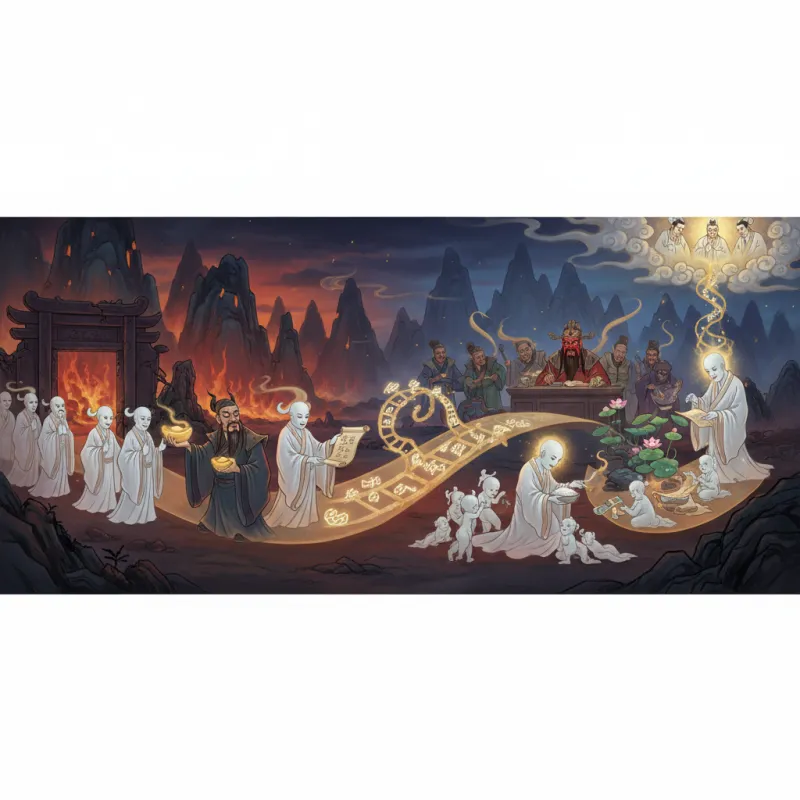
The judges of the Ten Courts of Hell keep meticulous records. Every lie you told, every promise you broke, every act of cruelty—it's all there in the ledgers, written in ink that never fades. But here's what the morality tales don't always mention: those same ledgers have columns for good deeds too. And in a bureaucracy as ancient and complex as the Chinese underworld, there are more ways to balance the books than you might think.
The Chinese approach to avoiding hellish punishment is refreshingly pragmatic. It's not about achieving spiritual perfection or divine grace. It's about understanding the system and working within it. Some methods are genuinely virtuous. Others are... let's call them creative accounting. Most people hedge their bets with a combination of both, because when you're facing the prospect of having your tongue pulled out with iron hooks, you don't want to rely on just one strategy.
Accumulate Merit Through Good Deeds
The most legitimate path is accumulating merit (积功累德, jī gōng lěi dé)—literally "accumulating merit and piling up virtue." This isn't abstract spiritual currency. In Chinese folk religion, merit is quantifiable. Every good deed adds to your account. Every bad deed subtracts from it. When you die, King Yanluo (阎罗王, Yánluó Wáng) and his fellow judges tally up the numbers.
What counts as merit? The classics are specific. Releasing captive animals (放生, fàngshēng) is a big one—buy fish or birds from the market and set them free. Building bridges and roads for public use. Donating to temples. Providing medicine to the sick. Feeding the hungry. The Jade Record (玉历宝钞, Yùlì Bǎochāo), a Ming Dynasty text that circulated widely as a guide to the underworld, lists hundreds of meritorious acts with their corresponding point values.
But here's where it gets interesting: intent matters, but so does scale. A wealthy merchant who builds a bridge gets more merit than a poor farmer who helps his neighbor fix a fence—not because the judges are classist, but because the bridge helps more people. The system rewards impact. This has led to centuries of wealthy Chinese families funding public works projects partly out of genuine charity, partly as afterlife insurance.
The most dedicated merit-accumulators become vegetarian, reasoning that not killing animals for food prevents countless karmic debts. Some take it further, refusing to even swat mosquitoes. Whether this level of commitment actually works is debatable—the underworld judges seem more concerned with how you treated other humans than whether you ate pork—but it certainly can't hurt your case.
Master the Art of Repentance
If you've already racked up serious karmic debt, repentance (忏悔, chànhuǐ) offers a path to reduction. But this isn't just saying "I'm sorry." The Chinese underworld requires formal, ritualized repentance, preferably witnessed by religious authorities and backed up by concrete actions.
The most powerful form is commissioning a repentance ritual (拜忏, bàichàn) at a Buddhist or Daoist temple. Monks chant sutras on your behalf, petition the celestial bureaucracy for leniency, and perform ceremonies that symbolically cleanse your karmic record. The Liang Emperor Repentance Ritual, created in the 6th century after Emperor Wu of Liang's consort died and allegedly became a python due to her jealousy in life, remains one of the most elaborate. It takes days to perform properly and costs accordingly.
Does it work? According to the tradition, yes—but only if your repentance is genuine. The underworld judges can detect performative remorse. They've been doing this for millennia. You can't just throw money at monks and expect your record to be wiped clean while you continue behaving badly. The ritual creates an opening for mercy, but you have to walk through it by actually changing your behavior.
Some people wait until they're dying to repent, figuring they'll squeeze in a deathbed conversion and avoid decades of virtuous living. The texts suggest this is risky. King Yanluo isn't stupid. A lifetime of cruelty followed by a last-minute "my bad" might get you a slightly shorter sentence, but you're still going to the Court of Tongue Ripping (拔舌地狱, Báshé Dìyù) if you were a habitual liar.
Burn Offerings: The Underworld Economy
Here's where Chinese afterlife strategy gets delightfully mercenary: you can send resources to the underworld through ritual burning. Hell money (冥币, míngbì), paper houses, paper cars, paper servants, paper credit cards—if you can make it out of paper, you can burn it and transfer it to the deceased or to underworld officials.
This practice has ancient roots but has evolved remarkably with the times. Modern offerings include paper smartphones, paper laptops, even paper mistresses (yes, really—you can buy these at specialty shops). The logic is consistent: the underworld mirrors the living world, and officials there are just as susceptible to material incentives as officials here.
The cynical interpretation is that you're bribing the judges. The more charitable interpretation is that you're providing resources that make the deceased's time in the underworld more comfortable, which indirectly influences their treatment. Either way, it's transactional. Burn enough offerings, and your deceased relatives might have the means to negotiate better conditions or even expedite their progression through the courts.
There's a whole economy around this. Families burn offerings during Qingming Festival (清明节, Qīngmíng Jié) and Ghost Month (鬼月, Guǐyuè). The more you burn, the more you're demonstrating filial piety, which itself generates merit. It's a system where material wealth in life can be converted into spiritual currency in death—which, let's be honest, is probably why wealthy families have always been enthusiastic participants.
Critics point out that this seems to contradict Buddhist teachings about non-attachment and the illusory nature of material goods. The folk religion response is essentially: "Sure, but the underworld bureaucrats didn't get that memo, so we're working with the system we have."
Invoke Divine Protection and Guarantors
The Chinese underworld isn't the only game in town. There's a vast celestial bureaucracy above it, and various deities who can intervene on your behalf. The trick is establishing relationships with these divine protectors before you die.
Guanyin (观音, Guānyīn), the Bodhisattva of Compassion, is the most popular choice. She's known for pulling people out of hell, sometimes literally. The Lotus Sutra describes her rescuing beings from the underworld courts. Devotees who chant her name regularly and maintain shrines in her honor can invoke her protection when facing judgment. The underworld judges respect her authority—she outranks them in the cosmic hierarchy.
Dizang (地藏, Dìzàng), the Bodhisattva who vowed not to achieve Buddhahood until all hells are empty, is another powerful ally. He literally works in the underworld, advocating for souls and negotiating reduced sentences. Devotion to Dizang is essentially hiring the best defense attorney in the afterlife. His famous vow—"If I don't go to hell, who will?"—means he's already there, ready to help.
Some traditions suggest you can also arrange for guarantors (保人, bǎorén)—respected monks or virtuous individuals who vouch for your character before the underworld courts. This is the afterlife equivalent of character witnesses. If a renowned monk testifies that you were a sincere practitioner, the judges take that into account. Of course, this requires actually building those relationships during life, which means you can't fake it.
The Underworld Judges and Their Courts respect the celestial hierarchy, but they're not pushovers. Divine intervention helps, but it's not a get-out-of-jail-free card. Even Guanyin's protection has limits if your karmic debt is truly massive.
Exploit Bureaucratic Loopholes
The Chinese underworld is a bureaucracy, and bureaucracies have procedural requirements. Miss a step, and the whole case can be thrown out. This has led to some creative strategies.
One approach: die in a way that creates jurisdictional confusion. If you die far from home, there might be disputes about which local underworld office has authority over your case. While they're sorting out the paperwork, you might slip through the cracks. This is obviously not a reliable strategy, but the folk tradition includes stories of souls who wandered in bureaucratic limbo for years because their files were misfiled.
Another loophole: reincarnation timing. If you can get processed quickly through the courts and reincarnated before your full karmic debt is assessed, you might avoid some punishments. This requires having connections—family members who perform the right rituals, monks who petition on your behalf, or enough burned offerings to expedite your case. It's the afterlife equivalent of knowing someone who knows someone.
Some texts mention that certain deaths grant automatic exemptions from specific punishments. Dying while performing a heroic act, for instance, or dying in childbirth. The logic is that these deaths involve sacrifice, which generates instant merit that offsets other debts. Whether this actually works or is just comforting folklore is unclear, but it's been repeated enough that it's become part of the tradition.
The most audacious loophole: become a ghost and refuse to report to the underworld at all. This is technically possible—some souls become wandering ghosts (游魂, yóuhún) who evade the underworld's jurisdiction. But this is a terrible long-term strategy. You're stuck in the mortal realm without a body, unable to reincarnate, slowly losing your identity. Eventually, the underworld's ghost catchers (鬼差, guǐchāi) will find you, and when they do, your sentence will be much worse for having evaded judgment. It's like being a fugitive: you might avoid prison temporarily, but you're making everything worse.
Live Virtuously (The Boring But Effective Method)
Here's the strategy that actually works best, even if it's less exciting than bribing judges with paper money: just be a decent person. Don't lie. Don't cheat. Don't kill. Don't steal. Treat others with kindness. Help when you can. Be filial to your parents. Be loyal to your friends. Honor your commitments.
The Ten Courts of Hell are designed to punish specific transgressions. Each court handles different categories of sin. If you simply don't commit those sins, you pass through quickly. No torture. No centuries of punishment. Just a brief review and on to reincarnation, possibly even to a better life than your current one.
This is the strategy that the morality texts emphasize most, even if it's the one people find least interesting. The Jade Record spends far more pages describing punishments than rewards, because humans are apparently more motivated by fear than aspiration. But the underlying message is clear: the system is designed to be fair. If you live well, you'll be treated well.
The challenge is that "living virtuously" is harder than it sounds. It's not just about avoiding major crimes. It's about the accumulation of small choices. Did you gossip and damage someone's reputation? That's a sin. Did you waste food while others starved? That's a sin. Did you fail to care for your aging parents? That's a serious sin. The underworld judges evaluate your entire life, not just the highlights.
But here's the encouraging part: you don't have to be perfect. The system accounts for human weakness. Small transgressions can be balanced by small good deeds. It's the pattern of your life that matters, not individual mistakes. Someone who generally tries to do right, who feels genuine remorse for their failures, who makes amends when possible—that person will fare reasonably well in the underworld courts.
The Combination Strategy
In practice, most Chinese people don't rely on just one approach. They hedge their bets. They try to live virtuously, but they also burn offerings, commission rituals, donate to temples, and cultivate relationships with divine protectors. It's a diversified portfolio of afterlife insurance.
This might seem cynical, but it's actually quite sophisticated. The Chinese folk religion tradition recognizes that humans are complex, that motivation is mixed, and that the afterlife is too important to leave to chance. Why choose between being good and being strategic when you can do both?
The wealthy have obvious advantages in this system—they can afford more elaborate rituals, larger donations, more offerings. But the system also provides paths for the poor. A lifetime of genuine kindness counts for more than a deathbed donation from someone who exploited workers for decades. The Underworld Bureaucracy is corrupt enough to accept bribes but not so corrupt that virtue is meaningless.
The most interesting aspect of these strategies is what they reveal about Chinese religious pragmatism. There's no single path to salvation, no one true way. There's a complex system with multiple entry points, and you're expected to figure out which combination works for you. It's transactional, yes, but it's also oddly egalitarian. Everyone gets judged by the same standards, and everyone has access to the same strategies, even if some have more resources to deploy them.
Will any of this actually help you avoid punishment in the Chinese hell? That depends on whether you believe the system exists. But even as metaphor, it's a remarkably sophisticated framework for thinking about moral accountability, the weight of our choices, and the possibility of redemption. The underworld judges are watching, the ledgers are being kept, and when your time comes, you'll face an accounting. The question is: what will your balance sheet look like?
Related Reading
- The Ten Kings of Hell: A Complete Guide to Chinese Underworld Justice
- Mengpo Soup: The Drink That Erases Memory
- Ox-Head and Horse-Face: The Messengers of Hell
- The Underworld Courts: How Chinese Hell Judges the Dead
- Talismans and Fu: The Ancient Art of Paper Magic
- Unraveling the Mystique of Chinese Supernatural Folklore and Afterlife Beliefs
- Zhong Kui: The Demon Queller
Explore Chinese Culture
- Explore ancient mythical creatures
- Explore Daoist exorcism traditions
- Explore Chinese folk beliefs and superstitions