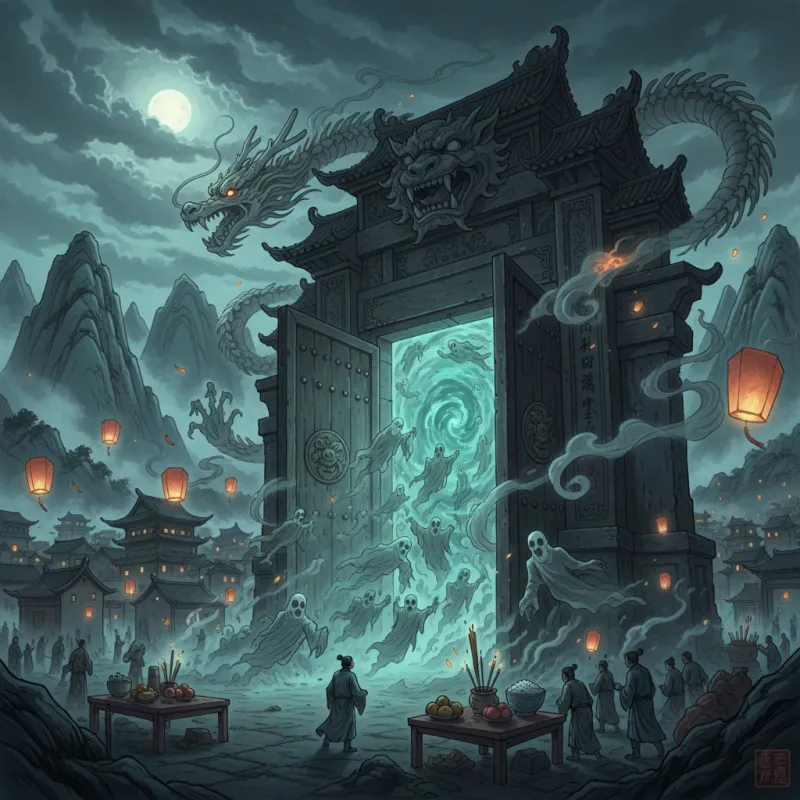
Every year on the fifteenth day of the seventh lunar month, families across China set out elaborate feasts on their doorsteps — but not for themselves. The food is for the dead. Incense smoke curls into the night air, paper money burns in metal drums, and the streets empty as darkness falls. This is the peak of the Hungry Ghost Festival (中元节, Zhōngyuán Jié), when the boundary between the living and dead dissolves completely, and hungry spirits roam freely through our world.
When Hell's Gates Swing Open
The seventh lunar month — known simply as Ghost Month (鬼月, guǐyuè) — marks the annual opening of the underworld gates. According to Daoist and Buddhist cosmology, the bureaucrats of the Ten Courts of Hell temporarily suspend their duties, allowing all souls to return to the mortal realm. This isn't a jailbreak. It's official policy, sanctioned by the celestial administration itself.
But not all returning spirits come with good intentions. While some are beloved ancestors making their yearly visit home, others are hungry ghosts (饿鬼, èguǐ) — tormented beings with insatiable appetites and needle-thin throats, condemned to eternal hunger as punishment for greed, gluttony, or neglect of family duties in life. These creatures are desperate, dangerous, and drawn to the living world by the scent of food and the warmth of human energy.
The festival's origins blend Daoist, Buddhist, and folk traditions into something uniquely Chinese. Daoists celebrate it as the birthday of the Earthly Official (地官, Dìguān), one of the Three Officials who govern heaven, earth, and water. Buddhists observe Yulanpen Festival (盂兰盆节, Yúlánpén Jié), commemorating the monk Mulian's rescue of his mother from the hungry ghost realm — a story so influential it shaped Chinese attitudes toward filial piety and ancestral worship for over a millennium.
The Hungry Ghosts Among Us
Not all ghosts are created equal during Ghost Month. The hierarchy matters. At the top are honored ancestors — those with living descendants who remember them, maintain their graves, and perform proper rituals. These spirits return home like visiting relatives, expecting clean houses, favorite foods, and respectful treatment.
Below them lurk the orphan ghosts (孤魂野鬼, gūhún yěguǐ) — souls with no living family to feed them, no one to burn offerings, no place in the ancestral tablets. These are the truly hungry ones. They died violently, far from home, or were simply forgotten. Imagine starving for decades, watching other ghosts feast while you get nothing. That desperation makes them unpredictable and potentially malevolent.
Then there are the vengeful spirits (厉鬼, lìguǐ) — ghosts who died with grievances unresolved, murdered without justice, or betrayed by those they trusted. Ghost Month gives them freedom to settle scores. The smart move? Stay out of their way. Don't whistle at night (it attracts their attention), avoid swimming (water ghosts drag the living down to take their place), and never pick up money on the street (it's ghost money, and taking it creates a debt).
Feeding the Hungry Dead
The central ritual of the Hungry Ghost Festival is the communal feast. Families prepare elaborate meals and set them outside their homes, in temples, or at roadside shrines. But this isn't charity — it's strategic appeasement. Feed the hungry ghosts well, and they'll leave you alone. Neglect them, and they might cause accidents, illness, or financial ruin.
The offerings follow specific rules. Whole chickens and ducks, heads and feet intact, demonstrate respect. Fresh fruit, rice, tea, and wine provide sustenance. Incense creates a bridge between worlds, allowing spirits to absorb the essence of food even if they can't physically consume it. And joss paper (纸钱, zhǐqián) — elaborate fake money, sometimes printed with denominations in the billions — gets burned to provide currency in the afterlife economy.
Temples and community organizations host massive public feasts called Pudu (普渡, pǔdù), meaning "universal salvation." Long tables groan under mountains of food, and Daoist priests perform elaborate rituals to guide lost souls toward reincarnation or peaceful rest. The largest celebrations feature Chinese opera performances — entertainment for both living and dead audiences — and auctions of blessed food afterward, with proceeds funding next year's festival.
The Rules of Ghost Month
Surviving Ghost Month requires following certain precautions. These aren't superstitions — they're survival tactics refined over centuries of coexistence with the supernatural.
Never swim during Ghost Month. Water ghosts (水鬼, shuǐguǐ) are particularly active, and drowning victims often become water ghosts themselves, condemned to drown others as substitutes so they can reincarnate. Lakes, rivers, and oceans become hunting grounds. Even swimming pools aren't entirely safe — the desperate dead aren't picky about water sources.
Avoid night activities. Your yang energy (阳气, yángqì) — the vital life force that keeps you alive and healthy — burns brightest during daylight. At night, especially during Ghost Month, it dims, making you vulnerable to spiritual interference. Ghosts are drawn to yang energy like moths to flame, and they'll drain it if given the chance.
Don't whistle or call names after dark. Whistling attracts wandering spirits who think you're summoning them. Calling someone's name makes them turn around, exposing the flame of life force on their shoulder — and ghosts can blow it out. If someone calls your name at night during Ghost Month, don't respond immediately. Make them call three times to ensure they're human.
Avoid major life events. No weddings, no moving houses, no starting new businesses. Ghost Month is inauspicious for beginnings. The spiritual interference is too strong, and you risk inviting unwanted supernatural guests to important occasions. Even hospitals see fewer elective surgeries scheduled during this period.
The Festival's Modern Evolution
Walk through any Chinese community during Ghost Month, and you'll see tradition adapting to contemporary life. In Singapore and Malaysia, where large Chinese populations maintain strong folk religious practices, entire streets shut down for massive Getai performances — live concerts featuring pop singers, dancers, and comedians, with the front rows left empty for ghost spectators.
In Taiwan, the festival has become a major cultural event, with some cities hosting month-long celebrations. The most elaborate rituals occur in Keelung, where different clans compete to host the most impressive Pudu feasts, some featuring food sculptures three stories tall. It's part religious observance, part community festival, part tourism draw — but the underlying belief remains serious.
Urban Chinese communities face practical challenges. Burning joss paper creates air pollution and fire hazards, leading some cities to establish designated burning areas or encourage electronic offerings — apps that let you burn virtual money for the dead. Younger generations question whether ghosts really need paper iPhones and luxury cars, but they still participate, hedging their bets against supernatural consequences.
The pandemic years added new dimensions to Ghost Month observances. With travel restricted and families separated, many turned to online rituals, streaming ceremonies, and virtual offerings. Some temples offered proxy services, performing rituals on behalf of overseas Chinese who couldn't return home. The dead, apparently, adapted to digital communication as readily as the living.
Why Ghost Month Still Matters
In an age of smartphones and space travel, why do millions still take Ghost Month seriously? Because it addresses something fundamental: our relationship with death, memory, and obligation.
The festival acknowledges that death doesn't end relationships. Your ancestors still care about you, still watch over you, still deserve respect and remembrance. But it also recognizes the darker truth — that not everyone gets a good death, not every soul finds peace, and the forgotten dead become dangerous precisely because they're forgotten.
This isn't ancestor worship in the abstract. It's practical theology. Feed the hungry, remember the forgotten, respect the dead, and maintain the cosmic balance. Neglect these duties, and consequences follow — not because ghosts are evil, but because hunger and abandonment create desperation, and desperate spirits do desperate things.
The Hungry Ghost Festival reminds us that we're part of a continuum stretching backward to our ancestors and forward to our descendants. We're temporary custodians of family memory, responsible for maintaining connections across the boundary of death. When we set out food for hungry ghosts, we're not just feeding spirits — we're acknowledging our place in an endless cycle of life, death, and obligation that predates us and will continue long after we join the ranks of those who return each seventh month, hoping someone remembers our names.
Related Reading
- The Chinese Afterlife Is a Bureaucracy (And That Tells You Everything)
- Hungry Ghosts and Wandering Souls: The Unquiet Dead of Chinese Folklore
- Exploring the Mystical Realm of Chinese Ghosts and Afterlife Beliefs
- The Afterlife in Chinese Culture: A Traveler's Guide to the Underworld
- Exploring Chinese Beliefs in the Afterlife: Ghosts, Spirits, and Folklore
- Unveiling the Secrets of Chinese Supernatural Folklore and Afterlife Beliefs
- Exploring Chinese Supernatural Folklore: Ghosts, Spirits, and Afterlife Beliefs
- Cursed Objects in Chinese Folklore: Things You Should Never Touch
Explore Chinese Culture
- Explore ancient mythical creatures
- Explore Daoist exorcism traditions
- Explore Chinese folk beliefs and superstitions