Zhong Kui: The Demon Queller Who Protects the Living
The Scholar Who Became a Demon Hunter
In the pantheon of Chinese supernatural protectors, few figures command as much respect and recognition as Zhong Kui (鍾馗, Zhōng Kuí), the fierce demon queller whose image has adorned doorways, scrolls, and amulets for over a millennium. With his wild beard, bulging eyes, and official's robes, Zhong Kui represents a unique fusion of scholarly achievement and martial prowess—a tragic hero who turned his own suffering into a mission to protect humanity from malevolent spirits.
Unlike many Chinese deities whose origins fade into prehistoric mists, Zhong Kui's story is remarkably specific, rooted in the Tang Dynasty (618-907 CE) and intertwined with imperial history. His legend speaks to fundamental Chinese values: the importance of justice, the tragedy of unfair treatment, and the belief that even death cannot prevent a righteous soul from fulfilling its purpose.
The Tragic Origin Story
The most widely accepted version of Zhong Kui's origin dates to the reign of Emperor Xuanzong (玄宗, Xuánzōng, r. 712-756 CE), one of the Tang Dynasty's most celebrated rulers. According to legend, Zhong Kui was a brilliant scholar from Zhongnan Mountain (終南山, Zhōngnán Shān) in Shaanxi Province, renowned for his exceptional learning and literary talent. Despite his formidable intellect, Zhong Kui possessed an unfortunate appearance—his face was marked by unusual features that many found frightening or repulsive.
When Zhong Kui traveled to the capital Chang'an (長安, Cháng'ān, modern-day Xi'an) to take the imperial examinations, he achieved the highest score, earning the coveted zhuangyuan (狀元, zhuàngyuán) title—the top scholar in the entire empire. This should have been his moment of ultimate triumph, the culmination of years of dedicated study. However, when he appeared before the emperor for the traditional audience, the court officials were horrified by his appearance. They convinced the emperor that such an ugly man could not possibly represent the dignity of the imperial court.
In a devastating reversal, Zhong Kui's title was stripped away and given to another candidate. The humiliation was unbearable. Standing on the palace steps, Zhong Kui denounced the injustice and, in a final act of protest, dashed his head against the palace pillars, killing himself instantly.
Emperor Xuanzong, moved by remorse and recognizing the terrible injustice, ordered that Zhong Kui be buried with full honors in a crimson robe—the color reserved for high officials. This act of posthumous respect would prove significant, as it acknowledged Zhong Kui's true worth and perhaps gave his spirit the authority it would later wield against demons.
The Emperor's Dream and Zhong Kui's Mission
The story takes a supernatural turn years later when Emperor Xuanzong fell gravely ill with a mysterious fever. In his delirium, the emperor experienced a vivid dream that would cement Zhong Kui's place in Chinese folklore. He saw a small demon, a xiao gui (小鬼, xiǎo guǐ), stealing his treasures and tormenting him. Just as the situation seemed hopeless, a large, fierce figure appeared—a man in official's robes with a wild appearance, who seized the small demon, tore it apart, and devoured it.
When the emperor asked who his savior was, the figure replied: "I am Zhong Kui. I failed the imperial examinations due to my appearance and took my own life in despair. Your Majesty honored me with burial in crimson robes, and I have vowed to repay this kindness by protecting you and your empire from all demons and evil spirits for eternity."
Upon awakening, Emperor Xuanzong found his fever had broken. Deeply moved, he summoned the court painter Wu Daozi (吳道子, Wú Dàozǐ), one of history's greatest Chinese artists, and described his dream in detail. Wu Daozi created a portrait so accurate that the emperor exclaimed it was exactly as he had seen. This painting became the prototype for countless subsequent depictions of Zhong Kui and helped establish his iconography throughout Chinese culture.
Iconography and Symbolism
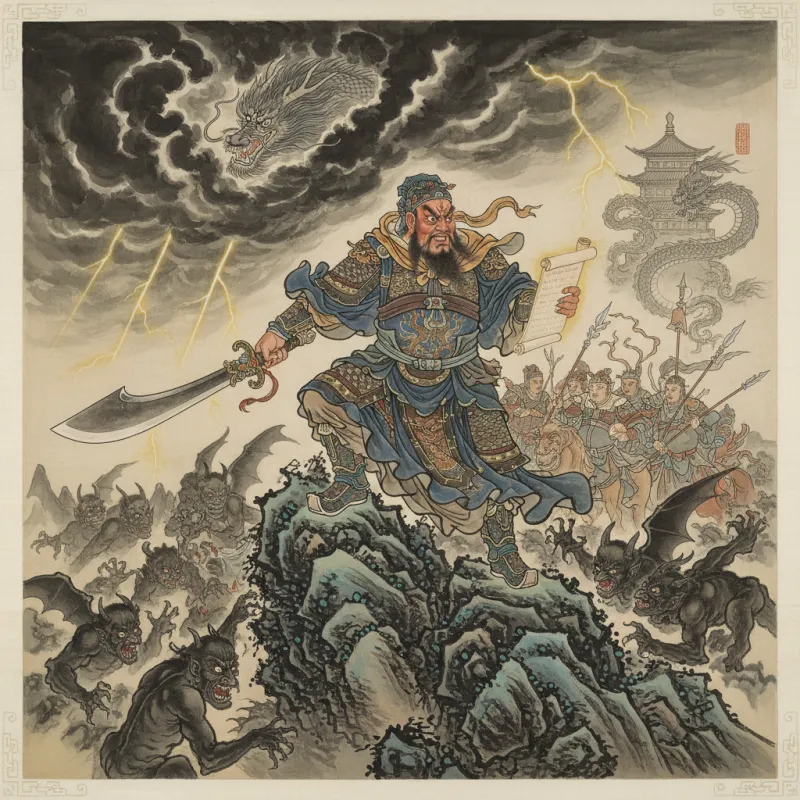
Zhong Kui's visual representation is instantly recognizable and laden with symbolic meaning. He is typically depicted as a large, imposing figure with several distinctive features:
Physical Appearance: His face is fierce and unconventional, with bulging eyes, a thick beard, and features that convey both ferocity and determination. Rather than being portrayed as handsome, his appearance emphasizes his power and his ability to frighten demons. This is crucial—his "ugliness" becomes his strength, as demons themselves are terrified of his countenance.
Official Robes: Zhong Kui wears the robes of a jinshi (進士, jìnshì), a successful examination candidate, often in green or blue, sometimes with the crimson robe granted by the emperor. This attire is significant—it represents his scholarly achievement and his official authority to combat demons. The combination of scholar and warrior in one figure reflects the Chinese ideal of wen wu shuang quan (文武雙全, wén wǔ shuāng quán)—being accomplished in both civil and martial arts.
The Sword: He invariably carries a sword, the jian (劍, jiàn), which represents his authority to execute demons. This is not merely a weapon but a symbol of righteous judgment. In many depictions, demons cower or flee before him, emphasizing that his power comes not just from physical strength but from moral authority.
Attendants and Demons: Zhong Kui is often shown with his sister, whom he protects, or with his demon servants—lesser spirits he has subdued and forced into his service. Some paintings show him leading a procession of demons, having transformed them from threats into servants. This reflects the Daoist concept that evil can be controlled and redirected rather than simply destroyed.
Cultural Significance and Worship
Zhong Kui's influence extends far beyond mere folklore—he became an integral part of Chinese protective practices and seasonal celebrations.
The Dragon Boat Festival Connection
Zhong Kui is particularly associated with the Duanwu Jie (端午節, Duānwǔ Jié), or Dragon Boat Festival, celebrated on the fifth day of the fifth lunar month. This period, occurring in early summer, was traditionally considered a time when yang qi (陽氣, yáng qì)—positive energy—was at its peak, but paradoxically, when evil influences and pestilence were also most active. The intense heat and humidity of this season brought disease, and people believed that demons and harmful spirits were particularly active.
During Duanwu, families would hang images of Zhong Kui on their doors or in their homes to ward off evil spirits and disease. These images, called Zhong Kui xiang (鍾馗像, Zhōng Kuí xiàng), served as powerful talismans. The practice was so widespread that producing Zhong Kui prints became a specialized art form, with different regional styles developing across China.
Protective Functions
Zhong Kui's protective role extended to multiple domains:
Household Protection: Images placed at doorways or in main halls protected the entire family from supernatural threats. His fierce countenance was believed to frighten away any gui (鬼, guǐ, ghosts) or yao (妖, yāo, demons) that might attempt to enter.
Health and Disease: As his legend involved curing the emperor's illness, Zhong Kui was invoked against disease, particularly epidemic illnesses that were attributed to demonic influence. During plague years, his images were distributed widely.
Exorcism: Daoist priests and ritual specialists would invoke Zhong Kui's name and authority when performing exorcisms or cleansing ceremonies. His status as an official in the spirit world gave him jurisdiction over lesser demons.
Protection of Travelers: Those embarking on journeys, particularly through wild or dangerous areas, might carry small images or amulets of Zhong Kui for protection against bandits and malevolent spirits.
Zhong Kui in Art and Literature
The artistic tradition surrounding Zhong Kui is remarkably rich, spanning painting, opera, literature, and folk art.
Painting Tradition
Since Wu Daozi's original portrait, depicting Zhong Kui became a specialized genre in Chinese painting. Artists throughout the dynasties created their own interpretations, from the elegant literati paintings of the Song Dynasty to the bold, expressive works of the Ming and Qing periods.
Notable painters like Gong Kai (龔開, Gōng Kāi) of the Song Dynasty created famous versions showing Zhong Kui in various scenarios—traveling with his demon servants, preparing for his sister's wedding, or actively hunting demons. These paintings often contained subtle political commentary, with Zhong Kui representing the righteous official fighting corruption (symbolized by demons) in government.
The Zhong Kui Marrying Off His Sister (鍾馗嫁妹, Zhōng Kuí Jià Mèi) became a particularly popular theme. According to legend, Zhong Kui's friend Du Ping had helped with his burial, and in gratitude, Zhong Kui arranged for his beloved sister to marry Du Ping. This story emphasized loyalty, gratitude, and family duty—core Confucian values—while showing Zhong Kui's human side.
Opera and Performance
Zhong Kui features prominently in Chinese opera, particularly in xiqu (戲曲, xìqǔ) traditions. The opera "Zhong Kui Marries Off His Sister" remains a classic, showcasing elaborate costumes, acrobatic demon-fighting sequences, and the distinctive jing (淨, jìng) or "painted face" role that Zhong Kui typically occupies. His makeup is bold and striking, with exaggerated features that emphasize his supernatural power.
These performances served both entertainment and ritual functions. Performing Zhong Kui operas during festivals was believed to actually invoke his protective power, turning the performance into a form of communal exorcism.
Regional Variations and Folk Beliefs
While Zhong Kui's core legend remained consistent, regional variations developed across China's vast territory.
In some areas, Zhong Kui was believed to command wu gui (五鬼, wǔ guǐ)—five demon servants who carried out his orders. These demons, once malevolent, had been subdued and now served the cause of justice. This reflects the Chinese philosophical concept that even negative forces can be transformed and put to positive use.
In southern China, particularly in Fujian and Guangdong provinces, Zhong Kui was sometimes syncretized with local protective deities, creating hybrid forms of worship. Some communities held annual processions where a person dressed as Zhong Kui would parade through streets, symbolically cleansing the area of evil influences.
In Taiwan, Zhong Kui worship remains vibrant, with temples dedicated to him and annual festivals featuring elaborate rituals. The Zhong Kui Cultural Festival in some Taiwanese communities includes traditional performances, art exhibitions, and protective ceremonies.
Philosophical and Psychological Dimensions
Beyond the supernatural elements, Zhong Kui's legend resonates on deeper philosophical and psychological levels.
Justice and Redemption
Zhong Kui's story is fundamentally about injustice and redemption. He was wronged by a system that valued appearance over merit, yet rather than becoming a vengeful ghost—a li gui (厲鬼, lì guǐ)—he chose to protect others. This transformation from victim to protector reflects Buddhist and Daoist concepts of transcending personal suffering to serve a higher purpose.
The emperor's act of honoring Zhong Kui's burial created a karmic bond, a debt of gratitude that Zhong Kui repaid eternally. This illustrates the Chinese concept of bao (報, bào)—reciprocity and the obligation to return kindness.
The Power of the Marginalized
Zhong Kui's effectiveness as a demon queller comes precisely from what society rejected—his frightening appearance. This inverts conventional values, suggesting that those whom society marginalizes may possess unique strengths. His story offers comfort to those who feel judged unfairly based on appearance or circumstances beyond their control.
Scholarly Authority Over Chaos
As a scholar who fights demons, Zhong Kui represents the Confucian ideal that education and moral cultivation provide the ultimate authority over chaos and evil. His sword is backed by learning and righteousness, not mere physical strength. This reflects the traditional Chinese belief that wen (文, wén)—culture, learning, and civilization—ultimately triumphs over barbarism and disorder.
Modern Relevance and Contemporary Interpretations
Zhong Kui remains relevant in contemporary Chinese culture, though his role has evolved.
In modern China, Taiwan, Hong Kong, and overseas Chinese communities, Zhong Kui images still appear during traditional festivals, though perhaps less universally than in the past. However, he has found new life in popular culture—appearing in films, television series, comics, and video games as a demon-hunting hero.
Contemporary artists continue to reinterpret Zhong Kui, sometimes emphasizing his tragic backstory, other times focusing on his fierce protective power. Some modern interpretations present him as a symbol of resistance against injustice and corruption, maintaining his relevance as a figure who fights for righteousness against systemic wrongs.
Conclusion: The Eternal Guardian
Zhong Kui's enduring appeal lies in his complex character—he is simultaneously tragic and triumphant, frightening and protective, a victim who became a hero. His legend addresses timeless human concerns: the pain of injustice, the desire for protection against unseen threats, and the hope that righteousness ultimately prevails.
In a world still filled with uncertainties and fears, Zhong Kui continues to stand guard, his fierce visage reminding us that even from tragedy can emerge a protector, and that true authority comes not from appearance or official recognition, but from moral integrity and the determination to defend the innocent. Whether painted on doorways, performed in operas, or invoked in rituals, the demon queller remains an eternal guardian, fulfilling his ancient vow to protect the living from the malevolent forces that lurk in darkness.
His story reminds us that sometimes the most powerful protectors are those who have known suffering themselves, and that justice, though it may be delayed, can transcend even death itself.