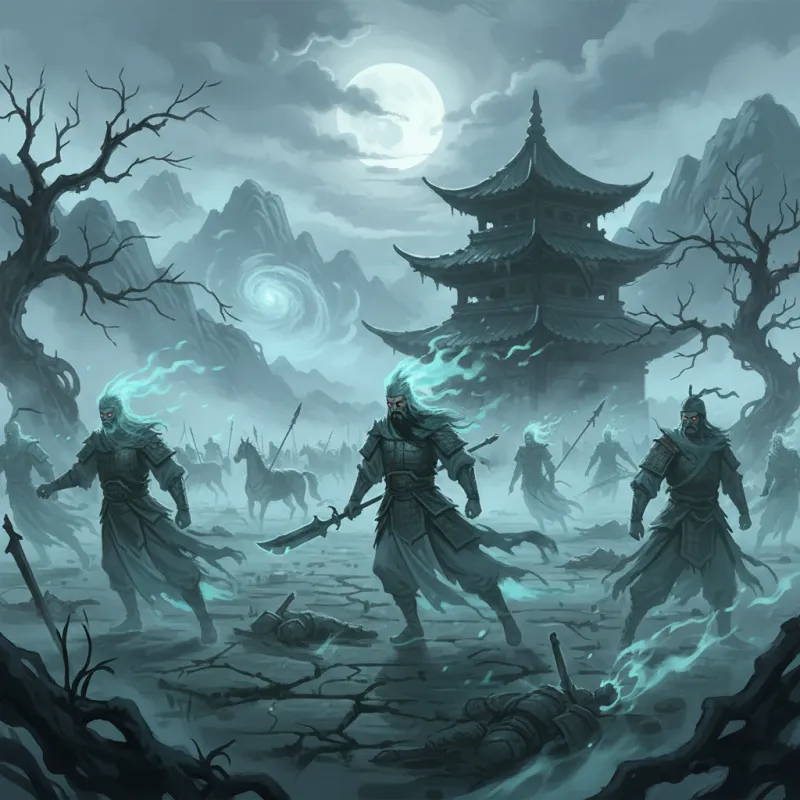
The general's head rolled across the execution platform, and within three days, the entire city knew his ghost was walking. Not metaphorically — literally walking through the streets of Jianye, armor clanking, demanding to know why his lord had betrayed him. This wasn't folklore that developed centuries later. According to the Records of the Three Kingdoms (三国志, Sānguó Zhì), people reported seeing the ghost of Gan Ning (甘宁) within weeks of his execution in 220 CE. When your death toll reaches millions and your heroes die through treachery, poison, and battlefield butchery, you don't get peaceful afterlives. You get hauntings.
The Geography of Violent Death
The Three Kingdoms period (三国, Sānguó, 220–280 CE) reduced China's population from roughly 56 million to 16 million in sixty years. That's not a typo. Warfare, famine, plague, and mass displacement killed approximately 40 million people — making it one of the deadliest conflicts in human history by percentage of population lost. The Yellow Turban Rebellion (黄巾起义, Huángjīn Qǐyì) that preceded the Three Kingdoms killed millions more starting in 184 CE.
In Chinese cosmology, violent death (横死, héngsǐ) creates problematic spirits. Death in battle, execution, assassination, suicide — these prevent the soul from completing its proper journey to the underworld. The hun (魂) and po (魄) souls become separated or trapped. Multiply that by millions, and you have a supernatural crisis on par with the political one.
The battlefields themselves became known as haunted grounds. The plains around Guandu (官渡), where Cao Cao defeated Yuan Shao in 200 CE, were reportedly so thick with ghost soldiers that travelers avoided the area after dark for generations. The Yangtze River valley, site of the Battle of Red Cliffs (赤壁之战, Chìbì Zhī Zhàn) in 208 CE, developed a reputation for phantom ships appearing in the mist — still burning, still full of screaming men.
When Guan Yu Became a God (By Haunting Everyone)
Guan Yu (关羽, 160–220 CE) is now worshipped as Guandi (关帝), the God of War, with temples across China and the Chinese diaspora. But his path to divinity started with revenge hauntings so persistent that they couldn't be ignored.
After Guan Yu was captured and executed by Sun Quan's forces in 220 CE, the hauntings began immediately. According to the Romance of the Three Kingdoms (三国演义, Sānguó Yǎnyì) — which draws on earlier historical accounts and oral traditions — Guan Yu's ghost appeared to the monk Pujing (普净) at Yuquan Mountain (玉泉山), still furious about his death, shouting "Give me back my head!" The monk had to explain that Guan Yu himself had killed countless men in battle: "Where are their heads?"
This story is significant because it addresses the central problem of Three Kingdoms ghost lore: how do you appease the spirits of men who were themselves killers? Guan Yu's ghost couldn't claim pure victimhood. His enlightenment — and eventual deification — came from accepting responsibility for the violence he'd perpetrated, not just the violence done to him.
But before enlightenment came haunting. Lu Meng (吕蒙), the general who captured Guan Yu, died within months, reportedly after seeing Guan Yu's ghost at a victory banquet. Sun Quan himself was said to be haunted by visions of Guan Yu. The historical Records of the Three Kingdoms notes that Lu Meng died suddenly of illness after the campaign, which later tradition interpreted as supernatural revenge.
The cult of Guan Yu grew precisely because his ghost was so powerful and so persistent. If you can't banish a spirit, you promote it. By the Sui Dynasty (581–618 CE), Guan Yu was receiving official sacrifices. By the Ming Dynasty (1368–1644 CE), he was a full deity. His temples became places where other restless spirits could be controlled — a haunter so powerful he could manage other haunters.
Cao Cao's Headache: The Ghost of Hua Tuo
Cao Cao (曹操, 155–220 CE) suffered from severe headaches, possibly migraines or a brain tumor. He summoned Hua Tuo (华佗), the most famous physician of the era, who recommended trepanation — drilling into the skull to relieve pressure. Cao Cao, paranoid and suspicious, decided this was an assassination attempt and had Hua Tuo executed in 208 CE.
The headaches got worse. Much worse.
According to multiple sources, including the Records of the Three Kingdoms and later commentaries, Cao Cao became convinced that Hua Tuo's ghost was tormenting him. The pain intensified. He saw visions. He heard voices. Modern readers might diagnose worsening neurological symptoms, but Cao Cao's contemporaries saw supernatural revenge. The man who could have cured him was now ensuring his suffering.
Cao Cao died in 220 CE, twelve years after executing Hua Tuo, still plagued by headaches. His tomb, discovered in 2009 in Anyang, contained his remains and evidence of the elaborate burial meant to protect him in the afterlife. Whether it protected him from Hua Tuo's ghost is another question.
This story resonates because it's about the consequences of paranoia and the specific irony of killing the one person who could help you. Hua Tuo's ghost doesn't haunt randomly — it haunts with precision, targeting the exact vulnerability Cao Cao wouldn't let him treat. It's revenge as medical malpractice from beyond the grave.
The Phantom Strategist: Zhuge Liang's Wooden Soldiers
Zhuge Liang (诸葛亮, 181–234 CE), the brilliant strategist of Shu, died during the Northern Expeditions against Wei. But according to legend, he didn't stop strategizing. His ghost — or perhaps his lingering consciousness — continued to protect Shu through supernatural means.
The most famous story involves the wooden ox and flowing horse (木牛流马, mùniú liúmǎ), mechanical transport devices Zhuge Liang invented to supply his armies through mountainous terrain. After his death, these devices reportedly continued operating on their own, guided by his spirit. Enemy forces who tried to capture them found the machines would malfunction or lead them into ambushes.
More dramatically, Zhuge Liang's ghost was said to appear on battlefields after his death, causing enemy troops to flee in terror. Sima Yi (司马懿), his rival strategist, reportedly saw Zhuge Liang's phantom commanding troops and ordered a retreat, giving rise to the saying "a dead Zhuge scares away a living Sima" (死诸葛吓走活仲达, sǐ Zhūgě xiàzǒu huó Zhòngdá).
This is a different kind of haunting — not revenge, but duty extending beyond death. Zhuge Liang's ghost stories reflect the Confucian ideal of loyalty (忠, zhōng) so profound that even death can't end it. He's not haunting because he died badly; he's haunting because his work wasn't finished. In Chinese ghost taxonomy, this makes him a guǐ (鬼) with purpose, potentially transitioning toward shén (神) status — a spirit becoming a deity through continued service.
The Drowned Army: Red Cliffs and River Ghosts
The Battle of Red Cliffs in 208 CE was a naval engagement where Cao Cao's massive fleet was destroyed by fire. Estimates suggest tens of thousands drowned in the Yangtze River. The Romance of the Three Kingdoms describes the river running red with blood, bodies so thick they formed rafts.
The Yangtze near Red Cliffs became notorious for shuǐguǐ (水鬼) — water ghosts. These spirits of the drowned were said to pull living people into the river, needing to drown someone else to escape their watery prison. Fishermen reported phantom hands grabbing their nets. Sailors saw burning ships in the fog that vanished when approached. Entire phantom fleets were said to replay the battle on certain nights.
Water ghost lore is particularly persistent in Chinese tradition because drowning is considered an especially bad death — the body often isn't recovered, preventing proper burial, and the soul becomes trapped in the water. The scale of drowning at Red Cliffs created what locals called a "ghost army" that couldn't disperse because they died together, in formation, still following orders.
This connects to broader Chinese beliefs about collective hauntings. Individual ghosts are dangerous, but ghost armies are catastrophic. They maintain military discipline in death, which makes them more organized and more threatening than random spirits. Some accounts suggest that Zhou Yu (周瑜), the Wu commander who won the battle, had to perform extensive rituals afterward to appease the spirits — not just of his enemies, but of his own men who died in the engagement.
The Red Cliffs hauntings persisted for centuries. Local temples dedicated to river gods and protective deities proliferated in the area, essentially creating a supernatural containment system. You can still visit temples near Red Cliffs today that perform annual rituals for the war dead, maintaining traditions that started in the immediate aftermath of the battle.
The Haunted Throne: Why Sun Quan Couldn't Sleep
Sun Quan (孙权, 182–252 CE), the founder of Eastern Wu, lived longer than most Three Kingdoms leaders and died of natural causes. But his final years were reportedly tormented by ghosts — specifically, the ghosts of family members and generals he'd executed or driven to death through paranoia.
Sun Quan had his own son, Sun He (孙和), deposed and effectively killed through political persecution. He executed loyal generals on suspicion of treason. As he aged, he became increasingly paranoid and cruel, seeing conspiracies everywhere. And then, according to court records and later histories, he started seeing ghosts everywhere too.
The palace at Jianye (建业, modern Nanjing) became known for supernatural disturbances during Sun Quan's final years. Guards reported seeing phantom soldiers. Sun Quan himself claimed to see his dead son and executed generals standing at the foot of his bed. He moved between palaces trying to escape the hauntings, but they followed him.
This is haunting as moral judgment. Sun Quan's ghosts weren't random victims of war — they were people he personally wronged through abuse of power. Chinese ghost stories often function as justice narratives, where the supernatural enforces accountability that human systems failed to provide. Sun Quan couldn't be tried for his crimes, but he could be haunted for them.
The historical sources are ambiguous about whether these were actual supernatural events or symptoms of guilt and mental decline. But that ambiguity is the point — in Chinese tradition, there's not always a clear line between psychological torment and spiritual haunting. Guilt itself can become a ghost.
The Legacy: Why These Ghosts Still Matter
Three Kingdoms ghost stories aren't museum pieces. Guan Yu temples still perform exorcisms, using his authority as a deified ghost to control other spirits. The Red Cliffs area still has annual rituals for the war dead. Zhuge Liang's tomb in Dingjun Mountain (定军山) is a pilgrimage site where people seek his wisdom — and some claim to receive it through dreams and visions.
These stories persist because they address something the historical record alone can't: the emotional and spiritual aftermath of mass violence. The Records of the Three Kingdoms tells you who won which battle. The ghost stories tell you what it cost, not just in lives but in souls.
They also reveal how Chinese culture processes trauma through supernatural narrative. When violence is too overwhelming to address directly, ghost stories provide a framework for discussing it. The hauntings make the invisible visible — they give form to grief, guilt, rage, and unfinished business.
Modern Chinese horror draws heavily on Three Kingdoms ghost lore. Films, novels, and games use these figures because they're immediately recognizable and carry deep cultural resonance. When a character encounters Guan Yu's ghost, Chinese audiences understand the full weight of that meeting — not just "scary ghost," but "the ghost of a man so powerful his rage became divine."
The Three Kingdoms period created heroes. It also created haunters. In Chinese tradition, those categories aren't mutually exclusive — they're often the same people, just at different points in their existence. The greatest heroes make the most dangerous ghosts, because they died with the most unfinished business and the strongest wills to continue affecting the world.
That's why, 1,800 years later, we're still telling their stories. And why, in temples and haunted battlefields across China, people still claim to see them walking.
Related Reading
- Ghost Month: Surviving the Seventh Month
- The Most Famous Chinese Ghost Stories: Tales That Have Haunted a Civilization
- Ghost Stories from Chinese Folklore: Tales That Will Keep You Awake
- Campus Ghost Stories in China: The Haunted Dormitories and Cursed Libraries
- Daoist Exorcism Rituals Explained: How to Kick Out a Demon the Chinese Way
- Exploring Chinese Supernatural Folklore: Ghosts, Spirits, and Afterlife Beliefs
- Daoist Exorcism: How Chinese Priests Fight Supernatural Evil
Explore Chinese Culture
- Explore ancient mythical creatures
- Explore Daoist exorcism traditions
- Explore Chinese folk beliefs and superstitions