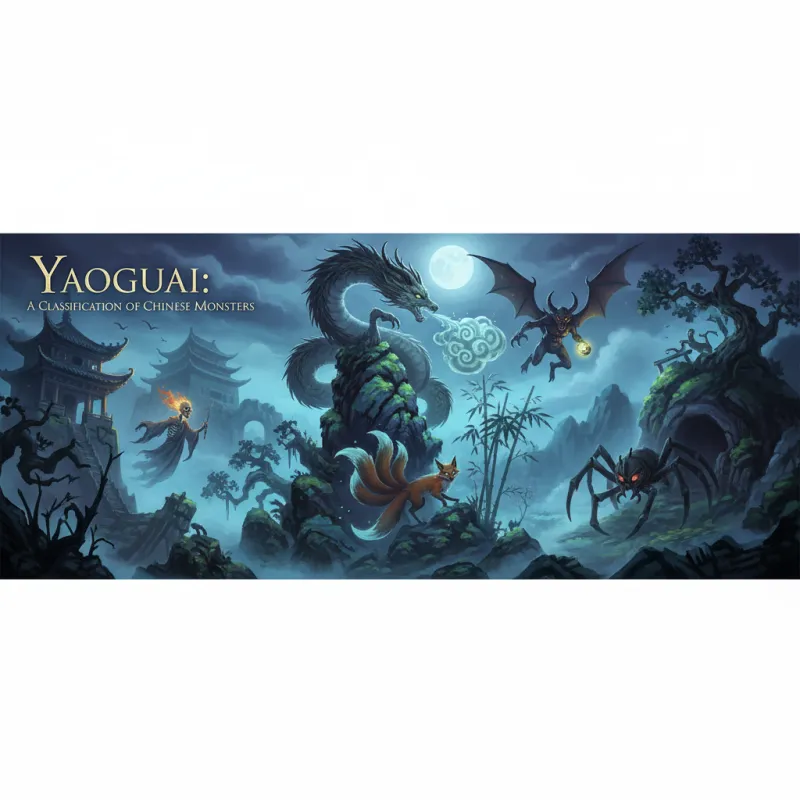
The fox spirit slips through the temple gate at dusk, her nine tails barely visible in the fading light. A scholar mistakes her for a beautiful woman. A farmer sees only a demon. The magistrate records her as a "yaoguai" (妖怪, yāoguài) in his official report—but what does that word actually mean? In Chinese supernatural taxonomy, yaoguai occupies a peculiar space: not quite demon, not quite spirit, but something that defies the neat categories Western readers expect from their monster manuals.
What Makes a Yaoguai Different
The character 妖 (yāo) carries connotations of bewitchment, seduction, and unnatural transformation. The character 怪 (guài) suggests strangeness, abnormality, something that shouldn't exist. Together, yaoguai describes beings that have transgressed natural boundaries—animals that cultivate human form, objects that gain sentience, spirits that refuse to stay dead. Unlike the gui or hungry ghosts that were once human, yaoguai typically originate from non-human sources. They're the result of excessive yin energy, prolonged exposure to human civilization, or simply living long enough to accumulate spiritual power.
The Ming dynasty novel "Journey to the West" (西游记, Xīyóu Jì) provides our most comprehensive catalog of yaoguai behavior. Nearly every chapter features a different monster blocking the pilgrims' path—but notice how author Wu Cheng'en distinguishes between them. The White Bone Demon (白骨精, Báigǔjīng) is explicitly called a "jing" (精), indicating she's achieved transformation through cultivation. The various demon kings ruling mountain territories are "yaoguai" because they've established themselves in the mortal realm, disrupting the natural order. The distinction matters: it tells us whether a creature is ascending toward enlightenment or descending into chaos.
The Cultivation Hierarchy
Chinese supernatural beings operate within a strict hierarchy based on cultivation level. At the bottom, you have ordinary animals and objects. A fox is just a fox. A stone is just a stone. But expose that fox to moonlight for three hundred years, or place that stone at a crossroads where human emotions accumulate, and something shifts. The creature begins to absorb qi (气, qì)—life energy—and develops awareness.
This is where yaoguai classification gets interesting. A creature in early-stage cultivation might be called a "jing" (精, jīng)—an essence or spirit. The term appears in compounds like huli jing (狐狸精, húlijīng) for fox spirits or shujing (树精, shùjīng) for tree spirits. These beings have achieved partial transformation but remain tied to their original nature. They're dangerous because they're liminal—powerful enough to harm humans but not wise enough to understand consequences.
After several centuries of cultivation, a jing might become a yaoguai proper. The difference? Intent and organization. Yaoguai establish territories, gather followers, and actively interfere with human affairs. The spider demons in "Journey to the West" who capture Tang Sanzang aren't just hungry—they've built an entire cave complex, developed a strategy, and work as a coordinated unit. That level of sophistication separates yaoguai from mere jing.
At the top of the hierarchy sit the xian (仙, xiān)—immortals who've transcended their monstrous origins entirely. The most famous example is Erlang Shen's celestial dog, originally a yaoguai who achieved enlightenment through service to heaven. This progression reveals something crucial about Chinese supernatural philosophy: the categories aren't fixed. A yaoguai can become a god. A god can fall and become a yaoguai. The boundary is behavioral, not ontological.
Regional Variations and Local Yaoguai
Travel from Guangdong to Manchuria and you'll encounter completely different yaoguai ecosystems. Southern China, with its dense forests and humid climate, produces snake and tiger yaoguai. The Qing dynasty collection "Liaozhai Zhiyi" (聊斋志异, Liáozhāi Zhìyì) by Pu Songling documents dozens of regional variants. In Shandong, fox spirits dominate. In Sichuan, mountain yaoguai called shanjing (山精, shānjīng) terrorize travelers. Northern regions feature more horse and wolf yaoguai, reflecting the pastoral lifestyle.
Water yaoguai deserve special mention. Rivers, lakes, and seas each harbor distinct species. The jiaolong (蛟龙, jiāolóng)—a flood dragon—represents a snake or fish that's cultivated for a thousand years but hasn't yet achieved true dragon status. These creatures occupy a fascinating middle ground: too powerful to be mere yaoguai, not legitimate enough to be dragons. Local officials would sometimes negotiate with jiaolong, offering sacrifices in exchange for flood control. The relationship between humans and water yaoguai was transactional rather than adversarial—you respected their territory, they didn't drown your village.
The Yaoguai-Human Relationship
Here's what Western readers often miss: yaoguai aren't inherently evil. They're inherently disruptive. A fox spirit who falls in love with a scholar and lives quietly as his wife might never be discovered. She becomes a problem only when her presence causes imbalance—the scholar neglects his duties, his health deteriorates, or (most commonly) a Daoist priest notices the supernatural energy and decides to intervene.
The "Strange Tales from a Chinese Studio" presents dozens of yaoguai-human relationships that end happily. The key factor is whether the yaoguai respects human social structures. A ghost bride who maintains her husband's household and produces children (even supernatural ones) might be tolerated by the community. A jiangshi or hopping vampire that drains villagers indiscriminately will be hunted down. The moral calculus isn't about the creature's nature but its behavior.
This explains why exorcism in Chinese tradition often involves negotiation before violence. A Daoist priest encountering a yaoguai will first determine its intentions. Is it seeking revenge for a legitimate grievance? Offer it justice and it might leave peacefully. Is it simply hungry? Provide alternative food sources. Only when negotiation fails do priests resort to talismans, swords, and binding spells. The goal isn't extermination but restoration of balance.
Yaoguai in Modern Context
Contemporary Chinese media has revitalized yaoguai classification in fascinating ways. The animated film "White Snake" (白蛇:缘起, Báishé: Yuánqǐ) explores the romance between a snake yaoguai and a human, but frames it through modern concepts of identity and choice. Video games like "Black Myth: Wukong" present yaoguai as complex characters with motivations beyond simple monstrosity. Even the terminology has evolved—younger Chinese speakers might use "yaoguai" affectionately to describe someone eccentric or unconventional.
This linguistic shift reflects changing attitudes toward the supernatural. In imperial China, yaoguai represented genuine threats that required ritual management. In modern China, they've become metaphors for otherness, transformation, and the persistence of tradition in a rapidly modernizing society. When a Chinese person calls their friend a "little yaoguai" (小妖怪, xiǎo yāoguài), they're invoking centuries of folklore while simultaneously acknowledging its distance from contemporary life.
Classification Systems Across Texts
Different texts employ different classification schemes. The "Shan Hai Jing" (山海经, Shān Hǎi Jīng) organizes creatures geographically—each mountain range has its characteristic monsters. The "Soushen Ji" (搜神记, Sōushén Jì) from the Jin dynasty categorizes by origin story—how the creature came to be supernatural. Ming and Qing dynasty novels like "Fengshen Yanyi" (封神演义, Fēngshén Yǎnyì) classify by power level and celestial allegiance.
The most sophisticated system appears in Daoist ritual texts, which categorize yaoguai by the type of qi they've absorbed. Wood-element yaoguai (tree spirits, plant demons) require different exorcism techniques than metal-element yaoguai (weapon spirits, ore demons). This elemental classification connects to traditional Chinese medicine and cosmology—the same five-element system that governs human health also governs supernatural beings.
Understanding these classification systems matters because they reveal how Chinese culture conceptualized the relationship between natural and supernatural. Yaoguai aren't invasions from another dimension—they're natural phenomena that have exceeded their proper boundaries. A tree that lives for eight hundred years naturally accumulates spiritual energy. Whether it becomes a benevolent guardian or a malevolent yaoguai depends on environmental factors, human interaction, and the tree's own choices during cultivation.
The Enduring Appeal
Why do yaoguai continue to fascinate? Perhaps because they represent transformation itself—the possibility that anything, given enough time and the right conditions, can transcend its original nature. In a culture that values cultivation, education, and self-improvement, yaoguai embody both the promise and danger of change. They remind us that boundaries between categories are permeable, that monsters can become gods and gods can fall, that the strange and supernatural are always closer than we think.
The next time you encounter a yaoguai in Chinese media, look beyond the surface. Ask what it was before transformation, what it wants now, and whether it's ascending or descending the cultivation hierarchy. Those questions will tell you more about Chinese supernatural philosophy than any simple definition of "monster" ever could.
Related Reading
- Unveiling the Shadows: A Journey Through Chinese Supernatural Folklore of Ghosts and Spirits
- Exploring the Dark Realms: Chinese Demons and Their Significance in Folklore
- Jiangshi: The Chinese Hopping Vampire
- Demons of Journey to the West: The Most Creative Monsters in Chinese Fiction
- Daoist Exorcism: The Art of Banishing Spirits in Chinese Culture
- The Legend of the White Snake: A Complete Retelling
- The Liaozhai Stories That Hollywood Should Adapt (But Probably Won't)
- Exploring the Multifaceted World of Chinese Supernatural Folklore and Afterlife Beliefs
Explore Chinese Culture
- Explore ancient mythical creatures
- Explore Daoist exorcism traditions
- Explore Chinese folk beliefs and superstitions