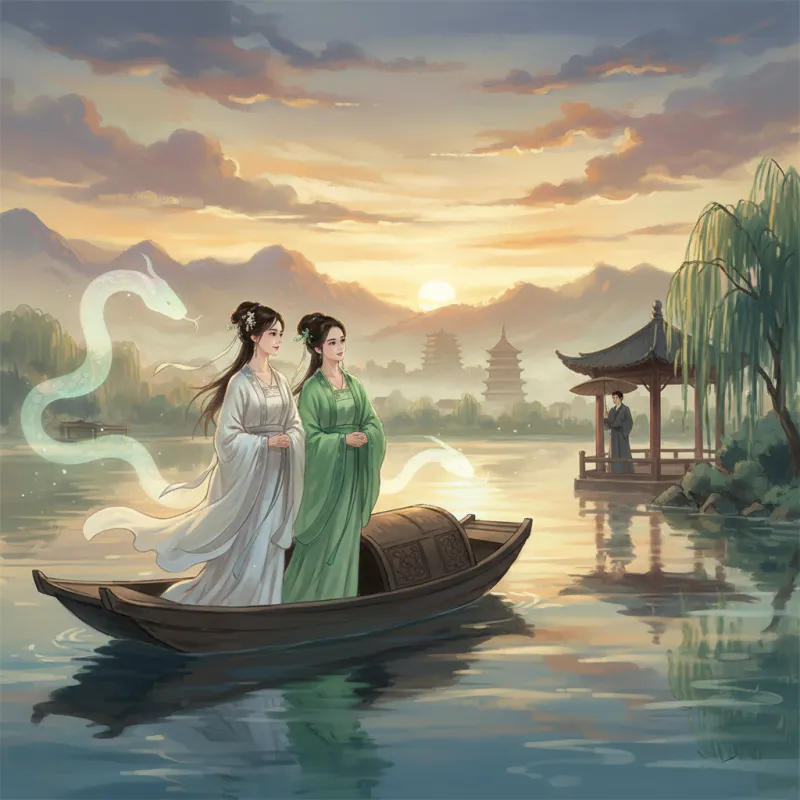
The Legend of the White Snake: China's Greatest Love Story
Introduction: A Tale That Transcends Time
Among the pantheon of Chinese folklore, few stories have captured the imagination quite like the Legend of the White Snake (白蛇传, Báishé Zhuàn). This tale of forbidden love between a snake spirit and a mortal man has endured for over a millennium, evolving through countless retellings in opera, literature, film, and television. At its heart lies a profound question that resonates across cultures: what defines true love, and can it transcend the boundaries between the human and supernatural worlds?
The legend centers on Bai Suzhen (白素贞, Bái Sùzhēn), a white snake demon who has cultivated herself for a thousand years to achieve human form, and her devoted love for Xu Xian (许仙, Xǔ Xiān), a humble scholar and pharmacist. Their romance, blessed by genuine affection yet cursed by cosmic law, represents one of Chinese literature's most poignant explorations of love, sacrifice, and the conflict between personal desire and social order.
Origins and Historical Development
Early Roots in Tang Dynasty Tales
The earliest traces of the White Snake legend appear during the Tang Dynasty (618-907 CE) in collections of strange tales known as zhiguai (志怪) literature. These proto-versions featured snake spirits in far more sinister roles—seductive demons who drained the life force from unsuspecting men. The Bianzheng Lun (辩正论), a Buddhist text from this period, contains references to white snake spirits that would later influence the legend's development.
However, the transformation from cautionary tale to romance began during the Song Dynasty (960-1279 CE). The story "The White Maiden Locked Forever in the Leifeng Pagoda" (白娘子永镇雷峰塔, Bái Niángzi Yǒng Zhèn Léifēng Tǎ) from the collection Qingping Shantang Huaben marked a crucial shift. Here, the white snake began to exhibit more sympathetic qualities, though the narrative still emphasized the danger of human-demon relationships.
Ming and Qing Dynasty Refinements
The legend reached its mature form during the Ming (1368-1644) and Qing (1644-1912) dynasties. Feng Menglong's (冯梦龙) story collection and various operatic adaptations softened Bai Suzhen's character, transforming her from a dangerous seductress into a devoted wife wronged by circumstance. The addition of Xiaoqing (小青, Xiǎoqīng), the green snake spirit and Bai Suzhen's loyal companion, added depth and emotional resonance to the narrative.
By the Qing Dynasty, the story had become a staple of Chinese opera, particularly in the kunqu (昆曲) and jingju (京剧, Beijing Opera) traditions. These performances emphasized the tragic nobility of Bai Suzhen's love and increasingly portrayed the Buddhist monk Fahai (法海, Fǎhǎi) as an antagonist rather than a righteous demon-slayer.
The Core Narrative: Love Across Realms
The Fateful Meeting at West Lake
The story traditionally begins at West Lake (西湖, Xī Hú) in Hangzhou, one of China's most celebrated scenic locations. On the Qingming Festival (清明节, Qīngmíng Jié), the day when Chinese honor their ancestors, Bai Suzhen and Xiaoqing take human form to experience the mortal world. A sudden rainstorm brings Bai Suzhen and Xu Xian together when he gallantly offers her his umbrella on the Broken Bridge (断桥, Duàn Qiáo).
This meeting is no accident. In many versions, Bai Suzhen seeks Xu Xian specifically because, in a previous life, he was a young boy who saved her when she was merely a small white snake. This concept of yuanfen (缘分)—predestined affinity or karmic connection—runs throughout the tale, suggesting that their love transcends a single lifetime.
Marriage and Domestic Bliss
Bai Suzhen and Xu Xian marry and open a medicine shop in Hangzhou. Here, the legend showcases Bai Suzhen's benevolent nature. Using her supernatural knowledge of herbs and healing, she provides miraculous cures to the sick, asking nothing in return. The couple's happiness represents an idealized vision of marital harmony, with Bai Suzhen embodying the Confucian virtues of a devoted wife while secretly using her powers to ensure their prosperity.
This period of contentment establishes the emotional stakes of the story. Bai Suzhen is not a demon seeking to harm humans; she genuinely loves Xu Xian and wishes only to live a normal life beside him. Her supernatural nature becomes irrelevant in the face of her sincere devotion and moral behavior.
The Intervention of Fahai
Enter Fahai, the abbot of Jinshan Temple (金山寺, Jīnshān Sì). In Buddhist cosmology, demons and spirits who assume human form violate the natural order, regardless of their intentions. Fahai, perceiving Bai Suzhen's true nature, sees it as his sacred duty to separate the couple and imprison the snake spirit.
The character of Fahai embodies a crucial tension in Chinese thought: the conflict between rigid adherence to cosmic law and human compassion. While Buddhist doctrine emphasizes compassion (cibei, 慈悲), Fahai represents a more dogmatic interpretation that prioritizes maintaining boundaries between realms over individual happiness.
The Dragon Boat Festival Revelation
The story's central crisis occurs during the Dragon Boat Festival (端午节, Duānwǔ Jié), traditionally a time when evil spirits are warded off. Fahai convinces Xu Xian to give his wife realgar wine (雄黄酒, xiónghuáng jiǔ), a substance toxic to snake spirits. Unable to refuse without arousing suspicion, Bai Suzhen drinks and temporarily loses control of her human form, revealing her true appearance as a massive white serpent.
Xu Xian, confronted with his wife's true nature, dies of fright. This moment represents the story's emotional nadir—the revelation that destroys their carefully constructed domestic happiness. However, it also sets the stage for Bai Suzhen's greatest act of devotion.
The Theft of the Immortal Herb
Desperate to revive her husband, Bai Suzhen undertakes a perilous journey to Kunlun Mountain (昆仑山, Kūnlún Shān), the mythical home of the immortals. There grows the lingzhi (灵芝) or immortal herb, guarded by the Crane Boy and Deer Boy, servants of the immortal Nanji Xianweng (南极仙翁, Nánjí Xiānwēng), the God of Longevity.
Bai Suzhen, heavily pregnant, must battle these guardians. The fight scenes in operatic versions of this episode showcase her martial prowess and unwavering determination. Moved by her devotion, Nanji Xianweng ultimately allows her to take the herb, recognizing that her love transcends the usual demon-human divide.
This sequence emphasizes a key theme: Bai Suzhen's willingness to risk everything—her life, her unborn child, her very existence—for Xu Xian's sake. Her love is proven not through words but through sacrifice.
The Flooding of Jinshan Temple
After reviving Xu Xian, Bai Suzhen faces Fahai's continued persecution. When the monk imprisons Xu Xian at Jinshan Temple, Bai Suzhen and Xiaoqing summon the waters of the Yangtze River to flood the temple in an attempt to rescue him. This spectacular scene, a highlight of operatic performances, demonstrates the full extent of Bai Suzhen's supernatural power.
The flooding of Jinshan Temple (shui man jinshan, 水漫金山) has become one of the most iconic images in Chinese folklore. It represents the clash between personal love and institutional authority, between the natural world (represented by water and serpents) and human civilization (represented by the temple).
However, Bai Suzhen's pregnancy weakens her powers, and she cannot overcome Fahai's Buddhist magic. The flood causes tremendous destruction, and this act of desperation ultimately provides Fahai with justification for his harsh judgment.
Imprisonment at Leifeng Pagoda
The legend reaches its tragic climax when Fahai imprisons Bai Suzhen beneath Leifeng Pagoda (雷峰塔, Léifēng Tǎ) on the shores of West Lake. She has just given birth to her son, Xu Mengjiao (许梦蛟, Xǔ Mèngjiāo), and must be separated from both her child and her husband. Fahai declares she will remain imprisoned until "the lake dries and the pagoda falls" (xihu gan, leifeng ta dao, 西湖干,雷峰塔倒)—essentially, forever.
This imprisonment represents the ultimate triumph of cosmic order over individual desire. Yet the image of Bai Suzhen trapped beneath the pagoda, separated from her family despite her genuine love and virtuous behavior, has resonated with audiences for centuries as a profound injustice.
Liberation and Reunion
In most traditional versions, the story concludes twenty years later when Xu Mengjiao, having grown into a brilliant scholar, places first in the imperial examinations. Returning to West Lake in glory, he prays at Leifeng Pagoda. His filial devotion and scholarly achievement—the highest virtues in Confucian society—finally break the spell. The pagoda collapses, and Bai Suzhen is freed to reunite with her family.
Modern adaptations often add that Xiaoqing, who escaped Fahai's capture, spent the intervening years cultivating her powers and ultimately defeats the monk, adding a note of justice to the conclusion. Some versions even suggest that Fahai's rigid interpretation of Buddhist law was itself a violation of true Buddhist compassion, and that his defeat represents a cosmic correction.
Themes and Cultural Significance
Love Transcending Boundaries
At its core, the White Snake legend explores whether love can exist across fundamental differences. Bai Suzhen and Xu Xian's relationship challenges the rigid categories that structure Chinese cosmology: human and demon, mortal and immortal, natural and supernatural. Their love suggests that genuine affection and moral behavior matter more than one's essential nature.
This theme resonates with universal human experiences of love across social, cultural, or religious boundaries. The story asks: should lovers be separated because of what they are, or should they be judged by how they treat each other?
Female Agency and Sacrifice
Bai Suzhen stands as one of Chinese literature's most powerful female characters. Unlike passive heroines who wait for rescue, she actively pursues her desires, uses her powers to help others, and fights formidable opponents to protect her family. Yet she also embodies traditional feminine virtues: devotion to her husband, care for her child, and willingness to sacrifice herself for her family's welfare.
This combination makes her a complex figure who appeals across ideological lines. Traditional audiences appreciate her wifely devotion; modern audiences admire her strength and agency. She represents an ideal that transcends simple categorization.
The Conflict Between Law and Compassion
Fahai's role in the story raises profound questions about justice and mercy. He acts according to established cosmic law—demons should not mingle with humans. Yet his rigid enforcement of this law destroys a loving family and causes tremendous suffering. The story suggests that laws, even divine ones, must be tempered with compassion and consideration of individual circumstances.
This theme reflects ongoing tensions in Chinese philosophy between Legalist emphasis on strict rule enforcement and Confucian/Buddhist emphasis on moral flexibility and compassion. The audience's sympathy for Bai Suzhen and criticism of Fahai suggests a cultural preference for the latter.
Cultivation and Transformation
Bai Suzhen's thousand years of cultivation (xiulian, 修炼) to achieve human form reflects Daoist and Buddhist concepts of spiritual development. Her journey from animal to demon to something approaching human represents the possibility of transformation through dedicated effort. Yet the story questions whether such transformation is ever complete—can one truly change one's fundamental nature, or does the past always reassert itself?
The Legend's Enduring Legacy
Artistic Adaptations
The White Snake legend has inspired countless artistic works. Traditional opera performances remain popular, with the role of Bai Suzhen considered one of the most demanding in the repertoire. The 1992 television series "The New Legend of Madame White Snake" introduced the story to a new generation and remains beloved across Asia. More recent adaptations include the 2019 animated film "White Snake" and the 2021 sequel "Green Snake," which reimagine the tale with stunning visuals and contemporary sensibilities.
Each adaptation reflects its era's values while maintaining the story's emotional core. Modern versions often emphasize Bai Suzhen's agency more strongly and question Fahai's authority more directly, but the central tragedy of lovers separated by forces beyond their control remains constant.
Cultural Impact
Leifeng Pagoda, which actually collapsed in 1924, was rebuilt in 2002 and stands as a monument to the legend. West Lake's Broken Bridge remains a popular destination for couples, who see it as a symbol of romantic destiny. The phrase "white snake" (baishe) in Chinese culture immediately evokes this legend, and references to it appear throughout Chinese literature, film, and popular culture.
The story has also influenced how Chinese culture thinks about the supernatural. Bai Suzhen's portrayal as a sympathetic demon helped shift Chinese folklore toward more nuanced depictions of supernatural beings, moving away from simple good-versus-evil dichotomies.
Conclusion: A Love That Defies Definition
The Legend of the White Snake endures because it speaks to fundamental human experiences: the joy of finding love, the pain of separation, the willingness to sacrifice for those we cherish, and the hope for reunion. Bai Suzhen's thousand-year cultivation, her brief happiness with Xu Xian, her imprisonment, and her ultimate liberation create a narrative arc that satisfies both emotionally and philosophically.
The story refuses simple interpretations. Is it a tragedy about love destroyed by inflexible authority? A cautionary tale about the dangers of crossing cosmic boundaries? A celebration of love's power to transcend all obstacles? Perhaps it is all of these, and this multiplicity of meanings ensures its continued relevance.
In Bai Suzhen, Chinese culture created a character who embodies contradictions: demon and devoted wife, supernatural being and moral exemplar, powerful sorceress and vulnerable lover. Her story reminds us that love, in its truest form, recognizes no boundaries—not between species, not between realms, not even between the mortal and the eternal. And perhaps that is why, after more than a thousand years, the White Snake's legend continues to captivate hearts across the world.