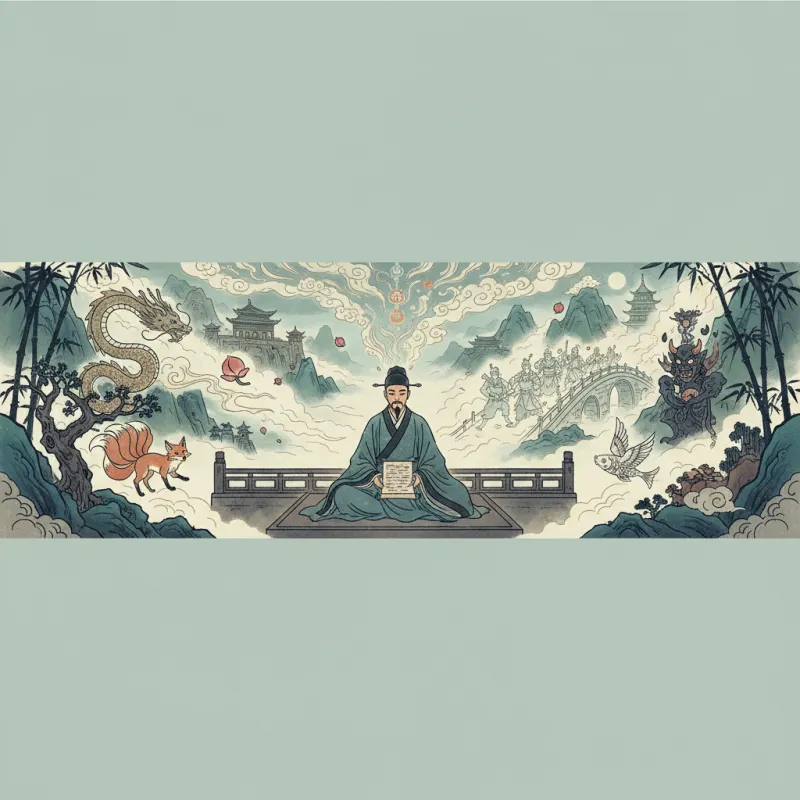
Your grandmother appears in your dream, standing at the foot of your bed, pointing silently toward the kitchen. You wake up unsettled. Three days later, a gas leak nearly kills your family. Coincidence? Not in Chinese tradition. That dream was a warning — and you should have listened sooner.
Chinese dream interpretation (解梦, jiěmèng) doesn't treat dreams as the brain's nightly garbage disposal. It treats them as intelligence reports from realms you can't access while awake. Your hun soul (魂, hún) — the ethereal part of you that wanders during sleep — travels to places your physical body cannot go. It observes. It receives messages. It brings back information encoded in symbols that you must learn to decode.
This isn't mysticism dressed up as psychology. It's a systematic approach to understanding communications from the dead, from spirits, and from the fabric of fate itself. The tradition has survived thousands of years not because people are superstitious, but because it works often enough to be taken seriously.
The Duke of Zhou Knew What He Was Talking About
The Zhou Gong Jie Meng (周公解梦, Duke of Zhou's Dream Interpretations) is the foundational text, attributed to the Duke of Zhou who served as regent around 1000 BCE during the early Zhou Dynasty. Whether he actually wrote it is debatable — the text we have today was likely compiled much later — but the attribution matters. The Duke of Zhou was considered the ideal Confucian statesman, a man of perfect virtue and wisdom. Attaching his name to a dream interpretation manual gave the practice intellectual legitimacy.
The text is essentially a dictionary. Dream of teeth falling out? Expect a death in the family. Dream of snakes? Someone is plotting against you. Dream of climbing a mountain? Success is coming, but only if you reach the summit. The interpretations are specific, practical, and often grim. This isn't a self-help book telling you to follow your dreams. It's a warning system.
What makes the Zhou Gong Jie Meng different from Western dream interpretation is its focus on prediction rather than psychology. Freud wanted to know what your dreams revealed about your repressed desires. The Duke of Zhou wanted to know what your dreams revealed about next week. The assumption is that time isn't as linear as we think, and your hun soul, freed from your body during sleep, can perceive events that haven't happened yet in the waking world.
The Wandering Hun Soul Does the Heavy Lifting
Understanding Chinese dream interpretation requires understanding the Chinese concept of the soul — or rather, souls, plural. You don't have one soul. You have at least two: the hun (魂, hún) and the po (魄, pò). The hun is your ethereal, spiritual soul, associated with yang energy. The po is your corporeal soul, tied to your physical body and yin energy. When you die, your hun ascends to the heavens or the afterlife, while your po remains with your corpse and eventually dissolves into the earth.
During sleep, your hun temporarily separates from your body and wanders. This is why you dream. You're not imagining things — you're experiencing what your hun soul is actually seeing and doing in the spirit realm. It might visit deceased relatives. It might encounter ghosts or demons. It might observe future events. It might receive messages from deities or ancestors who want to communicate with you.
This is also why waking someone suddenly is considered dangerous in Chinese tradition. If you startle someone awake, their hun might not have time to return to their body properly, leaving them disoriented, ill, or vulnerable to spiritual possession. Children are especially at risk because their hun souls are less firmly anchored. This belief is why you'll see Chinese parents being very gentle when waking their children, calling their names softly rather than shaking them.
The wandering hun explains why dreams feel so real and why they sometimes contain information you couldn't possibly know. Your hun was actually there. It saw things. The challenge is that the hun doesn't communicate in straightforward language — it communicates in symbols, and those symbols must be interpreted correctly.
Symbols Mean Specific Things, Not Whatever You Want
Western dream interpretation, especially the pop psychology version, tends toward the subjective. "What does this symbol mean to you?" Chinese dream interpretation is the opposite. Symbols have established meanings, and your personal feelings about them are largely irrelevant. This is a feature, not a bug. If everyone interpreted symbols differently, the system would be useless for prediction.
Water in dreams is almost always significant. Clear, calm water indicates good fortune and smooth progress. Turbulent or muddy water means obstacles and emotional turmoil. Drowning suggests you're overwhelmed by circumstances beyond your control. Crossing a river successfully means you'll overcome a major challenge. These interpretations are consistent across centuries of texts.
Snakes are complicated. A snake in your house means betrayal by someone close to you. Killing a snake means you'll defeat an enemy. Being bitten by a snake is a warning about health problems or poisonous relationships. But a snake transforming into a dragon — that's auspicious, indicating a major positive transformation in your life. The specific context matters enormously.
Death in dreams rarely means actual death. Dreaming of your own death often indicates a major life transition or the end of one phase and the beginning of another. Dreaming of someone else's death might mean that person will experience good fortune — the dream inverts the reality. But dreaming of attending a funeral? That's usually positive, suggesting you'll receive an inheritance or unexpected wealth.
Teeth falling out is consistently bad news. It indicates death or serious illness in the family, usually affecting an elder. The specific teeth matter: upper teeth represent elders on your father's side, lower teeth represent your mother's side. This interpretation is so widespread that even Chinese people who don't believe in dream interpretation will feel uneasy after such a dream.
Ancestors Use Dreams as Their Primary Communication Channel
Your deceased relatives haven't stopped caring about you just because they're dead. They're watching, and when they need to communicate, dreams are the most reliable method. A dream visit from a deceased grandparent isn't your subconscious processing grief — it's an actual visit from their hun soul, which persists after death.
These ancestral dream visits have recognizable characteristics. The deceased relative appears clearly, often looking younger and healthier than they did at death. They might speak directly, offering advice or warnings. They might gesture or point, indicating something you need to pay attention to. They might appear distressed, which usually means they need something from you — often proper ritual offerings or the resolution of unfinished business.
If a deceased relative appears in your dream asking for food, water, or money, you need to make offerings at their grave or at your family altar immediately. They're hungry or in need in the afterlife, and you've neglected your filial duties. Ignore such dreams at your peril — the ancestor might escalate to more aggressive haunting methods if you don't respond.
Sometimes ancestors appear to warn you about dangers. The grandmother pointing toward the kitchen wasn't being cryptic for fun — she was showing you where the problem was. Ancestors can perceive threats that you can't, and they'll use dreams to alert you. The challenge is that they can't always communicate clearly, so you need to pay attention to details and act on even vague warnings.
The most important ancestral dreams are those that occur around the Qingming Festival (清明节, Qīngmíng Jié) or the Ghost Festival (中元节, Zhōngyuán Jié). During these times, the boundary between the living and dead is thinner, and ancestral communications are more frequent and more urgent. If you dream of deceased relatives during these periods, take the dreams especially seriously.
Not All Dream Visitors Are Your Friends
Your hun soul wanders during sleep, but so do other entities. Ghosts, demons, and malevolent spirits can intercept your hun or invade your dreams directly. These aren't symbolic representations of your fears — they're actual spiritual intrusions that require protection and countermeasures.
Nightmares involving being chased, paralyzed, or attacked often indicate spiritual interference. Sleep paralysis, which Western medicine explains as a neurological phenomenon, is understood in Chinese tradition as a ghost pressing on your chest (鬼压床, guǐ yā chuáng). A ghost or demon is literally sitting on you, preventing you from moving. The experience is terrifying because it's an actual assault, not a dream.
Recurring nightmares are especially concerning. They suggest a persistent spiritual problem — either a ghost has attached itself to you, or you're being targeted by something malevolent. This is when you need intervention: protective talismans, cleansing rituals, or consultation with a Daoist priest or spirit medium who can identify the entity and drive it away.
Erotic dreams involving strangers or supernatural beings are particularly dangerous. These might be fox spirits (狐狸精, húlijīng) or other seductive entities that drain your life force through sexual encounters in dreams. Men are especially vulnerable to succubus-like spirits that appear as beautiful women. If you wake from such dreams feeling exhausted, drained, or ill, you're being fed upon. Fox spirits are notorious for this behavior, and they won't stop unless forced to.
The solution involves both spiritual protection and practical measures. Placing scissors under your pillow, hanging a mirror facing outward above your bed, or keeping a bowl of uncooked rice by your bedside can deter malevolent entities. More serious cases require professional help — a spirit medium can identify what's attacking you and perform the necessary rituals to drive it away.
The Government Bureaucracy Extends Into Your Dreams
Chinese cosmology includes a vast supernatural bureaucracy that mirrors the imperial government. The Jade Emperor (玉皇大帝, Yùhuáng Dàdì) presides over a hierarchy of deities, officials, and functionaries who manage everything from weather to human lifespans. This bureaucracy doesn't stop operating just because you're asleep. In fact, dreams are one of the primary ways these officials communicate with mortals.
Dreaming of official-looking figures, especially those wearing traditional robes or carrying scrolls, often indicates contact with supernatural bureaucrats. These aren't random dream characters — they're actual officials from the celestial administration. If such a figure speaks to you or hands you a document, pay close attention. You're receiving official communication from the spirit world.
The City God (城隍, Chénghuáng) and his subordinates are particularly active in dreams. The City God is responsible for the dead in his jurisdiction, and he sometimes appears in dreams to deliver messages about deceased relatives or to warn about impending death. If you dream of being summoned to a government office or courthouse in the afterlife, it's not symbolic — you're actually being called to account for your behavior.
Some dreams involve being given tasks or missions by supernatural officials. These aren't suggestions. If a deity or celestial official tells you to do something in a dream, you need to do it. Failure to comply can result in punishment, illness, or misfortune. The supernatural bureaucracy takes its authority seriously, and mortals who ignore official communications do so at their own risk.
Modern Chinese People Still Check the Dream Dictionary
Walk into any Chinese bookstore, and you'll find multiple editions of the Zhou Gong Jie Meng for sale. Download any Chinese app store's top apps, and you'll find dream interpretation apps with millions of users. This isn't a dead tradition kept alive by elderly villagers. Urban, educated, modern Chinese people still consult dream interpretation guides regularly.
The practice has adapted to modern life. Contemporary dream dictionaries include interpretations for dreaming about cars, airplanes, computers, and smartphones. Dreaming of a car accident has replaced dreaming of a carriage accident. Dreaming of your phone breaking might indicate communication problems in your relationships. The symbols change, but the underlying logic remains the same: dreams are messages that can be decoded.
Chinese social media is full of people sharing dreams and asking for interpretations. "I dreamed my teeth fell out, is my grandmother going to die?" "I keep dreaming about snakes, what does this mean?" The responses aren't dismissive — people take these questions seriously and offer interpretations based on traditional texts and personal experience.
Even Chinese people who consider themselves skeptical will often hedge their bets. "I don't really believe in dream interpretation, but..." followed by a detailed description of a disturbing dream and a request for interpretation. The tradition is too deeply embedded in the culture to dismiss entirely. Better to check the dream dictionary and take precautions than to ignore a potential warning and regret it later.
The persistence of dream interpretation in modern China suggests something important: the tradition provides value that scientific materialism doesn't. Whether the dreams are actually prophetic or whether the practice simply encourages people to pay attention to their intuition and subconscious warnings, it works well enough to survive in a rapidly modernizing society.
Your Dreams Deserve More Respect Than You're Giving Them
Western culture has trained you to dismiss your dreams as meaningless noise. Chinese tradition suggests you're ignoring valuable intelligence. Your hun soul is traveling, observing, and bringing back information. Your ancestors are trying to communicate. The supernatural bureaucracy is sending you messages. Spirits are interacting with you. All of this is happening while you sleep, and you're writing it off as random brain activity.
You don't have to believe in the literal truth of wandering souls and celestial bureaucrats to benefit from taking your dreams more seriously. At minimum, dreams reflect your subconscious awareness of patterns and dangers that your conscious mind hasn't processed yet. Your grandmother appearing in a dream and pointing toward the kitchen might be your subconscious noticing a gas smell you didn't consciously register. The interpretation method doesn't matter as much as the practice of paying attention.
Keep a dream journal. When you have a vivid or disturbing dream, write it down immediately upon waking. Note the symbols, the emotions, the specific details. Consult a dream interpretation guide — traditional Chinese texts are available in translation, and modern versions are easy to find online. Look for patterns. See if the interpretations correlate with events in your waking life.
If you have recurring nightmares or dreams that leave you feeling drained and disturbed, consider the possibility of spiritual interference. You don't need to fully believe in ghost possession to take basic protective measures. Clean your sleeping space. Remove clutter. Consider traditional protective items like mirrors or talismans. At worst, you've improved your sleep hygiene. At best, you've driven away something that was feeding on you.
Your dreams are trying to tell you something. The question is whether you're willing to listen.
Related Reading
- Ghost Press (鬼压床): The Chinese Explanation for Sleep Paralysis
- Dream Spirits and Sleep Demons: The Supernatural World of Chinese Dreams
- Soul Travel in Chinese Belief: When Your Spirit Leaves Your Body During Sleep
- Dream Interpretation in Chinese Culture: When the Spirit Wanders at Night
- Campus Ghost Stories in China: The Haunted Dormitories and Cursed Libraries
- Exploring Chinese Supernatural Folklore: Ghosts, Spirits, and Afterlife Beliefs
- The Ten Kings of Hell: A Complete Guide to Chinese Underworld Justice
Explore Chinese Culture
- Explore ancient mythical creatures
- Explore Daoist exorcism traditions
- Explore Chinese folk beliefs and superstitions