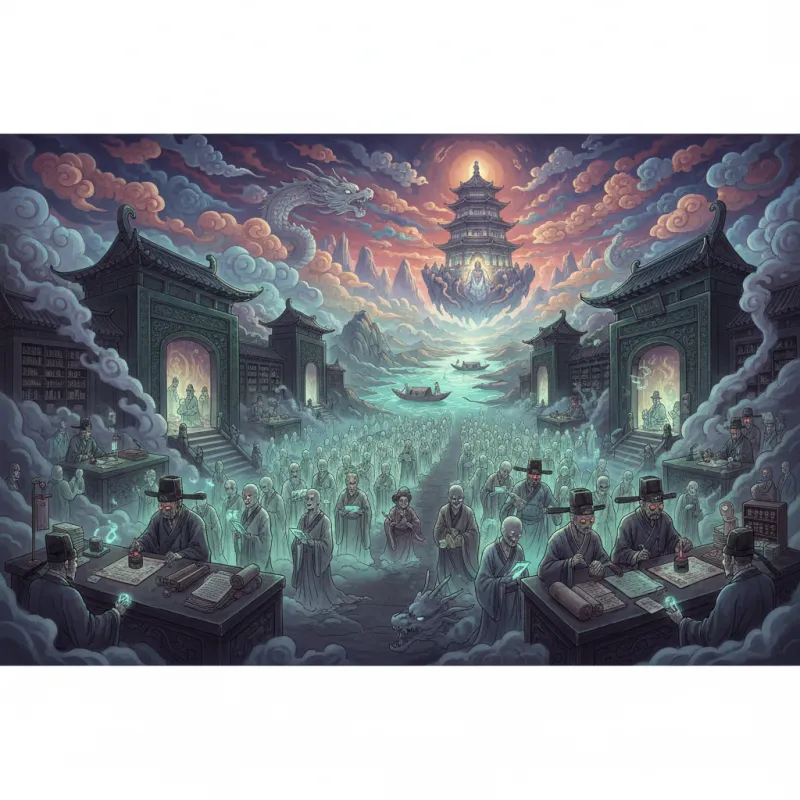
You die. Your soul separates from your body. And then—instead of ascending to clouds or descending into flames—you're handed a form to fill out.
Welcome to Diyu (地狱, dìyù), the Chinese underworld, where death isn't a moment of divine reckoning but the beginning of an administrative process that would make any DMV look efficient by comparison.
The Ten Courts of Hell
Forget Dante's nine circles. The Chinese afterlife operates through ten distinct courts, each presided over by a judge-king called a Yanluo (阎罗, yánluó). These aren't metaphorical stations of spiritual purification—they're actual bureaucratic departments with specific jurisdictions, case files, and processing procedures.
The first court, ruled by King Qinguang (秦广王, qínguǎng wáng), functions as intake and initial assessment. Every soul passes through here first, where clerks review your life record—yes, there's a record, meticulously maintained by celestial bureaucrats who've been tracking your deeds since birth. If you lived a reasonably decent life, you might get expedited processing straight to reincarnation. Most people aren't that lucky.
The subsequent courts handle specific categories of wrongdoing. The second court processes those who practiced medicine incompetently or ran fraudulent businesses. The third deals with ungrateful children and corrupt officials. The fourth punishes tax evaders and those who defaulted on debts. Each court has its own torture chambers, its own specialized punishments, and its own appeals process. Because of course there's an appeals process.
Punishment by Spreadsheet
What makes Diyu uniquely Chinese isn't just the bureaucracy—it's the precision. Western hell tends toward poetic justice: gluttons wallow in filth, the wrathful tear each other apart. Chinese hell operates on a point system.
Lie to your parents? That's Court Three, Chamber of Tongue Ripping, followed by assignment to the Mountain of Knives. The duration of your sentence depends on the severity and frequency of your lies, calculated according to formulas that would satisfy any actuary. Steal from a temple? Court Five has a specific sub-department for that, with punishments calibrated to the value stolen and your level of remorse.
The Jade Record (玉历, yùlì), a Ming Dynasty text that circulated widely as a kind of afterlife guidebook, lists punishments with the specificity of a tax code. It doesn't just say "murderers suffer"—it distinguishes between premeditated murder, crimes of passion, negligent homicide, and causing death through medical malpractice, each with different processing requirements and sentence lengths.
This obsessive categorization reflects something fundamental about Chinese cosmology: the universe operates on principles of order, balance, and reciprocity. Chaos isn't the natural state that must be overcome by divine intervention—it's a bureaucratic error that must be corrected through proper procedure.
The Paperwork Never Ends
Here's where it gets really Chinese: you can file complaints.
If you believe you've been assigned to the wrong court, or that your punishment exceeds your crimes, or that the celestial clerks made an error in your life record (they're only human—well, formerly human), you can submit a formal appeal. There are protocols for this. Forms to fill out. Waiting periods to observe.
Some souls spend decades navigating the appeals process, shuffled between courts, waiting for hearings, gathering evidence of good deeds that might have been overlooked. The bureaucracy of Diyu mirrors the bureaucracy of imperial China so precisely because it was imagined by people who spent their lives navigating that system—scholars who took civil service exams, officials who processed endless documents, citizens who knew that justice wasn't a lightning bolt from heaven but a form submitted in triplicate.
The concept of Reincarnation in Chinese Buddhism depends entirely on successfully navigating this system. You don't transcend the wheel of rebirth through enlightenment alone—you also need your paperwork in order.
King Yama's Office Hours
The supreme administrator of this system is Yanluo Wang (阎罗王, yánluó wáng), known in Sanskrit as Yama Raja. He's not a god in the Western sense—he's more like the director of a vast governmental agency. He has office hours. He takes meetings. He reviews cases brought by his subordinate judges.
In the Journey to the West, when Sun Wukong storms the underworld, he doesn't battle demons in a hellscape—he breaks into the administrative offices and starts crossing names out of the Book of Life and Death (生死簿, shēngsǐ bù). The book itself is telling: your fate isn't written in the stars or predetermined by divine will. It's recorded in a ledger, maintained by clerks, subject to revision.
Yanluo Wang can be petitioned, bribed (in the form of merit transferred through offerings made by living relatives), and even overruled by higher celestial authorities. He's powerful, but he operates within a system. There are rules. There are procedures. There's a chain of command.
Why Bureaucracy?
This vision of the afterlife emerged during the Tang Dynasty, when Buddhism merged with indigenous Chinese beliefs and the imperial examination system was reaching its mature form. For over a millennium, Chinese society had been organized around the principle that merit, properly documented and evaluated, should determine one's position in the social hierarchy.
The afterlife as bureaucracy isn't a failure of imagination—it's a profound statement about cosmic justice. In a world where earthly justice was often arbitrary, where emperors could be tyrants and local officials corrupt, the idea that the universe itself operated on bureaucratic principles was actually comforting. Bureaucracy, for all its frustrations, is at least theoretically fair. It's impersonal. It follows rules. It can be appealed.
The Western afterlife offers drama: eternal reward or eternal punishment based on a single judgment. The Chinese afterlife offers something more mundane and, in its way, more humane: a process. You get your day in court. Multiple days, actually. Your case is reviewed. Your circumstances are considered. The system is slow, often frustrating, sometimes corrupt—but it's a system, not a lottery.
The Living and the Dead
This bureaucratic model has profound implications for how the living interact with the dead. If your deceased relatives are navigating a complex administrative system, then your job isn't to pray for their souls in some abstract sense—it's to provide practical assistance.
You burn paper money so they can pay fees and bribe officials. You make offerings at specific times to ensure they have resources during their court appearances. You hire Buddhist monks to perform rituals that function essentially as legal advocacy, arguing your relative's case before the judges of Diyu. The entire apparatus of Chinese ancestor veneration makes sense once you understand that death isn't an ending but a transition into a different bureaucracy.
Those who die without descendants to make offerings become hungry ghosts—not because they're inherently evil, but because they lack the resources to navigate the system. They're the undocumented immigrants of the afterlife, stuck in limbo, unable to complete their processing.
The Cosmic Civil Service
There's something deeply Chinese about imagining the cosmos as a vast civil service. For two thousand years, the most important thing a Chinese family could achieve was having a son pass the imperial examinations and enter government service. The afterlife simply extends this logic to its ultimate conclusion: even death is just another posting, another assignment in an eternal bureaucracy.
The judges of the ten courts aren't demons or angels—they're officials who earned their positions through merit and who can theoretically be promoted, demoted, or transferred based on their performance. Some texts suggest that particularly virtuous humans can be appointed as judges after death, joining the celestial civil service.
This is a universe that runs on paperwork, where even the gods have supervisors, where justice is slow but methodical, where nothing is truly final because there's always another form to file, another appeal to submit, another court to petition.
It's frustrating. It's impersonal. It's often unfair in practice even when fair in principle.
In other words, it's exactly like life—which is perhaps the point. The Chinese afterlife doesn't offer escape from the human condition. It offers its continuation under new management, with the same rules, the same hierarchies, the same endless forms.
You can't cheat death. But you can, apparently, file a complaint about it.
Related Reading
- Exploring Chinese Beliefs in the Afterlife: Ghosts, Spirits, and Folklore
- The Afterlife in Chinese Culture: A Traveler's Guide to the Underworld
- Exploring the Mystical Realm of Chinese Ghosts and Afterlife Beliefs
- The Hungry Ghost Festival: When the Gates of Hell Open
- Soul Travel in Chinese Belief: When Your Spirit Leaves Your Body During Sleep
- Painted Skin: The Most Terrifying Story in Chinese Literature
- The Legend of the White Snake: A Complete Retelling
Explore Chinese Culture
- Explore ancient mythical creatures
- Explore Daoist exorcism traditions
- Explore Chinese folk beliefs and superstitions