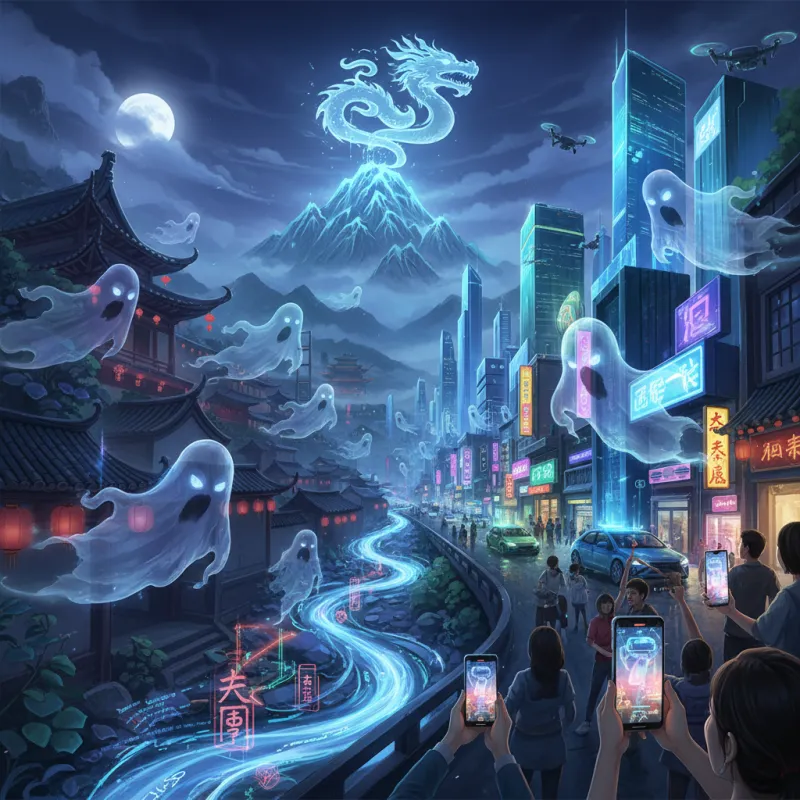
A woman in Chongqing livestreams her late-night walk through an abandoned hospital. Her phone's camera catches something her eyes don't see — a pale figure in the corner of the frame, gone when she turns around. Within hours, the clip has 40 million views. The comments section explodes: some claim it's CGI, others insist they've seen the same 女鬼 (nǚguǐ, female ghost) in that exact location. A Taoist priest offers his services in the replies. This is Chinese ghost culture in 2024 — ancient beliefs turbocharged by fiber optic cables and algorithmic feeds.
The supernatural hasn't retreated in the face of China's technological revolution. It has simply changed platforms. The same cosmological framework that produced Pu Songling's 聊斋志异 (Liáozhāi Zhìyì, Strange Tales from a Chinese Studio) in the Qing Dynasty now generates content for Douyin, Weibo, and Xiaohongshu. The ghosts haven't disappeared — they've gone viral.
The Infrastructure of Modern Hauntings
Chinese social media has become an unintentional archive of supernatural encounters. Unlike Western ghost stories that circulate primarily through dedicated paranormal forums, Chinese ghost sightings spread through mainstream platforms where hundreds of millions of users congregate daily. A construction worker posts a photo from a demolition site in Guangzhou. Commenters zoom in, enhance, circle what appears to be a face in the rubble. The post gets shared 200,000 times before the original poster deletes it, spooked by the attention or perhaps by something else.
The technology itself seems designed for ghost hunting. Smartphone cameras capture more than human eyes — longer exposures, different light spectrums, the ability to freeze moments that consciousness processes as continuous flow. Night mode photography, originally developed for low-light selfies, has become the accidental tool of amateur 捉鬼 (zhuō guǐ, ghost catching). Every phone is now a potential spirit detector, every user a potential witness.
Live-streaming platforms add another dimension. The real-time nature creates authenticity that pre-recorded videos lack. When a streamer in Shanxi explores an abandoned village and their camera glitches, viewers watching live become participants in the encounter. The chat explodes with warnings, protective mantras, suggestions to leave immediately. Some claim they can see things the streamer cannot. The collective experience mirrors traditional Chinese ghost stories, where witnesses validate each other's experiences and the supernatural event becomes socially real through shared testimony.
Urban Legends 2.0
The classic Chinese urban legend has evolved. The 红衣女鬼 (hóngyī nǚguǐ, red-dressed female ghost) who once haunted specific bridges or buildings now appears in multiple cities simultaneously, her story adapted to local landmarks but maintaining core elements. She's been spotted in Beijing subway stations, Shanghai shopping malls, Shenzhen office buildings. Each sighting includes photos, videos, precise timestamps and GPS coordinates. The documentation is exhaustive, the verification impossible.
These modern legends follow patterns established in classical Chinese ghost literature but accelerated to internet speed. The 画皮 (huàpí, painted skin) demon from Liáozhāi — a ghost who wears a beautiful human face to seduce men — now appears in dating app horror stories. Users share screenshots of profiles that seem normal until you notice the details: photos that don't quite match, responses that feel scripted, meetings that never happen or end strangely. The technology changes, the archetype persists.
Delivery drivers have become unexpected sources of supernatural encounters. Working late nights, entering unfamiliar buildings, knocking on doors in empty corridors — their job descriptions read like ghost story setups. Online forums dedicated to 外卖员 (wàimàiyuán, delivery workers) contain hundreds of accounts: orders to demolished addresses, customers who don't appear on security cameras, apartments that shouldn't exist according to building layouts. The gig economy has created a new class of accidental ghost witnesses, and they're documenting everything.
The Exorcism Economy Goes Digital
Where there are ghosts, there are those who claim to handle them. Chinese social media hosts thousands of accounts run by 道士 (dàoshì, Taoist priests), 和尚 (héshang, Buddhist monks), and 风水师 (fēngshuǐ shī, feng shui masters) offering remote supernatural services. For a fee transferred via WeChat Pay or Alipay, they'll perform rituals, provide protective talismans (delivered as digital images you print yourself), or conduct video consultations about your haunting.
The commercialization is blatant, but the demand is real. A Taoist priest in Sichuan with 2 million followers charges 888 RMB for a personalized 驱邪 (qūxié, evil-expelling) ritual performed via livestream. Clients send photos of their homes, describe their symptoms — insomnia, bad luck, strange sounds — and watch as he performs ceremonies in real-time, burning 符纸 (fúzhǐ, talisman paper) and chanting sutras. The comments section fills with testimonials from previous clients claiming the rituals worked. Whether through genuine belief or placebo effect, people report feeling better. The ghosts, apparently, respect digital transactions.
Some practitioners have adapted traditional methods with surprising sophistication. A feng shui master in Hangzhou offers virtual home assessments using floor plans and compass readings submitted through an app. He identifies 煞气 (shàqì, harmful energy) and recommends adjustments — move this mirror, place a plant here, hang this charm there. His clients report back with before-and-after stories. The principles are centuries old, the delivery mechanism is pure 21st century.
When Algorithms Meet Ancestors
The most fascinating intersection of technology and Chinese supernatural belief might be in ancestor worship. Traditional 祭祖 (jìzǔ, ancestor veneration) required physical presence at graves or ancestral halls, burning 纸钱 (zhǐqián, paper money) and offering food. Now, apps allow remote worship. You can send virtual offerings to your ancestors' digital memorial pages, burn virtual incense, even hire someone to visit the physical grave on your behalf while you watch via video call.
This raises genuine theological questions within Chinese folk religion. Do ancestors receive digital offerings? Can 孝道 (xiàodào, filial piety) be fulfilled through an app? The debates in online forums are surprisingly nuanced, with some arguing that intention matters more than medium, others insisting that physical ritual cannot be replaced. Meanwhile, millions of Chinese people living far from ancestral homes use these services during 清明节 (Qīngmíng Jié, Tomb Sweeping Day) and other festivals, creating a hybrid practice that would have been unimaginable a generation ago.
The ghost stories that emerge from this digital ancestor worship are particularly unsettling. Users report receiving messages from deceased relatives' accounts, photos appearing in family group chats that no one remembers taking, video calls where the connection seems to reach somewhere other than the intended recipient. These accounts blur the line between technical glitches and supernatural contact in ways that feel distinctly contemporary yet rooted in the ancient Chinese belief that the dead remain connected to the living.
The Skeptics and the Believers
Chinese social media hosts vigorous debates between supernatural believers and skeptics, but the terms of engagement differ from Western rationalist discourse. Few Chinese skeptics argue that ghosts categorically don't exist. Instead, they question specific evidence, suggest alternative explanations, or argue about the nature and behavior of 鬼 (guǐ) rather than their existence. The cosmological framework remains largely intact even among the skeptical.
This creates interesting dynamics. A viral ghost video will attract both believers sharing similar experiences and skeptics analyzing the footage for editing artifacts or optical illusions. But even the skeptics often hedge their conclusions with phrases like "probably fake" or "most likely explainable" rather than absolute denials. The cultural space for supernatural possibility remains open in ways that Western scientific materialism typically forecloses.
Professional debunkers exist, but they face different challenges than their Western counterparts. Proving a ghost video is fake doesn't necessarily reduce belief in ghosts generally — it just means that particular video was fake. The underlying framework of Chinese supernatural belief is too deeply embedded in cultural practice, too validated by centuries of literature and personal experience, to be dismantled by exposing individual hoaxes. The ghosts survive the debunking.
The Haunted Infrastructure
China's rapid development has created ideal conditions for ghost stories. Demolished neighborhoods, abandoned factories, half-finished construction projects — the landscape is littered with liminal spaces where the old world hasn't quite died and the new world hasn't fully arrived. These locations become supernatural hotspots in online ghost maps, marked with warnings and stories.
The 钉子户 (dīngzihù, nail houses) — holdout properties refusing demolition, standing alone amid cleared land — generate particularly rich ghost lore. These buildings become symbols of resistance, but also sites of supernatural activity. Residents report increased paranormal experiences as their neighbors disappear and the buildings around them fall. Are the ghosts real, or are they manifestations of the psychological stress of being the last inhabitant of a dying neighborhood? In Chinese supernatural belief, this distinction might not matter. The experience is real, therefore the ghost is real.
Urban explorers document these spaces extensively, posting videos of abandoned hospitals, closed schools, empty apartment blocks. The footage is eerie even without supernatural elements — the speed of abandonment, the personal items left behind, the sense of interrupted lives. When ghost sightings occur in these locations, they feel almost inevitable. The spaces themselves seem to demand haunting, and Chinese ghost culture provides the framework to interpret the unease these places generate.
The Future of Chinese Ghosts
As China continues its technological advancement, the supernatural adapts alongside it. Already, there are discussions about ghosts in the metaverse, about whether AI can be haunted, about what happens to digital consciousness after death. These questions might seem absurd, but they're logical extensions of a cosmological system that has always been flexible about the boundaries between material and spiritual realms.
The 鬼 (guǐ) of Chinese tradition were never confined to one medium or manifestation. They appeared in dreams, possessed objects, influenced fortune, caused illness, and occasionally helped the living. They were always already multimedia entities, operating across different planes of existence. The digital realm is simply another plane, and the ghosts have migrated there as naturally as they once migrated from oral tradition to written literature to film.
What's remarkable is not that Chinese ghost culture has survived modernization, but that anyone thought it wouldn't. The beliefs are too useful, too explanatory, too deeply woven into how millions of people understand causation, morality, and the relationship between past and present. The smartphones and social media platforms are just new tools for engaging with very old truths — or at least, very old beliefs that function as truths for those who hold them.
The woman in Chongqing is still livestreaming, still exploring abandoned places, still capturing things that might be ghosts or might be glitches or might be something in between. Her follower count grows. The comments debate what she's found. And somewhere in the digital infrastructure connecting millions of screens, the 鬼 (guǐ) continue their work, adapting to new platforms, finding new ways to make themselves known. The technology changes, but the hauntings persist.
For more on how traditional Chinese supernatural beliefs manifest in contemporary contexts, see The Hungry Ghost Festival in Modern China and Chinese Exorcism Practices: Ancient Rituals in the 21st Century.
Related Reading
- Chinese Urban Legends That Went Viral: From Elevator Ghosts to Cursed Phone Numbers
- Exploring Chinese Supernatural Folklore: Ghosts, Spirits, and Afterlife Beliefs Unveiled
- Chinese Urban Legends: The Ghost Stories Your Taxi Driver Tells
- Ghosts of the Beijing Subway: Urban Legends Underground
- Chinese Campus Ghost Stories: The Haunted Universities
- Unraveling the Mystique of Chinese Supernatural Folklore and Afterlife Beliefs
- Exploring the Dark Realms: Chinese Demons and Their Significance in Folklore
- Lady White Snake: China's Greatest Love Story
Explore Chinese Culture
- Explore ancient mythical creatures
- Explore Daoist exorcism traditions
- Explore Chinese folk beliefs and superstitions