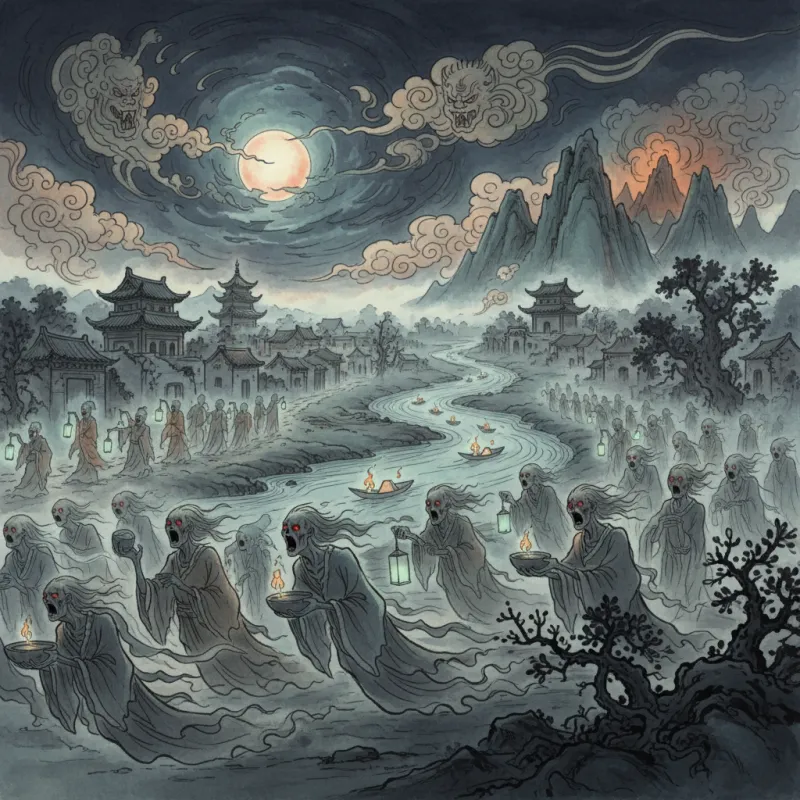
The seventh lunar month arrives, and across China, families set out plates of food on empty streets. Not for themselves—for the dead who have no one else to feed them. These aren't the honored ancestors receiving incense at family altars. These are the forgotten ones, the hungry ghosts who wander because the living have failed to remember them.
The Mechanics of Being Dead
In Chinese cosmology, death is not an ending but a transition—and like any bureaucratic process, it can go catastrophically wrong. When someone dies properly, their hun soul (魂, hún) ascends to the heavens while their po soul (魄, pò) remains with the body and eventually dissipates. But this assumes everything goes according to plan.
It rarely does.
A person who dies violently, suddenly, or far from home may find their souls unable to complete the journey. Someone who drowns becomes a water ghost (水鬼, shuǐ guǐ), trapped at the site of death until they can lure a replacement to drown in their place. Those who die without descendants have no one to perform the necessary rites, no one to burn paper money or offer food. They become hungry ghosts (饿鬼, è guǐ)—not through any moral failing, but through the simple absence of the living to care for them.
The Ming dynasty novel Investiture of the Gods (封神演义, Fēngshén Yǎnyì) depicts this vividly: souls who cannot move on accumulate like bureaucratic backlog, creating a supernatural traffic jam between the worlds. The solution isn't exorcism—it's administration. Someone needs to file the proper paperwork, make the correct offerings, and allow the dead to proceed.
Hungry Ghosts: A Failure of the Living
The hungry ghost is perhaps the most tragic figure in Chinese supernatural folklore. Unlike the vengeful spirits who haunt their murderers or the demon foxes who seduce scholars, hungry ghosts didn't choose their fate. They're victims of neglect.
Traditional descriptions paint them with distended bellies and needle-thin throats—a physical manifestation of endless craving that can never be satisfied. But the real horror isn't their appearance. It's what they represent: the complete breakdown of the social contract between the living and the dead.
During the Qing dynasty, the scholar Ji Yun documented hundreds of ghost encounters in his Notes from the Thatched Cottage of Close Scrutiny (阅微草堂笔记, Yuèwēi Cǎotáng Bǐjì). Many involve hungry ghosts who appear not to terrorize but to beg. One account describes a ghost who haunted a family's kitchen, not stealing food but watching them eat with desperate longing. When the family finally left offerings, the hauntings stopped immediately.
This reframes everything we think we know about ghosts. They don't haunt because they're evil. They haunt because they're starving.
The Seventh Month: When the Gates Open
The Hungry Ghost Festival (中元节, Zhōngyuánjié), celebrated on the fifteenth day of the seventh lunar month, operates on a simple premise: if the dead are hungry, feed them. All of them.
For the entire seventh month, the gates between the world of the living and the dead stand open. Ghosts wander freely, and the living respond not with fear but with hospitality. Families set out elaborate feasts on street corners, burn incense at intersections, and float paper lanterns on rivers to guide lost souls. Theaters perform operas with the front rows left empty—reserved seating for the dead.
But this isn't charity. It's insurance.
The festival acknowledges a uncomfortable truth: you cannot possibly know all the dead who might have a claim on you. Perhaps your ancestors failed someone generations ago. Perhaps you're living on land where someone died badly. Perhaps you simply walked past a hungry ghost on the street, and your warmth and life-force drew its attention. The seventh month offerings are a blanket policy, feeding any ghost who might otherwise turn their hunger toward you.
In Taiwan, businesses close early during Ghost Month. Construction projects halt. Weddings are postponed. The living cede space to the dead, recognizing that for one month each year, this world belongs as much to them as to us.
Wandering Souls and Unfinished Business
Not all restless dead are hungry ghosts. Some are wandering souls (游魂, yóu hún)—spirits with specific unfinished business that keeps them tethered to the mortal world. These are the ghosts of Chinese opera and literature, the ones with stories.
The Strange Tales from a Chinese Studio (聊斋志异, Liáozhāi Zhìyì) by Pu Songling is essentially a catalog of wandering souls and their unfinished business. There's the ghost of a young woman who returns to ensure her infant son is properly cared for. The spirit of a murdered man who cannot rest until his killer is exposed. The soul of a scholar who died before completing his masterwork and haunts his study, trying to finish it.
These ghosts aren't trapped by hunger but by attachment—to people, to places, to uncompleted tasks. They're the supernatural equivalent of a computer program stuck in a loop, unable to proceed to the next line of code until a specific condition is met.
The solution, according to folk tradition, is to help them complete their business. Find the murderer. Care for the child. Finish the manuscript. Unlike malevolent spirits that require exorcism, wandering souls need resolution, not banishment.
The Bureaucracy of the Afterlife
Chinese folk religion treats the afterlife like an extension of imperial bureaucracy—complete with officials, courts, and paperwork. The Ten Courts of Hell (十殿阎罗, Shí Diàn Yánluó) process souls like a government agency, determining their fate based on their earthly deeds.
But bureaucracies have loopholes, and the dead exploit them constantly.
A soul might bribe an underworld official with paper money burned by descendants. They might appeal their sentence through multiple courts. They might simply get lost in the system, wandering between worlds while their case sits in some cosmic inbox. The Journey to the West (西游记, Xīyóujì) features a subplot where a king's soul is trapped in the underworld due to an administrative error—he's technically dead on paper, but his body is still alive, creating a bureaucratic paradox.
This view of the afterlife explains why proper funeral rites are so crucial. You're not just honoring the dead—you're ensuring they have the resources to navigate the system. The paper money, the offerings, the prayers: these are legal tender in the afterlife economy.
Living with the Unquiet Dead
Modern China has largely moved away from these beliefs, but they persist in subtle ways. During Ghost Month, Hong Kong's stock market historically shows decreased trading volume. Taiwanese airlines avoid using the number four (which sounds like "death") in seat assignments. Families still burn paper offerings, even if they claim not to believe.
Because here's the thing about hungry ghosts and wandering souls: they represent something true about death that no amount of modernization can erase. The dead do linger—in our memories, our guilt, our unfinished conversations. They haunt us not because they're supernatural but because we're human.
The genius of Chinese folk belief is that it externalizes this haunting, gives it form and rules and solutions. You can't resolve your guilt about a dead parent through therapy alone—but you can burn incense, make offerings, and perform the rites that say: I remember you. I have not forgotten.
The hungry ghosts aren't just out there in the dark. They're the parts of ourselves that hunger for connection with those we've lost, the wandering souls of our own grief and regret. The seventh month opens the gates between worlds, but those gates were never fully closed. The dead are always with us, hungry or not, and the living must decide: will we feed them, or will we pretend they're not there?
The answer determines whether we're haunted by ghosts—or by our own failure to remember.
Related Reading
- Exploring the Mystical Realm of Chinese Ghosts and Afterlife Beliefs
- Diyu: The Chinese Underworld and Its Ten Courts of Hell
- Exploring Chinese Beliefs in the Afterlife: Ghosts, Spirits, and Folklore
- The Afterlife in Chinese Culture: A Traveler's Guide to the Underworld
- The Wheel of Reincarnation: How the Chinese Afterlife Recycles Souls
- Chinese Horror Novels and Web Fiction: A Reading Guide
- Lady White Snake: China's Greatest Love Story
- Spirit Writing: Fuji Divination and Messages from the Gods
Explore Chinese Culture
- Explore ancient mythical creatures
- Explore Daoist exorcism traditions
- Explore Chinese folk beliefs and superstitions