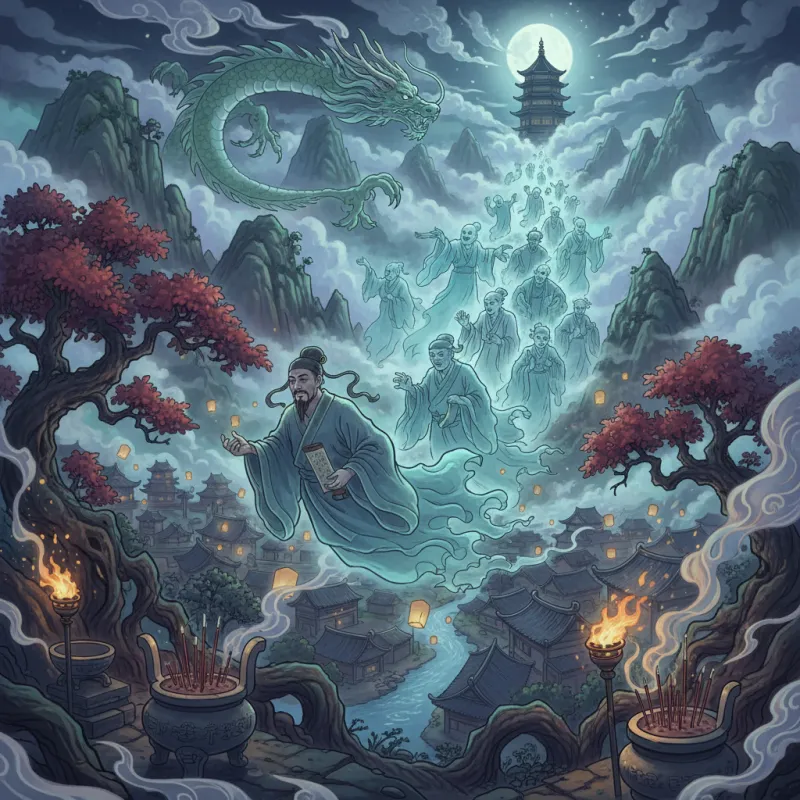
The old woman burns paper money at midnight, watching the flames carry wealth to her deceased husband. But she knows the offering might feed something else entirely—a hungry ghost, a wandering spirit, or worse, something that was never human at all. This scene plays out across China every night, a ritual born from beliefs so ancient they predate written history itself.
The Three Souls and Seven Spirits
Chinese metaphysics doesn't mess around with simple dualism. Forget the Western notion of one soul per customer. According to traditional belief, each person houses three hun (魂, hún) souls and seven po (魄, pò) spirits. The hun are yang in nature—ethereal, intellectual, associated with consciousness. They ascend to heaven after death. The po are yin—tied to the physical body, instinctual, earthbound. They descend with the corpse.
This division explains why Chinese funeral rites are so elaborate. You're not just sending off one entity—you're managing a whole committee of spiritual components, each with different destinations and needs. When someone dies improperly (murder, suicide, accident), these souls and spirits can fragment or refuse to separate. That's when you get gui (鬼, guǐ)—ghosts—and not the friendly kind.
The Tang Dynasty scholar Duan Chengshi documented cases in his Youyang Zazu where po spirits remained so attached to corpses that they animated them, creating what we'd recognize as jiangshi (僵尸, jiāngshī), or hopping vampires. The hun, meanwhile, might wander as a confused shade if proper rituals aren't performed. This isn't superstition—it's spiritual logistics.
Diyu: The Chinese Underworld Bureaucracy
If you thought earthly bureaucracy was bad, wait until you see the afterlife version. Diyu (地狱, dìyù), the Chinese underworld, operates like a cosmic DMV run by Yanluo Wang (阎罗王, Yánluó Wáng), the King of Hell. But he's not alone—he oversees ten courts, each presided over by a judge specializing in particular sins.
The Journey to the West gives us a glimpse when Sun Wukong storms the underworld and crosses out his name from the Book of Life and Death. But most souls don't have that option. They face the First Court, where Judge Qin Guang reviews their life record. Lied to your parents? Second Court. Committed adultery? Third Court. Each transgression has its designated torture chamber, and the punishments are creative in the worst possible way.
What makes Diyu fascinating is its impermanence. Unlike Christian hell, it's not eternal. Souls serve their sentences—sometimes for thousands of years—then get recycled through reincarnation. Drink from Meng Po's (孟婆, Mèng Pó) soup of oblivion at the exit, forget everything, and start fresh. Unless you were really terrible, in which case you might come back as a hungry ghost or an animal.
This system reflects Confucian values of justice and Buddhist concepts of karma, creating a hybrid that's uniquely Chinese. The concept of karmic retribution permeates every level of this bureaucratic nightmare.
Hungry Ghosts and the Seventh Month
The fifteenth day of the seventh lunar month marks Ghost Festival (中元节, Zhōngyuán Jié), when the gates of Diyu swing open and spirits flood back to the mortal realm. But not all returnees are beloved ancestors. Many are egui (饿鬼, èguǐ)—hungry ghosts—condemned to eternal starvation because they died without descendants to make offerings, or because they were particularly wicked in life.
These creatures are depicted with needle-thin throats and bloated bellies, forever unable to satisfy their hunger. They're not just metaphors for greed or desire—people genuinely believe they roam during Ghost Month, causing accidents, illness, and misfortune. That's why you don't swim in July (ghosts might pull you under), don't whistle at night (attracts their attention), and definitely don't pick up money on the street (ghost bait).
The Yulanpen Sutra, introduced to China during the Northern and Southern Dynasties, tells of Mulian (目连, Mùlián), a monk who discovered his mother had become a hungry ghost. Even his supernatural powers couldn't feed her—the food turned to flames in her mouth. Only through collective Buddhist ritual could she be saved. This story established the practice of making offerings not just to your own dead, but to all wandering spirits.
Modern Taiwan still takes this seriously. During Ghost Month, businesses delay major decisions, couples avoid weddings, and entire streets fill with elaborate food offerings. Dismiss it as superstition if you want, but try telling that to the construction company that ignored the taboo and watched three workers die in accidents within a week.
Fox Spirits and Shape-Shifters
Not all supernatural beings are human souls. Chinese folklore teems with yaoguai (妖怪, yāoguài)—creatures that gain consciousness and power through cultivation. The most famous are huli jing (狐狸精, húlijīng), fox spirits, who appear throughout classical literature as seductresses, tricksters, and occasionally, devoted lovers.
Pu Songling's Strange Tales from a Chinese Studio (1740) features dozens of fox spirit stories. Some are malevolent, draining men's life force through sexual encounters. Others, like Nie Xiaoqian, are tragic figures forced into evil by more powerful demons. The ambiguity is the point—these beings exist in moral gray zones, neither fully good nor evil.
Fox spirits achieve human form through centuries of cultivation, often by absorbing moonlight or human essence. A fox that survives a thousand years grows nine tails and can transform at will. They're drawn to scholars and officials, perhaps because intelligence and power are what they themselves seek. The relationship between human and fox often ends badly—either the man discovers the deception and the fox flees, or the fox's demonic nature overwhelms her human feelings.
What's interesting is how these stories reflect anxieties about female sexuality and social mobility. Fox spirits are almost always female, beautiful, and sexually aggressive—everything Confucian society feared. Yet they're also sympathetic, trapped between their animal nature and human desires. The transformation of demons in Chinese folklore shows how these figures evolved from pure evil to complex characters.
Ancestor Veneration and Filial Piety
The flip side of ghost fear is ancestor worship, the bedrock of Chinese spiritual practice. Your deceased parents and grandparents aren't gone—they're watching, judging, and capable of blessing or cursing you based on how well you maintain their memory.
This isn't optional. Filial piety (孝, xiào) extends beyond death. You burn incense, offer food, maintain graves, and most importantly, produce descendants to continue the cycle. Die without children, and you become a lonely ghost with no one to feed you. This fear drove adoption practices, ghost marriages (marrying a deceased person to provide them with a spouse in the afterlife), and the absolute terror of family extinction.
The Qingming Festival (清明节, Qīngmíng Jié) in spring sees millions of Chinese people sweeping graves, burning paper offerings, and sharing meals with the dead. But it's not just tradition—people report dreams where ancestors complain about neglect, or family misfortunes that cease after proper rituals are performed. Coincidence? Maybe. But when your business starts failing after you skip grave-sweeping, you tend to reconsider.
Modern Chinese people, even educated urbanites, often maintain these practices "just in case." Pascal's Wager applies to ancestor worship—the cost of belief is low, but the potential cost of disbelief (angering powerful spirits who know your weaknesses) is catastrophic.
The Living Dead: Jiangshi and Corpse Walkers
Chinese vampire lore takes a different path than Dracula. Jiangshi (僵尸, jiāngshī) are reanimated corpses that hop because rigor mortis has stiffened their legs. They're created when the po spirit refuses to leave the body, often because the person died far from home or in a state of extreme emotion.
Qing Dynasty records describe "corpse walkers" (赶尸, gǎnshī)—Taoist priests who would reanimate bodies to walk them home for proper burial. They'd travel at night, ringing bells to warn the living, the corpses hopping in single file behind them. Sounds like pure folklore, right? Except multiple historical accounts from Hunan and Sichuan provinces describe this practice, complete with specific techniques involving talismans placed on the corpse's forehead.
Jiangshi hunt by sensing breath and life force. The classic defense? Hold your breath and stand perfectly still. They're also repelled by chicken blood, mirrors, and glutinous rice. These aren't random—each has symbolic significance in Taoist cosmology. The hopping motion itself might have practical origins: corpses transported in bamboo poles would bounce with the carriers' gait, creating the illusion of movement.
Hong Kong cinema turned jiangshi into comedy-horror icons in the 1980s, but the underlying beliefs remain serious. Even today, some Chinese people avoid buying homes where deaths occurred, fearing residual po energy might animate or attract corpses.
Modern Persistence of Ancient Beliefs
Walk through any Chinese city and you'll find the old beliefs alive beneath the modern surface. Apartment buildings skip the fourth floor (four sounds like death). Construction sites have Taoist priests perform rituals before breaking ground. Ghost Month still affects business decisions across Asia.
The Communist Party spent decades trying to eradicate "feudal superstition," but these beliefs proved remarkably resilient. They're not really about ghosts—they're about family, obligation, respect for the past, and acknowledging forces beyond human control. When a Shanghai businessman consults a fengshui master before signing a contract, he's not being irrational. He's hedging his bets in a universe where the dead have agency and the spiritual realm intersects with the material.
The internet age has only amplified these traditions. Forums overflow with ghost encounter stories. Apps help calculate auspicious dates for funerals. Young people who've never read classical texts still know not to stick chopsticks upright in rice (resembles incense offerings to the dead) or open umbrellas indoors (attracts wandering spirits).
Chinese afterlife beliefs aren't museum pieces. They're living traditions that adapt while maintaining their essential logic: death is not an ending but a transformation, the dead remain part of the community, and the boundary between worlds is thinner than we'd like to believe. That old woman burning paper money? She's not stuck in the past. She's maintaining a relationship that transcends death itself, feeding the hungry, honoring the ancestors, and keeping the cosmic order intact—one paper bill at a time.
Related Reading
- Diyu: The Chinese Underworld and Its Ten Courts of Hell
- The Chinese Afterlife Is a Bureaucracy (And That Tells You Everything)
- Hungry Ghosts and Wandering Souls: The Unquiet Dead of Chinese Folklore
- The Afterlife in Chinese Culture: A Traveler's Guide to the Underworld
- The Hungry Ghost Festival: When the Gates of Hell Open
- The Legend of the White Snake: A Complete Retelling
- What is Liaozhai Zhiyi? A Guide to China's Greatest Ghost Stories
- Exploring the Multifaceted World of Chinese Supernatural Folklore and Afterlife Beliefs
Explore Chinese Culture
- Explore ancient mythical creatures
- Explore Daoist exorcism traditions
- Explore Chinese folk beliefs and superstitions