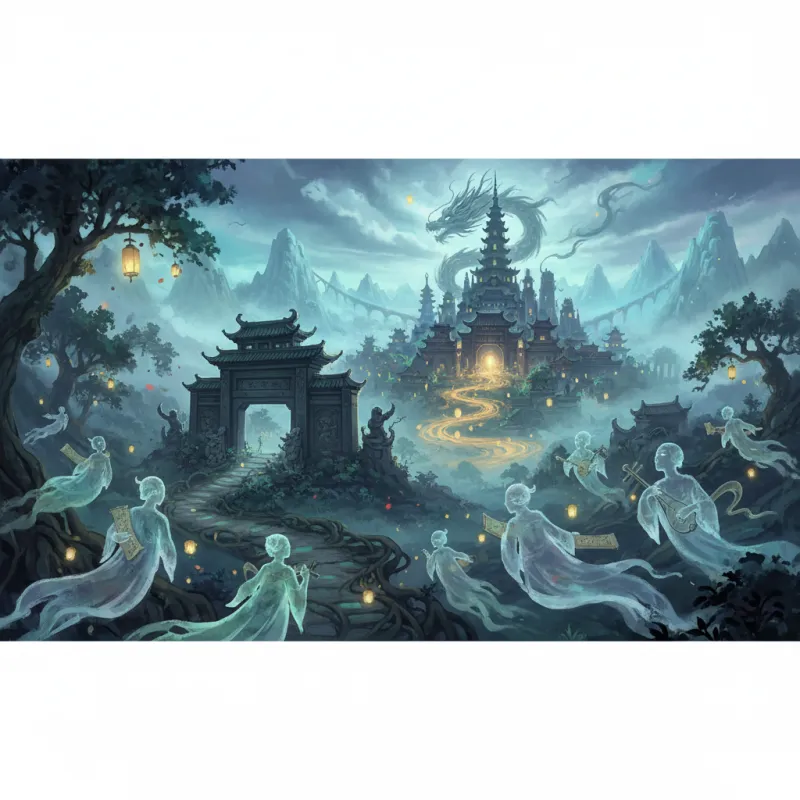
The old woman's hands trembled as she placed three sticks of incense before the ancestral tablet. "If you don't feed them," she whispered to her grandson, "they'll come back hungry." She wasn't speaking metaphorically. In the Chinese understanding of death, the boundary between the living and dead isn't a wall—it's a membrane, thin enough that hungry ghosts can push through when the living forget their obligations.
The Architecture of the Chinese Afterlife
Chinese afterlife beliefs didn't emerge from a single revelation or prophet. They accumulated over millennia, layer upon layer, like sediment forming rock. By the Han Dynasty (206 BCE - 220 CE), a complex bureaucratic underworld had taken shape in the popular imagination—because of course the Chinese would envision the afterlife as another government office, complete with paperwork and officials who could be bribed.
The Diyu (地狱, dìyù)—often translated as "hell" but more accurately "earth prison"—operates as a vast administrative complex with ten courts, each presided over by a judge. But unlike the eternal damnation of Western hell, Diyu functions more like purgatory. Souls pass through, receive punishment proportional to their earthly misdeeds, and eventually reincarnate. The system is harsh but ultimately fair, reflecting Confucian ideals of justice and Buddhist concepts of karma.
What makes this particularly fascinating is how it mirrors earthly Chinese bureaucracy. Dead souls need travel permits. They require currency—hence the tradition of burning joss paper (冥币, míngbì) for the deceased. They can even hire lawyers in the underworld courts. The Ming Dynasty novel "Journey to the West" features a scene where a judge in the underworld literally checks his ledger and realizes someone's death was recorded incorrectly—a bureaucratic error that gets corrected.
Hungry Ghosts and the Obligations of the Living
Not all spirits make it to Diyu's orderly processing system. Some become egui (饿鬼, èguǐ)—hungry ghosts—condemned to wander the earth with insatiable appetites and throats too narrow to swallow. These aren't random monsters from folklore; they represent specific failures in the social contract between the living and dead.
A person becomes a hungry ghost through several paths: dying without descendants to perform rituals, dying violently or unjustly, or being forgotten by their family. The seventh lunar month, known as Ghost Month (鬼月, guǐyuè), sees the gates of the underworld swing open, releasing these restless spirits. During this time, the living take elaborate precautions—avoiding swimming (ghosts might pull you under), not staying out late, and most importantly, setting out food offerings for wandering spirits who have no family to feed them.
This isn't superstition for its own sake. The hungry ghost represents a profound anxiety about social abandonment. In a culture where filial piety (孝, xiào) forms the bedrock of ethics, the hungry ghost embodies the ultimate failure: to be forgotten, to have no one remember your name or tend your grave. The rituals and offerings for the deceased serve as insurance against this fate.
The Bureaucracy of Death: Yanluo Wang and His Courts
Yanluo Wang (阎罗王, Yánluó Wáng), the king of the underworld, presides over this vast machinery of death. Borrowed from the Buddhist Yama but thoroughly sinicized, Yanluo Wang became a Chinese official—stern, incorruptible (mostly), and obsessed with proper procedure. Each of his ten courts specializes in particular sins: the First Court handles those who died prematurely, the Second Court punishes the dishonest, and so on through increasingly specific categories of wrongdoing.
The Qing Dynasty text "Jade Record" (玉历, Yùlì) provides an exhaustive catalog of these punishments, and they're creative in their horror. Liars have their tongues pulled out by ox-headed demons. Those who wasted food are forced to swallow burning coals. People who mistreated animals are transformed into animals themselves in their next life. The punishments fit the crimes with a precision that reveals deep cultural values about proper behavior.
But here's what Western audiences often miss: this system includes appeals processes. The dead can argue their case. Living relatives can perform rituals and make offerings to reduce sentences. Buddhist monks can be hired to chant sutras that generate merit transferable to the deceased. The afterlife operates on a kind of spiritual economy where debts can be paid, sentences commuted, and fates altered through the right interventions.
Ghosts in Literature: From Strange Tales to Modern Horror
Chinese ghost stories reached their artistic peak during the Qing Dynasty with Pu Songling's "Strange Tales from a Chinese Studio" (聊斋志异, Liáozhāi Zhìyì). These weren't simple horror tales meant to frighten. Pu Songling used ghosts to critique society, explore desire, and question the boundaries between human and spirit. His female ghosts often possess more integrity and loyalty than living humans—a pointed commentary on his society's moral decay.
The ghost Nie Xiaoqian, from one of his most famous tales, has been adapted countless times in film and television. She's a ghost forced to seduce men and deliver them to a tree demon, but she falls genuinely in love with a scholar and helps him escape. The story works because it inverts expectations: the ghost becomes the moral center, while living humans prove themselves monsters. This pattern repeats throughout Chinese ghost literature—spirits often embody virtues that the living have abandoned.
Modern Chinese horror continues this tradition while adding new anxieties. Films like "The Eye" and "Rigor Mortis" blend traditional ghost lore with contemporary urban settings, but the underlying logic remains consistent. Ghosts appear because of unresolved injustice, broken social bonds, or neglected obligations. They're not random evil—they're consequences of specific failures in human relationships.
The Intersection of Three Teachings
What makes Chinese afterlife beliefs so complex is how they synthesize three distinct philosophical systems. Confucianism provides the emphasis on filial piety and ancestor veneration. Buddhism contributes karma, reincarnation, and the possibility of escaping the cycle through enlightenment. Daoism adds the concept of immortals (仙, xiān) who transcend death entirely through cultivation practices.
These systems don't always agree. Confucianism focuses on this-worldly relationships and proper ritual. Buddhism sees earthly attachments as obstacles to liberation. Daoism pursues physical immortality through alchemy and meditation. Yet in popular practice, Chinese people blend all three without seeing contradiction. You might burn incense for ancestors (Confucian), chant Buddhist sutras for the dead, and consult a Daoist priest about feng shui—all in service of the same deceased relative.
This syncretism creates a remarkably flexible system. If one approach doesn't work, try another. If Buddhist rituals don't ease a ghost's suffering, perhaps Daoist exorcism will. The Chinese approach to dealing with supernatural entities reflects this practical eclecticism—use whatever works.
Living with the Dead
The most striking aspect of Chinese ghost beliefs isn't their complexity or antiquity—it's how they structure ongoing relationships between the living and dead. Death doesn't sever bonds; it transforms them. The dead still need care, still have preferences, still participate in family decisions through divination and dreams.
During Qingming Festival (清明节, Qīngmíng Jié), families visit graves not just to pay respects but to maintain relationships. They bring the deceased's favorite foods, burn paper versions of useful items (increasingly including paper smartphones and cars), and update them on family news. The dead remain family members, just residing in a different location.
This creates a worldview where ghosts aren't necessarily frightening. A ghost of a beloved grandmother might be comforting. It's the forgotten dead, the improperly buried, the unjustly killed who become dangerous. The vengeful spirits in Chinese folklore emerge from specific social failures, not from death itself.
The Modern Afterlife
These ancient beliefs persist in surprising ways. Even in modern, urban China, Ghost Month observances continue. Real estate prices drop for apartments where someone died. People still burn joss paper, though now you can buy elaborate paper mansions and luxury cars for the deceased. The forms adapt, but the underlying logic—that the dead need care and can affect the living—remains powerful.
What Chinese ghost beliefs offer is a way of thinking about death that doesn't require severing all ties. The dead remain present, requiring attention and offering protection. It's a system built on obligation and reciprocity, extending the social contract beyond the grave. Whether you believe in literal ghosts or not, there's something profound in a culture that refuses to forget its dead, that maintains relationships across the boundary of death, that sees the afterlife not as an ending but as a continuation of family bonds under different circumstances.
Related Reading
- Hungry Ghosts and Wandering Souls: The Unquiet Dead of Chinese Folklore
- The Chinese Afterlife Is a Bureaucracy (And That Tells You Everything)
- Exploring Chinese Beliefs in the Afterlife: Ghosts, Spirits, and Folklore
- The Afterlife in Chinese Culture: A Traveler's Guide to the Underworld
- The Hungry Ghost Festival: When the Gates of Hell Open
- Unveiling the Secrets of Chinese Supernatural Folklore and Afterlife Beliefs
- Exploring the Multifaceted World of Chinese Supernatural Folklore and Afterlife Beliefs
- The Drowning Ghost (水鬼): China's Most Feared Water Spirit
Explore Chinese Culture
- Explore ancient mythical creatures
- Explore Daoist exorcism traditions
- Explore Chinese folk beliefs and superstitions