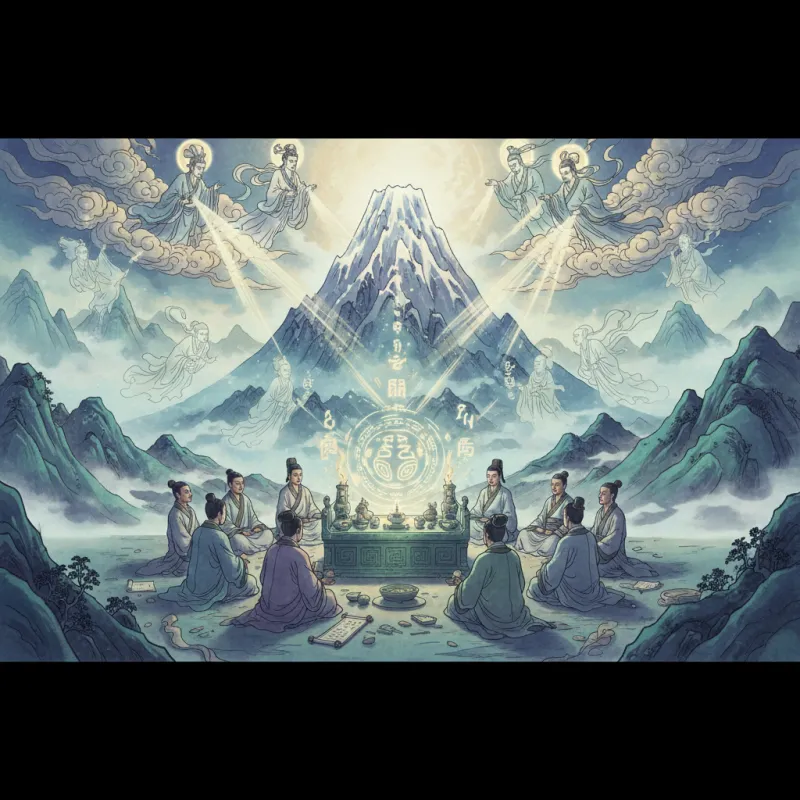
The wooden frame trembles. Two men grip its handles, their eyes half-closed, bodies swaying. Below them, a tray of fine sand waits, smooth and unmarked. Then the frame lurches—not randomly, but with purpose. It drags through the sand, leaving behind a perfect Chinese character. Then another. And another. An attendant kneels beside the tray, calling out each character as it forms. A scribe's brush flies across paper, recording every stroke. The men holding the frame claim they're not moving it. They say a god has descended into the wood.
This is spirit writing—扶乩 (fújī), also written 扶箕—and for over a thousand years, it's been one of the most productive methods of divine communication in Chinese religious life. Not just parlor tricks or fortune-telling games, but a technology that's generated entire religious movements, medical texts, moral treatises, and volumes of poetry attributed to immortals and deities. If you think this sounds like China's answer to the Ouija board, you're not entirely wrong. But spirit writing's cultural impact makes the Ouija board look like a novelty toy.
The Mechanics of Divine Possession
The apparatus itself is deceptively simple. The ji (乩) is typically a Y-shaped or T-shaped wooden frame, sometimes resembling a dowsing rod, sometimes more elaborate. Two operators—called jisheng (乩生) or "divination students"—grip the handles. The frame's pointer end hovers over a tray filled with sand, ash, or rice. When the deity arrives, the frame moves, and the pointer traces characters.
But here's where it gets interesting: the operators are supposed to enter a trance state. They're not consciously directing the movement. The deity—whether it's the war god Guan Yu (关帝, Guān Dì), the immortal Lü Dongbin (吕洞宾, Lǚ Dòngbīn), or the compassionate Guanyin (观音, Guānyīn)—possesses the implement itself, not the human bodies. This distinguishes fuji from other forms of spirit mediumship where the deity directly inhabits the medium's body.
The process requires a team. Beyond the two operators, you need a duji (读乩)—the reader who calls out each character as it forms—and a luji (录乩), the scribe who records everything. Some temples employed professional teams who performed spirit writing sessions regularly, almost like a divine customer service department.
A History Written by Ghosts
Spirit writing's origins are murky, which is fitting for a practice that claims to channel the dead. References appear as early as the Song Dynasty (960-1279 CE), though some scholars trace precursors back to the Han Dynasty. By the Ming (1368-1644) and Qing (1644-1912) dynasties, fuji had become widespread across all social classes.
The practice exploded during the late Qing period, when China was convulsing with rebellions, foreign invasions, and social upheaval. When the human world falls apart, people turn to the divine for answers. Spirit writing temples proliferated. Some became centers of local governance, with deities issuing moral guidance, settling disputes, and even prescribing medicine through the sand tray.
The most famous example is probably the Tongshan She (同善社), a redemptive society founded in the early 20th century that used spirit writing as its primary method of receiving divine instruction. The society's spirit-written texts formed the basis of an entire religious movement that spread across China and Southeast Asia. We're not talking about a few cryptic messages—these were systematic theological works, organizational guidelines, and moral codes, all supposedly dictated by celestial beings.
What the Gods Actually Say
So what do deities write about when given a sand tray and an audience? The content varies wildly depending on who's asking and which god shows up.
Medical prescriptions were common. A sick person would petition a deity, and the spirit writing session would produce a detailed herbal formula. Some of these prescriptions were remarkably sophisticated, suggesting either genuine divine intervention or operators with serious medical knowledge. The line between the two was never clear, and perhaps that was the point.
Moral exhortations were another staple. Deities loved lecturing humans about filial piety, loyalty, and proper behavior. These sessions often produced texts that read like Confucian primers mixed with Buddhist karma theory and Daoist cultivation practices—a syncretic stew that characterized much of Chinese folk religion.
Poetry was surprisingly common. Chinese deities, it turns out, are accomplished poets. Spirit writing sessions frequently produced classical Chinese verse in various forms—regulated verse, ancient-style poetry, even song lyrics. Some of this poetry was genuinely good, which raises uncomfortable questions about either divine literary talent or the unconscious abilities of the operators.
Prophecies and predictions appeared regularly, especially during times of crisis. The Taiping Rebellion, the Boxer Uprising, the fall of the Qing Dynasty—all these cataclysmic events generated spirit writing sessions where deities offered cryptic warnings or explanations. The predictions were usually vague enough to be interpreted multiple ways, a feature shared with oracles across cultures.
The Skeptic's Dilemma
Let's address the obvious question: is anyone actually moving the frame? The ideomotor effect—unconscious muscular movements—explains Ouija boards and similar phenomena in Western contexts. Two people holding a frame, even in a trance state, could easily produce movement through tiny, unconscious muscle actions. Add in the cultural expectation of what should happen, and you have a recipe for self-fulfilling prophecy.
But here's what makes Chinese spirit writing harder to dismiss outright: the literacy problem. Classical Chinese is difficult. Writing legible characters in sand with a wooden pointer while in a trance state, producing coherent poetry in regulated verse forms with proper tonal patterns—this requires significant skill. Many spirit writing operators were illiterate or poorly educated. Yet the texts they produced were often sophisticated.
Skeptics argue that the literate members of the team—the readers and scribes—were doing creative interpretation, turning random scratches into coherent characters. This probably happened sometimes. But it doesn't explain cases where multiple witnesses, including skeptical observers, reported watching clear characters form in the sand.
The anthropologist David Jordan, who studied spirit writing in Taiwan in the 1970s, noted that the practice seemed to tap into a collective cultural knowledge that transcended individual operators. Whether you call that divine intervention or the unconscious mind accessing deep cultural programming is perhaps a matter of preference.
Spirit Writing and Social Power
Here's what often gets overlooked: spirit writing was a political act. When a deity issues instructions through a sand tray, those instructions carry divine authority. This made fuji a powerful tool for social organization and, occasionally, resistance.
Local elites used spirit writing to legitimize their decisions. Religious societies used it to build organizational structures. Rebels used it to justify uprisings—the Taiping Heavenly Kingdom, though not primarily a spirit writing movement, drew on similar ideas of direct divine communication to challenge imperial authority.
The Qing government was ambivalent about spirit writing. On one hand, it promoted moral behavior and social stability. On the other hand, it could be used to challenge authority or spread heterodox ideas. The state periodically cracked down on spirit writing societies, especially those that seemed to be organizing politically.
This tension between state control and popular religious practice is a recurring theme in Chinese history. Spirit writing existed in that dangerous space where folk religion met political organization, where divine authority could challenge imperial authority.
The Modern Decline and Persistence
The Communist revolution of 1949 was not kind to spirit writing. The new government classified it as feudal superstition and actively suppressed it. Temples were closed, spirit writing implements destroyed, practitioners persecuted. The practice largely disappeared from mainland China.
But it survived in Taiwan, Hong Kong, and overseas Chinese communities. In Taiwan especially, spirit writing temples continued operating, adapting to modern contexts. Some temples now use electronic devices instead of sand trays—the deity moves a stylus across a digital screen, and characters appear on a monitor. The technology changes, but the basic concept remains.
There's been a modest revival in mainland China since the reform era, though spirit writing remains controversial and officially discouraged. Some temples have quietly resumed the practice, framing it as cultural heritage rather than active religious ritual. The line between performance and genuine religious practice has become deliberately blurred.
What's fascinating is how spirit writing has influenced modern Chinese culture in unexpected ways. The idea that deities communicate through written text, that divine wisdom can be transcribed and distributed—this shaped how Chinese religious movements organized themselves and spread their teachings. It's part of why Chinese folk religion produced so many written texts compared to purely oral traditions.
The Unanswered Questions
After a thousand years, spirit writing still resists easy explanation. The rationalist dismissal—it's all fraud or self-delusion—doesn't account for the sophisticated texts produced or the genuine religious experiences reported by participants. The believer's acceptance—the gods really do descend and write—requires accepting claims that can't be verified.
Maybe the more interesting question isn't whether spirit writing is "real" but what it reveals about how humans create meaning and authority. The practice sits at the intersection of literacy, religion, and social organization. It's a technology for generating authoritative texts in a culture that deeply values written words. Whether those texts come from gods, from the unconscious minds of operators, or from some collaborative process between humans and the cultural matrix they inhabit—perhaps that's less important than the fact that the texts were produced, believed, and acted upon.
The wooden frame still trembles in temples across Taiwan and Southeast Asia. The sand still receives its messages. And people still gather to hear what the gods have to say, one character at a time.
Related Reading
- The Tongji: Spirit Mediums of Southeast Asia's Chinese Communities
- Spirit Mediums in Chinese Culture: The Living Who Speak for the Dead
- Modern Spirit Mediums in Taiwan: Where Gods Still Talk Through People
- Shamanism in Chinese Folk Religion: The Original Spirit Workers
- Water Ghosts: The Spirits That Pull You Under
- Unraveling the Mystique of Chinese Supernatural Folklore and Afterlife Beliefs
- Nie Xiaoqian: The Ghost Romance That Conquered Cinema
Explore Chinese Culture
- Explore ancient mythical creatures
- Explore Daoist exorcism traditions
- Explore Chinese folk beliefs and superstitions