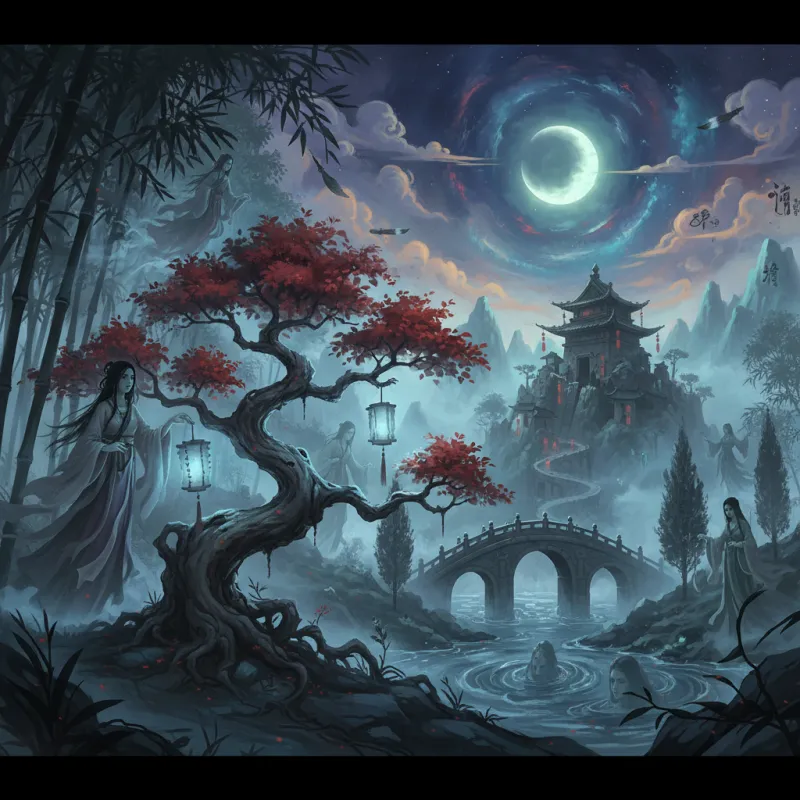
The first time you stay up until 4 AM reading a Chinese web novel about a paper effigy that comes to life, you realize Western horror has been playing in the shallow end of the pool. Chinese horror fiction doesn't just want to scare you—it wants to drag you through a cosmology where every shadow has rules, every ghost has grievances, and death is just the beginning of your bureaucratic nightmare.
From Banned Books to Billion-Dollar Platforms
Chinese horror didn't die with the Qing Dynasty—it went into hiding. After the founding of the People's Republic in 1949, ghost stories were officially classified as "feudal superstition," and authors who wrote about the supernatural risked serious consequences. The genre survived in Hong Kong and Taiwan, where writers like Ni Kuang (倪匡, Ní Kuāng) kept the tradition alive through the 1960s-80s with his Wisely series, blending horror with science fiction in ways that would later influence mainland writers.
The real explosion came in the early 2000s with the rise of web fiction platforms like Qidian (起点, Qǐdiǎn) and Jinjiang Literature City. Suddenly, anyone with an internet connection could publish serialized fiction, and readers could comment chapter-by-chapter, influencing plots in real-time. Horror found its natural home in this format—the serialized structure mirrors traditional Chinese storytelling, where tales were told in installments at teahouses, each ending with a cliffhanger to bring audiences back.
By 2010, the genre had fractured into dozens of subgenres: tomb-raiding adventures, urban ghost stories, cultivation horror, infinite flow (无限流, wúxiàn liú) where protagonists are trapped in deadly supernatural games, and more. Some platforms now host over 100,000 horror titles, with top authors earning six-figure incomes and seeing their work adapted into films, dramas, and games.
The Big Three: Where to Start
If you're new to Chinese horror web fiction, three novels serve as essential entry points, each representing a different approach to the genre.
Ghost Blows Out the Light (鬼吹灯, Guǐ Chuī Dēng) by Tianxia Bachang launched the tomb-raiding subgenre in 2006 and remains the gold standard. The story follows Hu Bayi, a former Red Guard who becomes a tomb raider, navigating ancient burial sites filled with supernatural dangers. What makes it brilliant is the meticulous research—the author incorporates real feng shui principles, historical burial practices, and Chinese cosmology. When Hu Bayi explains why you should never light more than three candles in a tomb, or how to read the "dragon veins" in a landscape, it feels authentic because it draws from actual traditions. The novel spawned an entire industry of imitators and has been adapted multiple times, though the original remains unmatched for its blend of adventure, horror, and historical detail.
My House of Horrors (我有一座恐怖屋, Wǒ Yǒu Yī Zuò Kǒngbù Wū) by I Fix Air-Conditioners takes a completely different approach. Chen Ge inherits a failing haunted house attraction and discovers that completing supernatural missions in real haunted locations unlocks new "props"—which turn out to be actual ghosts he can recruit. It's horror comedy done right, with genuinely creepy moments balanced by absurd situations, like negotiating with a ghost bride about her employment contract. The novel excels at creating memorable ghost characters with tragic backstories, and the protagonist's gradual transformation from scared owner to confident ghost manager is deeply satisfying.
Thriller Paradise (惊悚乐园, Jīngsǒng Lèyuán) by San Tian Liang Ye represents the "infinite flow" subgenre, where the protagonist Feng Bujue is trapped in a virtual reality game that pulls scenarios from horror films, literature, and mythology worldwide. Each arc is essentially a different horror story—one might be based on Chinese zombie folklore, another on Lovecraftian cosmic horror, another on Japanese urban legends. It's metafictional horror that rewards readers familiar with multiple horror traditions, and Feng Bujue's sardonic commentary on horror tropes makes it accessible even during the most disturbing scenarios.
The Subgenres You Need to Know
Chinese horror web fiction has developed its own taxonomy, distinct from Western genre classifications. Understanding these categories helps you find what you're looking for—and avoid what you're not.
Tomb-raiding fiction (盗墓小说, dàomù xiǎoshuō) focuses on exploring ancient burial sites, combining archaeology, history, and supernatural horror. Beyond Ghost Blows Out the Light, check out Grave Robbers' Chronicles (盗墓笔记, Dàomù Bǐjì) by Xu Lei, which adds more emphasis on conspiracy and mystery. These novels treat tombs as complete ecosystems with their own rules and dangers, from poison mechanisms to guardian spirits to the accumulated resentment of millennia.
Urban ghost stories (都市灵异, dūshì língyì) transplant traditional supernatural elements into modern cities. The best of these explore how ancient ghosts and demons adapt to contemporary life—what happens when a fox spirit tries to seduce someone via dating apps, or when a vengeful ghost haunts an apartment complex. My Girlfriend is a Zombie (我的女友是丧尸, Wǒ de Nǚyǒu shì Sàngshī) by Dark Lychee plays with this concept, following a protagonist trying to protect his girlfriend after she's infected during a zombie outbreak.
Infinite flow novels trap protagonists in supernatural game-like scenarios where death is permanent. Think Squid Game meets Silent Hill, but with Chinese supernatural elements. The genre rewards strategic thinking—protagonists must figure out the rules of each scenario to survive. Terror Infinity (无限恐怖, Wúxiàn Kǒngbù) by Zhttty pioneered this subgenre, sending characters into horror movie scenarios where they must complete objectives to earn points and upgrades.
Cultivation horror merges the popular cultivation/xianxia genre with horror elements, exploring the dark side of immortality-seeking. What happens when cultivation techniques require human sacrifice? What kind of demons do immortals become? Reverend Insanity (蛊真人, Gǔ Zhēnrén) by Gu Zhen Ren isn't pure horror, but its protagonist's ruthless pursuit of immortality and the novel's exploration of gu poison cultivation creates genuinely disturbing moments.
What Makes Chinese Horror Different
Reading Chinese horror fiction requires adjusting your expectations if you're coming from Western horror traditions. The scares operate differently, rooted in a cosmology where the supernatural is systematic rather than chaotic.
Chinese horror is rules-based. Ghosts and demons don't appear randomly—they follow specific conditions and can be countered with proper knowledge. This creates a different kind of tension: the fear isn't just that something supernatural exists, but that you don't know the rules well enough to survive it. When a character in Ghost Blows Out the Light enters a tomb, the suspense comes from watching them navigate complex supernatural protocols, knowing that one mistake in ritual or procedure could be fatal.
The genre also treats death as a transition rather than an ending. The Chinese underworld is a bureaucracy, complete with judges, clerks, and procedures. Many horror novels feature protagonists who can interact with this system—bribing ghost officials, filing paperwork for reincarnation, or exploiting loopholes in supernatural law. It's horror, but it's also weirdly practical.
Revenge is a major theme, but it's complicated. Ghosts typically have legitimate grievances—they were murdered, betrayed, or denied proper burial. The horror comes from their methods of revenge, which often ensnare innocent people, but the novels rarely present ghosts as purely evil. This moral ambiguity creates richer stories than simple good-versus-evil narratives.
The Translation Challenge and Where to Find English Versions
The vast majority of Chinese horror web fiction remains untranslated, and what does get translated often faces significant challenges. Horror relies heavily on cultural context—references to specific ghost types, folk practices, and supernatural rules that Chinese readers understand intuitively but require extensive footnotes for international audiences.
Fan translations dominate the landscape. Websites like Webnovel, Wuxiaworld, and various independent translator sites host ongoing translations, though quality varies wildly. Some translators are skilled at conveying both meaning and atmosphere; others produce barely readable machine-translation-adjacent text. The serialized nature of web fiction means translations are often incomplete—a novel might have 2000 chapters in Chinese but only 300 translated.
For newcomers, start with officially licensed translations when available. Webnovel has licensed several popular horror titles, and while their translations sometimes smooth out cultural elements too much, they're generally readable and complete. My House of Horrors has a complete fan translation that's quite good, maintaining the novel's humor while explaining cultural references.
The real treasure trove remains locked behind the language barrier. Platforms like Qidian host thousands of horror novels that will likely never be translated, including experimental works that push genre boundaries in fascinating ways. If you're serious about exploring Chinese horror fiction, learning to read Chinese—even at a basic level with heavy dictionary use—opens up exponentially more options.
Why This Matters Now
Chinese horror web fiction represents something unprecedented in literary history: a massive, commercially successful genre producing thousands of works annually, driven by reader feedback and market forces rather than traditional publishing gatekeepers. The best novels are genuinely innovative, creating new subgenres and narrative structures that Western horror hasn't explored.
But it's also a window into contemporary Chinese culture's relationship with its supernatural traditions. These novels are written by and for modern Chinese readers who grew up with both traditional ghost stories and Western horror films, who live in rapidly modernizing cities but maintain connections to folk beliefs. The fiction reflects this tension—ancient demons adapting to surveillance cameras, traditional exorcism techniques applied to internet hauntings, fox spirits navigating modern gender dynamics.
The genre is evolving rapidly. Five years ago, infinite flow was barely a category; now it's one of the most popular subgenres. New authors are experimenting with unreliable narrators, non-linear timelines, and metafictional elements in ways that would make Western literary horror authors jealous. And because web fiction allows for immediate reader feedback, successful innovations spread quickly across the genre.
Start with the Big Three, explore the subgenres that interest you, and don't be afraid to abandon novels that aren't working—with this much content available, there's no reason to force yourself through something you're not enjoying. The ghosts learned to type, and they have stories to tell that you've never heard before.
Related Reading
- Jiangshi: The Hopping Vampire Genre That Conquered Hong Kong Cinema
- The Best Chinese Horror Films: A Genre Guide — Cnspirit Perspective
- Chinese Horror Literature: From Liaozhai to Modern Thrillers
- Chinese Internet Ghost Stories: The Creepypasta of the East — Cnspirit Perspective
- Modern Spirit Mediums in Taiwan: Where Gods Still Talk Through People
- Daoist Exorcism Rituals Explained: How to Kick Out a Demon the Chinese Way
- Demons of Journey to the West: The Most Creative Monsters in Chinese Fiction
Explore Chinese Culture
- Explore ancient mythical creatures
- Explore Daoist exorcism traditions
- Explore Chinese folk beliefs and superstitions