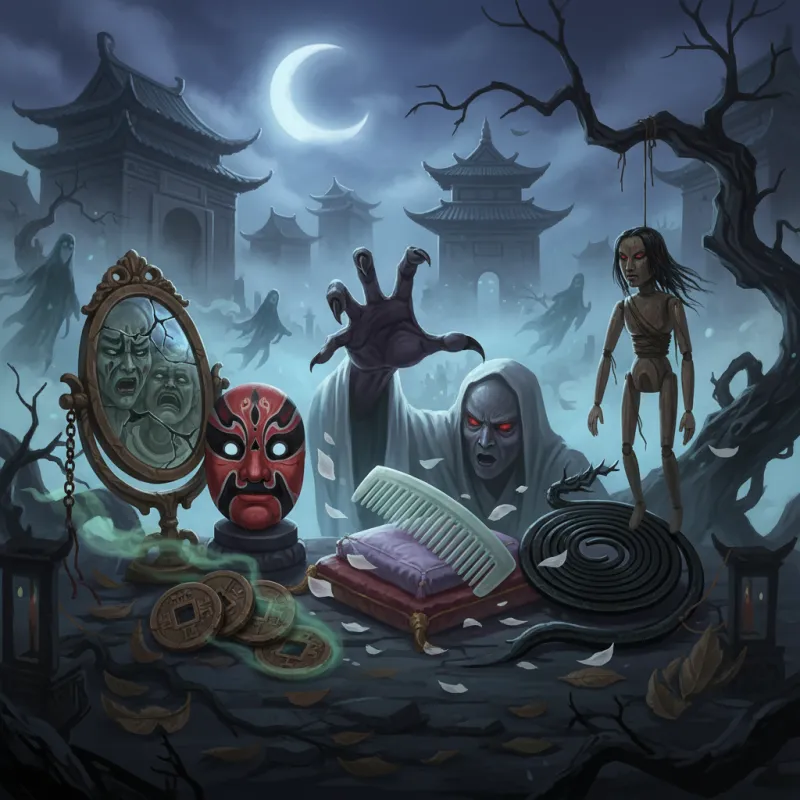
Your grandmother's jade bracelet shatters on the bathroom floor at 3 AM, and you wake to find the pieces arranged in a perfect circle. The antique mirror you bought at the estate sale shows your reflection — but it's smiling when you're not. That porcelain doll your aunt insisted you take keeps appearing in different rooms, always facing the door. In Chinese supernatural tradition, these aren't coincidences. They're warnings that you've brought something into your home that remembers.
The Memory of Matter
Chinese folklore operates on a principle that Western materialism finds difficult to digest: objects are not inert. The concept of 气 (qì, vital energy) doesn't distinguish cleanly between animate and inanimate. Everything — flesh, stone, metal, wood — is permeable to spiritual influence. Given sufficient time, exposure to intense emotion, or proximity to death, ordinary things develop what the tradition calls 灵性 (língxìng) — a kind of proto-consciousness that makes them responsive, reactive, and occasionally malevolent.
This isn't metaphor. In the Liaozhai Zhiyi (聊斋志异, Strange Tales from a Chinese Studio), Pu Songling's 17th-century collection of supernatural accounts, objects routinely act as vessels for spiritual contamination. A scholar's writing brush begins composing suicide notes on its own after its owner hangs himself. A bed where a woman was murdered refuses to let anyone sleep peacefully, inducing nightmares that replay her final moments. The stories treat these phenomena as natural consequences of spiritual mechanics, not supernatural exceptions.
The term for such objects — 凶物 (xiōngwù, inauspicious things) — appears throughout Ming and Qing dynasty ghost literature. Unlike Western cursed objects that typically require a deliberate hex or demonic possession, Chinese cursed objects often develop their malevolence organically, through accumulated exposure to negative 气. A sword doesn't need a witch's spell to become dangerous. Kill enough people with it, and it absorbs 杀气 (shāqì, killing energy) until it begins to influence its wielder toward violence, creating a feedback loop of bloodshed.
Mirrors That Remember Too Much
Of all cursed objects in Chinese tradition, mirrors hold a special place of dread. Bronze mirrors (铜镜, tóngjìng) have been used in China since the Shang dynasty, and their reflective surfaces were believed to reveal not just physical appearance but spiritual truth. Daoist exorcists used mirrors to expose demons hiding in human form. But this same quality — the ability to capture and reveal what's hidden — makes mirrors dangerous receptacles for supernatural contamination.
The logic is straightforward: if a mirror can reflect the spiritual realm, it can also retain what it reflects. A mirror present during a suicide doesn't just witness the death — it captures the despair, the final moment of consciousness, the 怨气 (yuànqì, resentment energy) that accompanies violent or untimely death. Anyone who subsequently looks into that mirror risks contact with the trapped consciousness, which may manifest as disturbing visions, personality changes, or in extreme cases, possession.
The Yuewei Caotang Biji (阅微草堂笔记, Notes from the Yuewei Hermitage), Ji Yun's 18th-century collection of supernatural accounts, includes multiple stories of haunted mirrors. In one, a scholar purchases an antique bronze mirror at a market and begins seeing a woman's face behind his own reflection. The face grows clearer each day until he recognizes her as his deceased first wife, who died in childbirth. The mirror, it turns out, had belonged to her family and was present in the room when she died. Her consciousness, unable to let go, had imprinted on the reflective surface.
Modern Chinese communities maintain these taboos. Covering mirrors in a house where someone has died is standard practice, preventing the deceased's spirit from becoming trapped in the reflection. Antique mirrors, especially those with unknown provenance, are treated with caution. The older the mirror, the more likely it has witnessed death, and the more dangerous it becomes as a spiritual vessel.
Jade: The Stone That Drinks Qi
Jade (玉, yù) occupies a unique position in Chinese culture — simultaneously the most auspicious and potentially most dangerous of materials. For millennia, jade has been believed to absorb and store 气 from its wearer. A piece of jade worn for years becomes attuned to that person's energy signature, essentially becoming an extension of their spiritual body. This is why jade is traditionally given as an heirloom, passed down through families — it carries the accumulated positive energy of ancestors.
But this same absorptive quality makes jade treacherous when its provenance is unknown. Jade taken from a corpse (陪葬玉, péizàngyù, burial jade) is considered especially dangerous. In traditional Chinese burial practices, jade pieces were placed in the mouth, hands, and on the body of the deceased to preserve the corpse and provide spiritual protection in the afterlife. These pieces spend years or centuries in direct contact with death energy, becoming saturated with 阴气 (yīnqì, yin energy) — the cold, dark, death-associated force that opposes living 阳气 (yángqì, yang energy).
The Zibuyu (子不语, What the Master Would Not Discuss), Yuan Mei's 18th-century collection of supernatural tales, includes an account of a merchant who purchased a jade pendant from a tomb robber. Within weeks, he developed a wasting illness that physicians couldn't diagnose. His body grew cold to the touch, he lost all appetite, and he began speaking in a woman's voice during sleep. A Daoist priest identified the jade as having come from a Ming dynasty noblewoman's tomb and still carrying her consciousness. The jade was ritually cleansed and reburied, and the merchant recovered.
Contemporary Chinese antique markets still observe these distinctions. Reputable dealers will disclose if jade pieces are 出土 (chūtǔ, excavated from the ground), and prices reflect the spiritual risk. Some buyers specifically seek burial jade, believing that proper cleansing rituals can neutralize the death energy while retaining the jade's accumulated power. Others refuse to touch it at any price, considering the risk of spiritual contamination too great.
Weapons and the Accumulation of Killing Intent
Chinese martial tradition recognizes that weapons are not neutral tools. A sword used to take life absorbs 杀气 (shāqì, killing energy) with each death, gradually developing what practitioners call 兵煞 (bīngshà, weapon malevolence). This isn't superstition — it's treated as observable fact in martial arts lineages that maintain historical weapons. A blade that has killed develops a different quality, a heaviness or coldness that experienced practitioners claim they can feel when handling it.
The Soushen Ji (搜神记, In Search of the Supernatural), a 4th-century collection compiled by Gan Bao, includes the famous story of the Ganjiang and Moye swords (干将莫邪剑). These legendary blades, forged by a master swordsmith who sacrificed himself to complete them, were said to possess such concentrated 杀气 that they would fly from their sheaths to kill on their own. While clearly mythologized, the story reflects a genuine belief that weapons accumulate spiritual properties through use.
Historical weapons, particularly those from battlefields or executions, are treated with extreme caution. Execution swords (斩首刀, zhǎnshǒudāo) used by imperial executioners were believed to carry the concentrated resentment of everyone they killed. These blades were never kept in homes and were ritually disposed of or sealed in temples when no longer in use. The few that survive in museums are often accompanied by documentation of cleansing rituals performed before display.
This belief extends beyond obvious weapons. Kitchen knives used in murders, scissors involved in suicides, even needles used in fatal poisonings can become vectors for spiritual contamination. The principle is consistent: any object that facilitates death or violence absorbs the energy of that act and can transmit it to subsequent users. This is why Chinese exorcism rituals often include the cleansing or disposal of objects associated with hauntings — the object itself may be the source of supernatural activity.
Dolls and the Uncanny Vessel
Dolls occupy a particularly unsettling category in Chinese supernatural tradition. The human form, even when rendered in cloth, porcelain, or wood, creates what practitioners call 形煞 (xíngshà, form malevolence) — a spiritual vulnerability that comes from resembling a human without being one. This resemblance makes dolls ideal vessels for spiritual possession, whether by wandering ghosts seeking a body or by deliberate magical binding.
The practice of 替身术 (tìshēnshù, substitute body technique) in Chinese folk magic explicitly uses dolls as spiritual proxies. A doll made to resemble a specific person can be used to transfer illness, bad luck, or curses from the person to the doll. But this same principle works in reverse — a doll can become a vessel for unwanted spiritual entities, particularly if it's old, has been present during deaths, or resembles someone who has died.
Liaozhai Zhiyi includes multiple accounts of possessed dolls. In one story, a merchant's daughter receives a beautifully crafted doll as a gift. The doll begins moving on its own at night, and the daughter starts exhibiting personality changes — speaking in an adult voice, knowing things she shouldn't know, expressing desires inappropriate for a child. Investigation reveals the doll was crafted by a woman who died in childbirth, and her consciousness, unable to accept death, had attached to her final creation.
Modern Chinese communities maintain wariness around certain types of dolls. Antique dolls, especially those from the Republican era (1912-1949) or earlier, are often avoided unless their history is known. Dolls found abandoned or discarded are never brought into homes — the assumption being that they were disposed of for spiritual reasons. And dolls that resemble deceased family members are considered especially dangerous, as they may attract the deceased's consciousness or be mistaken for the person by wandering spirits.
Furniture That Witnessed Death
In Chinese supernatural tradition, furniture present during deaths — particularly violent or untimely deaths — becomes spiritually contaminated. Beds where people died, chairs where suicides occurred, tables used in murder scenes: these objects absorb the death energy and can transmit it to subsequent users. This isn't abstract theory. Estate sales and secondhand furniture markets in Chinese communities routinely disclose death history, and prices reflect the spiritual liability.
The mechanism is the same as with other cursed objects: prolonged contact with intense negative emotion or death energy causes the object to absorb and retain that energy. But furniture presents a particular problem because of sustained physical contact. You sleep in a bed for eight hours a night. You sit in a chair for meals, work, conversation. This extended contact creates more opportunity for spiritual contamination to transfer from object to person.
Yuewei Caotang Biji includes an account of a family that purchased a bed from an estate sale. Within weeks, everyone who slept in the bed experienced the same nightmare: a woman hanging from the bed's canopy frame, her face blue, her eyes bulging. Investigation revealed that the bed's previous owner had hanged herself from that exact spot. The bed was burned, and the nightmares stopped.
Contemporary practice maintains these taboos. Furniture from hospitals, funeral homes, or houses where violent deaths occurred is typically destroyed rather than resold. Even furniture from natural deaths is often cleansed with ritual methods before being passed to new owners. The principle is precautionary: better to assume contamination and cleanse unnecessarily than to risk bringing death energy into your home.
The Cleansing Question
The existence of cursed objects raises an obvious question: can they be cleansed? Chinese tradition answers yes, but with significant caveats. The effectiveness of cleansing depends on the depth of contamination, the skill of the practitioner, and the nature of the object itself.
Daoist and Buddhist cleansing rituals (净化仪式, jìnghuà yíshì) typically involve some combination of: exposure to sunlight (yang energy), immersion in flowing water (to carry away contamination), fumigation with specific incenses (sandalwood, mugwort, realgar), and recitation of purification mantras. For objects with deep contamination — burial jade, execution weapons, furniture from murder scenes — more intensive rituals may be required, including burial in salt, exposure to temple incense smoke for extended periods, or ritual destruction.
But some objects are considered beyond cleansing. Objects that have developed 灵性 (língxìng, proto-consciousness) through extreme contamination may resist purification or require such intensive ritual work that destruction becomes more practical. The principle is pragmatic: if an object has absorbed enough negative energy to develop autonomous spiritual properties, attempting to cleanse it may simply anger whatever consciousness has formed, making the situation worse.
This is why traditional Chinese households maintain strict protocols around object acquisition. Antiques require provenance documentation. Gifts from unknown sources are politely declined. Objects found abandoned are left where they are. The assumption underlying these practices is simple: prevention is easier than cleansing, and some contaminations cannot be undone.
The jade bracelet that shattered at 3 AM? Your grandmother might have been protecting you, breaking the object before whatever it carried could transfer to you. The mirror showing the wrong reflection? Cover it immediately and call someone who knows the old rituals. The doll that moves between rooms? Don't try to throw it away — it will come back. Some objects, once they remember, never forget.
Related Reading
- Temple Guardian Spirits: The Supernatural Protectors of Sacred Spaces
- Haunted Temples: Where Gods and Ghosts Coexist
- The Most Haunted Temples in China: Ghost Stories from Sacred Ground
- Temple Legends: The Ghost Stories That Live in China's Sacred Spaces
- Diyu: The Chinese Underworld and Its Ten Courts of Hell
- Mengpo Soup: The Drink That Erases Memory
- Jiangshi: The Chinese Hopping Vampire
Explore Chinese Culture
- Explore ancient mythical creatures
- Explore Daoist exorcism traditions
- Explore Chinese folk beliefs and superstitions