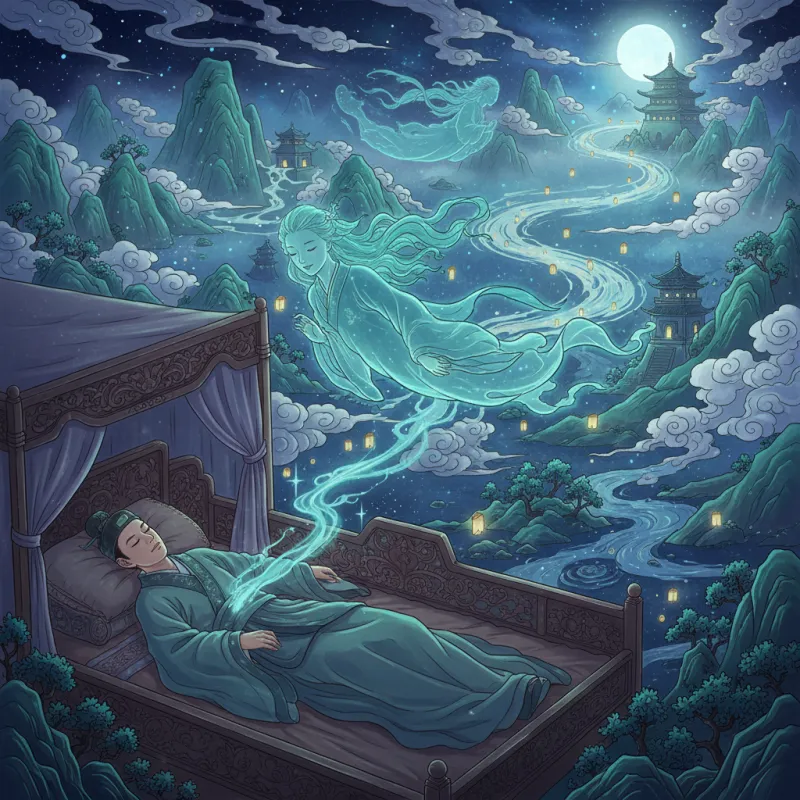
You wake up exhausted, though you slept eight hours. Your legs ache. There's dirt under your fingernails that wasn't there last night. In traditional Chinese belief, this isn't a mystery—it's evidence. While you slept, your hún soul (魂) left your body and went somewhere. The fatigue, the phantom pains, the inexplicable traces: these are the costs of nocturnal travel to places your waking mind can barely remember.
The Architecture of the Chinese Soul
Western psychology treats dreams as mental phenomena—neurons firing, memories consolidating, anxieties processing. Chinese metaphysics takes a different position: dreams are travel logs. To understand why, you need to grasp how traditional Chinese thought divides the human soul.
You don't have one soul. You have at least two, possibly more depending on which text you're reading. The hún (魂) is your ethereal soul—the part associated with consciousness, personality, and yang energy. It's mobile, curious, and dangerously prone to wandering. The pò (魄) is your corporeal soul—the part that keeps your lungs breathing and your heart beating, rooted in yin energy and tied to your physical body. Some texts describe three hún and seven pò, but the functional division remains: one part of you can leave, one part must stay.
When you fall asleep, the hún detaches. Not metaphorically. Actually detaches. It slips out through specific exit points—often the crown of the head or the eyes—and begins its nightly journey. The pò remains behind, maintaining your body's basic operations like a caretaker watching an empty house. This is why a sleeping person still breathes, why their heart still beats, why they don't simply die the moment they lose consciousness.
Where Your Soul Goes at Night
The hún doesn't wander randomly. It travels to specific locations in the spirit world, a realm that overlaps with but remains distinct from the physical world. Sometimes it visits places you know—your childhood home, your workplace, a temple you once attended. But the spirit world versions of these places are not identical to their physical counterparts. They're older, stranger, populated by beings who don't exist in daylight.
In the Liaozhai Zhiyi (聊齋誌異, Strange Tales from a Chinese Studio), Pu Songling documents dozens of cases where dreamers encounter fox spirits, ghosts, and demons during their sleep travels. These aren't hallucinations. In the logic of the text, the dreamer's hún has genuinely entered a space where such beings exist. The scholar who dreams of a beautiful woman and wakes to find fox fur on his pillow hasn't imagined the encounter—his hún met an actual fox spirit, and the physical evidence proves it.
Other times, the hún travels to the underworld itself. The bureaucratic afterlife of Chinese belief—with its courts, judges, and record-keepers—is not sealed off from the living. Your hún can visit while you sleep, sometimes summoned by officials who need to question you about someone else's case, sometimes wandering in by accident. The Yuewei Caotang Biji (閱微草堂筆記, Notes from the Yuewei Hermitage) by Ji Yun includes multiple accounts of people who dream of being interrogated by underworld magistrates, only to wake and discover that the person they were questioned about has just died.
The Dangers of Interrupted Return
This is why your grandmother told you never to wake someone suddenly. It's not superstition—it's safety protocol. When the hún is away, waking the body too abruptly can trap the soul outside, or cause it to return incorrectly, or damage the connection between hún and pò. The results range from disorientation and illness to permanent soul loss.
Soul loss (失魂, shī hún) is a recognized medical condition in traditional Chinese culture. Symptoms include lethargy, depression, memory problems, and a sense of being "not quite there." Children are especially vulnerable—their hún is less firmly attached and more easily startled away. This is why you'll still see Chinese parents being careful about waking sleeping children, why they might call the child's name gently before touching them, giving the hún time to return properly.
The treatment for soul loss involves calling the hún back. A family member or ritual specialist will stand at the location where the soul was lost—often the place where the person was startled awake—and call the person's name, sometimes while holding an article of their clothing. The logic is straightforward: the hún is lost, confused, unable to find its way home. You're giving it directions.
Physical Evidence of Spirit Travel
Here's what makes the Chinese understanding of dream-travel particularly interesting: it accounts for physical evidence. You dream of walking through mud, you wake with dirty feet. You dream of fighting, you wake with bruises. You dream of eating a feast, you wake feeling full. Western psychology dismisses these as coincidence or psychosomatic effects. Chinese metaphysics says: of course there's physical evidence. Your soul was actually somewhere, doing something. The body reflects what the hún experienced.
The Taiping Guangji (太平廣記, Extensive Records of the Taiping Era), compiled in the 10th century, contains numerous accounts of this phenomenon. A man dreams of attending a banquet in a magnificent palace. He wakes to find his stomach full and wine on his breath. A woman dreams of being beaten by demons. She wakes covered in bruises that match exactly where she was struck in the dream. These aren't presented as miraculous exceptions—they're presented as normal consequences of soul travel.
This creates interesting legal and moral questions. If your hún commits adultery while your body sleeps, are you guilty? Some texts say yes—the hún is you, its actions are your actions. Others argue that the hún operates under different rules in the spirit world, that dream-actions don't carry the same moral weight as waking actions. The debate reveals how seriously Chinese culture took the reality of dream experiences.
Controlling Your Nocturnal Wanderings
Not everyone's hún wanders uncontrolled. Daoist cultivation practices include techniques for conscious dream travel—training your hún to go where you direct it, to remember what it sees, to return with useful information. This is different from modern "lucid dreaming" techniques. You're not trying to control the dream narrative. You're trying to control where your actual soul goes while your body sleeps.
Advanced practitioners claim to visit distant locations, gather intelligence, communicate with spirits, even attack enemies by sending their hún to the target's sleeping body. The Baopuzi (抱朴子, Master Who Embraces Simplicity) by Ge Hong describes methods for stabilizing the hún, strengthening its connection to the body, and directing its travels. These aren't psychological exercises—they're spiritual technologies for managing a real phenomenon.
The flip side: if you can control your hún's travels, so can others. Sorcerers and malevolent spirits can trap, redirect, or attack your wandering soul. This is one explanation for nightmares—your hún has encountered something hostile during its travels and is struggling to escape or defend itself. Protective talismans, prayers, and proper bedroom arrangements aren't about psychology. They're about securing your soul's safe passage through dangerous territory.
When the Soul Doesn't Come Back
Sometimes the hún doesn't return. The body continues breathing, the heart keeps beating, but the person doesn't wake up. In Western medicine, this is a coma. In Chinese metaphysics, this is a soul that's lost, trapped, or stolen. The pò keeps the body alive, but without the hún, there's no consciousness, no personality, no person.
Treatment requires finding where the hún went and bringing it back. This might involve ritual specialists traveling in their own spirit bodies to search for the lost soul. It might require negotiations with whatever entity is holding the hún—spirits don't always release souls willingly. Sometimes they want something in exchange. Sometimes they're keeping the soul for their own purposes.
The most disturbing cases involve souls that don't want to return. The spirit world can be more appealing than the physical world—more beautiful, more exciting, free from physical pain and social constraints. A hún that's found happiness elsewhere might resist being dragged back to its body. This creates an ethical dilemma: do you force the soul to return against its will? Some texts suggest that in such cases, it's better to let the body die and release the pò as well, allowing the person to fully transition to their new existence.
The Modern Dismissal and Persistent Experience
Contemporary Chinese culture largely treats soul travel as superstition, a pre-scientific misunderstanding of neurological processes. Dreams are brain activity, nothing more. The hún and pò are metaphors, not actual entities. Waking someone suddenly won't trap their soul because souls don't leave bodies.
Yet the experiences persist. People still wake exhausted from dreams of running. Still find unexplained marks on their bodies that match dream injuries. Still feel that peculiar sense of having been somewhere real, somewhere other, during sleep. Modern psychology offers explanations—sleep paralysis, false memories, psychosomatic responses—but these explanations often feel like they're describing the symptoms while missing the experience.
Perhaps the question isn't whether the hún literally detaches and travels to a literal spirit world. Perhaps the question is: what kind of reality do we inhabit when we sleep? Chinese metaphysics offers one answer, one that takes dream experiences seriously as genuine encounters with genuine otherness. Whether you call it soul travel or something else, the phenomenon remains: sleep is not passive, dreams are not mere imagination, and something in us goes somewhere when consciousness fades.
The next time you wake up tired from a full night's sleep, consider the possibility. Maybe you weren't resting. Maybe you were traveling. And maybe the journey took more out of you than you remember.
Related Reading
- Dream Interpretation in Chinese Culture: When the Spirit Wanders at Night
- Dream Spirits and Sleep Demons: The Supernatural World of Chinese Dreams
- Ghost Press (鬼压床): The Chinese Explanation for Sleep Paralysis
- Chinese Dream Interpretation: What Your Dreams Mean in Traditional Culture
- Unveiling the Mysteries of Chinese Supernatural Folklore: Ghosts, Spirits, and Afterlife Beliefs
- Ghost Marriage: When the Dead Need a Spouse
- Chinese Folklore: The Stories That Grandmothers Tell
Explore Chinese Culture
- Explore ancient mythical creatures
- Explore Daoist exorcism traditions
- Explore Chinese folk beliefs and superstitions