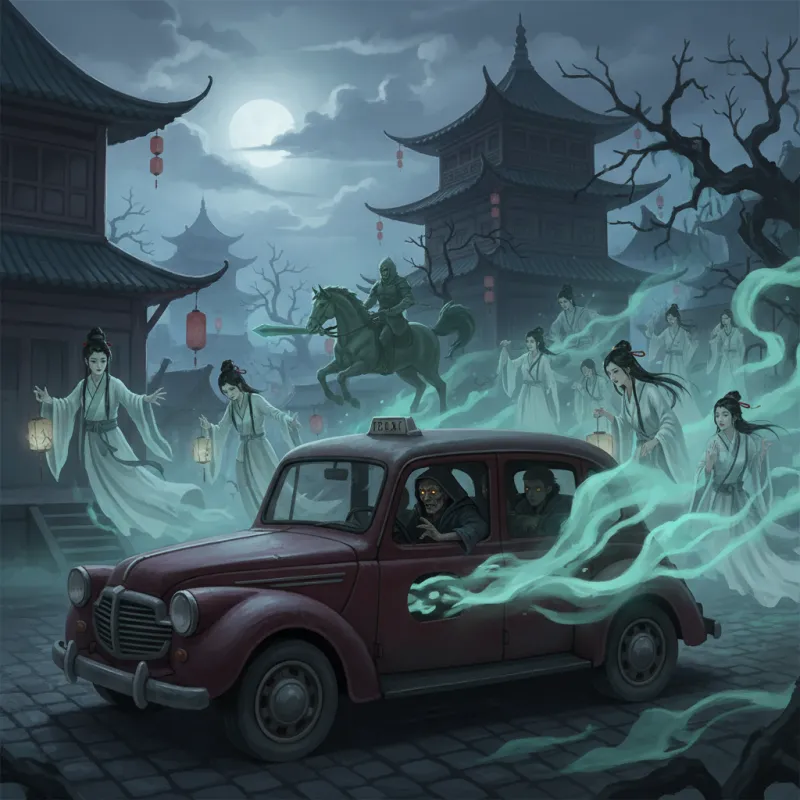
Your taxi driver leans back at a red light and asks if you've heard about the woman in white who appears on the Third Ring Road at 2 AM. He's not making conversation — he's genuinely warning you. In China's megacities, ghost stories aren't relics from dusty folklore collections. They're living narratives, passed between strangers in taxis, whispered in office break rooms, and shared in WeChat groups with deadly seriousness. These modern guǐ gùshi (鬼故事, ghost stories) follow the same supernatural logic as Pu Songling's 17th-century Liaozhai Zhiyi, but they've traded fox spirits for elevator ghosts and haunted temples for cursed apartment complexes.
The Taxi Driver's Canon
Taxi drivers are the unofficial archivists of urban supernatural lore. They work the night shift when the boundary between worlds grows thin, and they traverse the entire city, collecting stories from every district. The most widespread legend involves the late-night passenger who gives an address, sits silently in the back seat, and vanishes before paying — leaving only a pool of water or a handful of ghost money (míngbì, 冥币) on the seat.
But the sophisticated versions are more unsettling. In Shanghai, drivers speak of a woman who boards near Yan'an Road around 3 AM, always requesting the same destination in the former French Concession. She pays with real money, makes small talk about the weather, and exits normally. The disturbing part? Multiple drivers report picking up the exact same woman — same face, same dress, same destination — on different nights, sometimes years apart. She never ages. When one driver tried to follow her after drop-off, she walked through a locked cemetery gate.
The 3 AM timing isn't arbitrary. In Chinese supernatural belief, the hours between 1 and 3 AM represent yīn shí (阴时, yin time), when ghostly energy peaks. This concept appears throughout classical literature, from Tang dynasty ghost tales to Ming dynasty supernatural fiction. Modern urban legends simply relocated this ancient timing to contemporary settings.
Subway Spirits and Underground Worlds
Beijing's subway system, the second-longest in the world, has become a breeding ground for supernatural narratives. Line 1, which cuts through the heart of the capital along Chang'an Avenue, carries the most persistent legends. Passengers on the last train report seeing figures in Qing dynasty clothing boarding at Tiananmen East station. These passengers sit silently, never use phones, and disappear before the train reaches the next stop.
The legend gains credibility from historical fact: Beijing's subway construction in the 1960s and 70s disturbed countless burial sites. The city has been continuously inhabited for over three millennia, with layer upon layer of graves beneath the modern streets. Construction workers reportedly encountered mass graves, ancient tombs, and execution grounds while digging tunnels. Some stations were allegedly built directly over former cemetery land, a violation of traditional fēngshuǐ (风水) principles that's believed to trap restless spirits underground.
Shanghai's Metro Line 2 has its own notorious legend involving Jing'an Temple station. According to the story, a construction worker died during excavation in the late 1990s, and his ghost now appears on the platform between midnight and 1 AM. Multiple security guards have reported seeing a figure in a yellow safety vest walking along the tracks, vanishing when approached. The detail that makes this legend stick: the figure always appears on the anniversary of the worker's death, a date that varies depending on who's telling the story — suggesting either multiple deaths or a single legend that's fractured into variants.
The Haunted Apartment Complex
If you're apartment hunting in any major Chinese city, you'll eventually encounter a unit priced suspiciously below market rate. The real estate agent might mention it had a "previous incident" (chū guò shì, 出过事), a euphemism meaning someone died there — usually by suicide or murder. These xiōng zhái (凶宅, ominous houses) are legally required to be disclosed in some cities, but the practice is inconsistent.
The most famous haunted apartment legend involves a high-rise in Guangzhou's Tianhe district. In the early 2000s, a woman allegedly jumped from the 14th floor after discovering her husband's affair. The apartment remained empty for years despite being in a prime location. When a young couple finally moved in at a steep discount, they reported hearing sobbing at night, finding wet footprints leading to the balcony, and waking to see a woman's silhouette standing at the window. They moved out after three weeks.
What makes this legend particularly Chinese is the emphasis on yuàn qì (怨气, resentment energy). In traditional belief, people who die with unresolved grievances become lì guǐ (厉鬼, fierce ghosts) who cannot move on. This concept appears throughout classical literature, from the vengeful spirits in Strange Tales from a Chinese Studio to the ghost plays of the Yuan dynasty. Modern urban legends simply transplanted this ancient belief system into concrete high-rises with central air conditioning.
The Hospital's Fourth Floor
Chinese hospitals are supernatural hotspots in urban legend, and the fourth floor carries special significance. The number four (sì, 四) is homophonous with death (sǐ, 死), making it the most inauspicious number in Chinese culture. Many hospitals skip the fourth floor entirely in their numbering system, jumping from three to five. But in older hospitals that retain the fourth floor, legends proliferate.
The most common narrative involves nurses working night shifts who hear call buttons ringing from empty rooms on the fourth floor. When they investigate, they find the rooms dark and unoccupied, but the call button light is illuminated. Some versions include the detail of finding the bed still warm, or seeing an indentation on the pillow as if someone had just been lying there.
A more elaborate legend from a hospital in Chengdu describes a specific room — 444 — that was sealed after multiple patients died there in quick succession. According to the story, the room is still there behind a plastered-over doorway, and staff members walking past that section of hallway report feeling sudden cold spots and hearing muffled voices. The legend connects to the broader Chinese belief in bìng sǐ guǐ (病死鬼, illness-death ghosts), spirits of those who died from disease and linger in the places where they suffered.
The Elevator Game
The "elevator game" legend originated in South Korea but found fertile ground in China, where it merged with existing beliefs about liminal spaces and supernatural thresholds. The game involves entering an elevator alone and pressing a specific sequence of floor buttons. If performed correctly, the elevator allegedly transports you to another dimension — or brings something back with you.
Chinese versions of the legend add specific cultural details. Some variants specify that you must perform the ritual at zǐ shí (子时, the hour of the rat, 11 PM to 1 AM) for it to work. Others warn that if you see a woman enter the elevator during the sequence, you must not look at her or acknowledge her presence, as she's a guǐ (鬼, ghost) testing whether you're worthy of entering the other realm.
The elevator game taps into the Chinese concept of jiè (界, boundary or threshold). Elevators are liminal spaces — neither here nor there, suspended between floors. In traditional Chinese supernatural belief, boundaries are dangerous: doorways, bridges, crossroads, and thresholds are places where the spirit world can bleed through. The elevator is simply the modern architectural equivalent of these ancient dangerous thresholds, and urban legends have adapted accordingly.
The University Dormitory
Chinese university campuses are rich sources of supernatural legends, particularly the older institutions built on former execution grounds or cemetery land. Nanjing University, established in 1902, sits partially on land that was once part of the Taiping Heavenly Kingdom's capital, where thousands died during the rebellion's suppression in 1864. Students report seeing Qing-era soldiers walking through dormitory walls and hearing battle sounds late at night.
The most persistent campus legend involves the "ghost student" — a figure in outdated school uniform who appears in libraries, study halls, and dormitories. At Peking University, students speak of a young woman in 1980s-style clothing who sits in the library's reading room, always at the same desk, always reading the same book. When approached, she vanishes. The legend claims she was a student who died by suicide during exam season and continues studying in death, unable to let go of her academic ambitions.
This legend resonates because it reflects real anxieties about China's intensely competitive education system. The ghost student embodies the fear of being consumed by academic pressure, of losing yourself so completely to study that even death can't release you. It's a modern morality tale dressed in supernatural clothing, much like the scholar-ghost stories in classical Chinese literature that warned against obsessive pursuit of examination success.
Why These Stories Persist
Modern Chinese urban legends aren't just entertainment — they're a way of processing rapid urbanization and social change. When your city transforms beyond recognition in a decade, when ancient neighborhoods are demolished for high-rises, when subway lines tunnel through centuries of burial grounds, ghost stories become a way of acknowledging what's been displaced and disturbed.
These legends also preserve traditional supernatural beliefs in a modern context. The logic of yīn and yáng (阴阳, yin and yang), the danger of yuàn qì (怨气, resentment energy), the significance of death dates and inauspicious numbers — all these concepts from classical Chinese cosmology survive in urban legends about subway ghosts and haunted apartments. The stories are new, but the underlying worldview is ancient.
Your taxi driver finishes his story as you reach your destination. He's not trying to scare you, he insists. He's just telling you what he's seen, what other drivers have told him, what everyone knows if they work the night shift long enough. You pay and exit, and as the taxi pulls away, you notice he's already picked up another passenger. You didn't see anyone approach the car. The back seat was empty a moment ago. But maybe you weren't paying attention. Maybe it's nothing. Maybe it's just another story waiting to be told.
Related Reading
- Ghosts of the Beijing Subway: Urban Legends Underground
- Exploring Chinese Supernatural Folklore: Ghosts, Spirits, and Afterlife Beliefs Unveiled
- Modern Ghost Sightings in China: When Ancient Beliefs Meet the Digital Age
- Chinese Urban Legends That Went Viral: From Elevator Ghosts to Cursed Phone Numbers
- Chinese Campus Ghost Stories: The Haunted Universities
- Yin Feng Shui: The Art of Placing Graves for Good Fortune
- The Nine-Tailed Fox: From Divine Symbol to Ultimate Villain
- Ox-Head and Horse-Face: The Messengers of Hell
Explore Chinese Culture
- Explore ancient mythical creatures
- Explore Daoist exorcism traditions
- Explore Chinese folk beliefs and superstitions