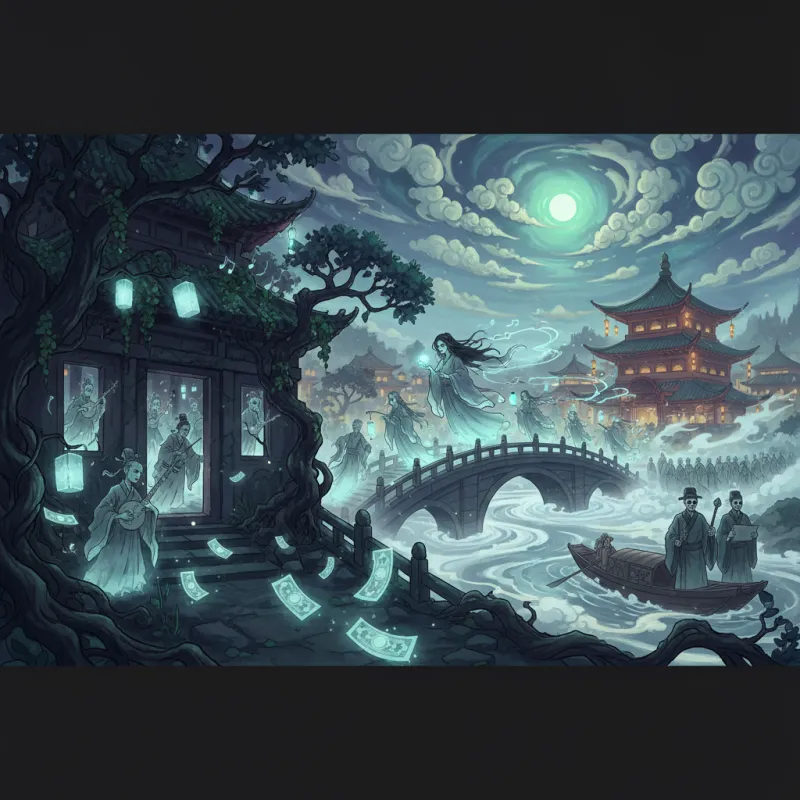
The old woman's funeral procession had barely left the village when her grandson saw her standing in the doorway of her house, wearing the same blue cotton jacket she'd been buried in. He wasn't afraid—he knew exactly what she wanted. In Chinese supernatural tradition, the dead don't simply vanish into an abstract afterlife. They linger, they negotiate, they demand their due. And if you ignore them, things get complicated.
The Hungry Ghost Problem: Why the Dead Won't Stay Dead
Chinese supernatural folklore operates on a fundamentally different premise than Western ghost stories. The issue isn't whether ghosts exist—of course they do. The question is whether you've fulfilled your obligations to them. The concept of 饿鬼 (è guǐ, hungry ghosts) emerged during the Han Dynasty (206 BCE - 220 CE) as Buddhism merged with indigenous Chinese beliefs, creating a supernatural ecosystem where the dead could become genuinely problematic if neglected.
These aren't your Hollywood jump-scare specters. Hungry ghosts are beings trapped in a state of perpetual craving, usually because their descendants failed to perform proper funeral rites or provide regular offerings. The seventh lunar month, known as 鬼月 (guǐ yuè, Ghost Month), sees families across China, Taiwan, and Southeast Asian Chinese communities setting out elaborate meals for wandering spirits. Miss this obligation, and you might find your business failing, your children falling ill, or worse—a persistent presence in your home that no amount of sage burning will eliminate.
The Ming Dynasty novel "What the Master Would Not Discuss" (子不語, Zǐ Bù Yǔ) by Yuan Mei catalogs hundreds of cases where neglected ancestors returned to settle scores. In one account, a merchant who refused to maintain his father's grave found his entire warehouse infested with rats that no cat would touch. The solution? A proper apology, three years of offerings, and a rebuilt ancestral tablet. The supernatural world, it turns out, runs on bureaucracy and reciprocity.
The Underworld Civil Service: Death as Administrative Transfer
If you think earthly bureaucracy is tedious, wait until you hear about 地府 (dì fǔ, the Underworld). Chinese afterlife beliefs don't feature a simple heaven-or-hell binary. Instead, the dead enter a complex governmental system overseen by 阎罗王 (Yán Luó Wáng, King Yama), complete with courts, judges, and an extensive filing system tracking every deed from your mortal life.
The "Journey to the Underworld" sections in classical texts like "Strange Tales from a Chinese Studio" (聊斋志异, Liáo Zhāi Zhì Yì) by Pu Songling describe the afterlife as essentially a mirror of Qing Dynasty administration—just with more torture chambers. The dead must pass through ten courts, each presided over by a judge specializing in particular sins. Lied to your parents? Court Three. Wasted food? Court Five. The punishments are creative and disturbingly specific: liars get their tongues pulled out by ox-headed demons, while those who disrespected books get crushed under mountains of texts.
But here's where it gets interesting: the system is negotiable. Wealthy families would burn elaborate paper offerings—houses, servants, credit cards, even iPhones in modern practice—to ensure their deceased relatives had resources to bribe underworld officials. The practice of burning 纸钱 (zhǐ qián, paper money) isn't just symbolic; it's practical estate planning for the afterlife. Some families burn paper lawyers to help their deceased navigate the legal proceedings.
Fox Spirits and the Erotic Supernatural
While Western supernatural traditions often separate the sacred from the sexual, Chinese folklore gleefully mingles them. 狐狸精 (hú li jīng, fox spirits) occupy a unique space in the supernatural hierarchy—neither fully demon nor deity, capable of transformation, seduction, and occasionally, genuine love.
The most famous fox spirit tale involves 妲己 (Dá Jǐ), the consort who supposedly bewitched the last Shang Dynasty emperor into tyranny, leading to the dynasty's collapse around 1046 BCE. But fox spirits aren't always villains. In Pu Songling's stories, many fox spirits form genuine relationships with human scholars, offering companionship, wisdom, and yes, physical pleasure. The tale of "Lotus Fragrance" features a fox spirit who helps a struggling student pass his imperial examinations while maintaining a tender, if unconventional, romance.
What makes fox spirits fascinating is their ambiguity. They can drain your life force through sexual encounters, or they can become devoted partners who bear children and manage households. The determining factor often comes down to the human's character—treat a fox spirit with respect and sincerity, and you might gain a powerful ally. Approach with lust and deception, and you'll likely end up a desiccated corpse. It's supernatural Darwinism with a moral lesson attached.
The Qing Dynasty saw an explosion of fox spirit temples, where people would pray to fox deities for everything from business success to fertility. This wasn't considered heretical—it was simply acknowledging another layer of the supernatural bureaucracy. Some scholars argue that fox spirits represented female agency in a patriarchal society, beings who could choose their partners and leave unsatisfactory relationships, unlike human women bound by Confucian propriety.
Jiangshi: The Hopping Corpse Phenomenon
Forget shambling zombies—Chinese reanimated corpses have style. 僵尸 (jiāng shī, stiff corpses) move by hopping because rigor mortis has locked their joints, their arms outstretched, dressed in Qing Dynasty official robes. They navigate by sensing the breath of the living, which is why the classic defense involves holding your breath and standing perfectly still.
The jiangshi tradition emerged from a practical problem: during the Qing Dynasty, many people died far from their ancestral homes. Professional corpse drivers (赶尸人, gǎn shī rén) would transport bodies back for proper burial, traveling at night to avoid frightening villagers. The corpses were tied to bamboo poles and carried in a way that made them appear to hop. Over time, folklore transformed this macabre profession into tales of reanimated corpses hopping through the countryside.
But jiangshi aren't mindless. In many stories, they retain fragments of memory and purpose. A jiangshi might return to its family home, not to attack, but to complete unfinished business—signing a document, revealing hidden treasure, or exposing a murderer. The 1980s Hong Kong jiangshi films turned them into comedy-horror staples, but the original folklore treats them as tragic figures, neither fully dead nor alive, stuck in an uncomfortable liminal state.
The method for controlling jiangshi reveals the Daoist influence on Chinese supernatural beliefs. A 符 (fú, talisman) pasted on the forehead can freeze a jiangshi in place. These aren't random symbols—they're specific characters and diagrams drawn by Daoist priests, essentially divine restraining orders. The supernatural world, once again, responds to proper paperwork and religious authority.
The Water Ghost Substitution Rule
Here's a genuinely unsettling belief that persists in rural China: 水鬼 (shuǐ guǐ, water ghosts). When someone drowns, their spirit becomes trapped at the drowning site until they can find a substitute—another person to drown in their place. Only then can the original victim proceed to the underworld for judgment.
This belief has real-world consequences. In some regions, people are reluctant to save drowning victims, fearing they might be interfering with a water ghost's substitution attempt. The logic is grimly practical: if you save someone a water ghost has marked, the ghost might target you instead. Folk tales are full of stories about kind-hearted people who saved drowning children, only to face a series of near-drowning incidents themselves until they performed specific rituals to appease the frustrated water ghost.
The substitution rule appears in "Strange Tales from a Chinese Studio" multiple times, usually with a moral twist. In one story, a water ghost refuses to drown a filial son who's supporting his elderly mother, choosing to wait decades for a less virtuous victim rather than create an orphan. The tale suggests that even malevolent spirits operate within a moral framework—they're not evil, just desperate to escape their liminal state.
Modern Chinese horror films like "The Eye" and "Dumplings" draw heavily on this substitution logic, where supernatural beings must follow specific rules to achieve their goals. It's a far cry from Western horror's often arbitrary supernatural threats. Chinese ghosts and spirits operate within systems, bound by cosmic bureaucracy and karmic accounting.
Exorcism as Spiritual Pest Control
When supernatural problems arise, Chinese tradition offers multiple solutions depending on the spirit's nature and the family's religious inclination. Buddhist monks, Daoist priests, and folk ritual specialists all offer different approaches to the same problem: unwanted supernatural presence.
Daoist exorcism, particularly the 茅山术 (Máo Shān shù, Maoshan techniques), treats spirits as entities that can be commanded, trapped, or redirected through proper ritual knowledge. The priest doesn't necessarily destroy the spirit—that might create karmic complications—but rather negotiates, threatens with divine authority, or physically traps it in a container for later disposal. The famous "peachwood sword" (桃木剑, táo mù jiàn) used in exorcisms isn't meant to kill spirits but to channel divine energy that compels them to obey.
Buddhist approaches focus more on compassion and release. Rather than commanding spirits to leave, monks perform rituals to help them understand their situation and move on to their next rebirth. The 放焰口 (fàng yàn kǒu, Flaming Mouth) ceremony feeds hungry ghosts and provides them with Buddhist teachings, essentially offering spiritual education and sustenance so they can graduate from their current miserable state.
Folk exorcists, often operating outside official religious structures, use a mix of techniques—talismans, spirit mediums, and sometimes outright trickery. The line between genuine spiritual practice and performance art can blur, but the cultural function remains: providing communities with a sense of control over supernatural threats. Whether the rituals "work" in an objective sense matters less than their ability to restore psychological equilibrium and social harmony.
The Modern Ghost: Adapting Ancient Beliefs
Chinese supernatural folklore hasn't fossilized into museum pieces. It adapts, incorporating new technologies and social anxieties while maintaining core principles. Modern urban legends feature ghosts using smartphones, appearing in elevator security footage, or haunting subway stations. The phantom hitchhiker legends that appear worldwide take on distinctly Chinese characteristics—the ghost often needs a ride to complete some filial duty or right a wrong.
The internet has become a new medium for ghost stories, with forums dedicated to sharing supernatural encounters and debating proper ritual responses. Young Chinese people who might not regularly worship ancestors still avoid whistling at night (it attracts ghosts) or leaving chopsticks standing upright in rice (it resembles incense offerings to the dead). These practices persist not necessarily from belief, but from cultural muscle memory—why risk it?
The Chinese government's complicated relationship with supernatural beliefs adds another layer. Officially atheist, the state discourages "feudal superstitions," yet Ghost Month observances continue, funeral practices remain elaborate, and temples stay busy. The supernatural exists in a semi-official space, acknowledged through practice while denied in rhetoric. It's a very Chinese solution to ideological contradiction.
Contemporary Chinese horror films and literature continue mining traditional folklore while addressing modern anxieties. The ghost in "The Eye" isn't just scary—she's a victim of social neglect, much like the hungry ghosts of classical tales. The supernatural serves as metaphor for social problems: corruption, family breakdown, environmental destruction. The ghosts are angry, and they have good reason to be.
The persistence of these beliefs, even among educated urban Chinese, suggests something deeper than superstition. Chinese supernatural folklore provides a framework for processing death, maintaining family connections across generations, and acknowledging that the universe contains more than material reality. Whether you believe in literal ghosts or view them as cultural metaphors, they remain a vital part of how Chinese culture understands the relationship between the living and the dead, the seen and unseen, the rational and the mysterious.
Related Reading
- Ghosts of the Beijing Subway: Urban Legends Underground
- Modern Ghost Sightings in China: When Ancient Beliefs Meet the Digital Age
- Chinese Urban Legends: The Ghost Stories Your Taxi Driver Tells
- Chinese Urban Legends That Went Viral: From Elevator Ghosts to Cursed Phone Numbers
- Chinese Campus Ghost Stories: The Haunted Universities
- The Legend of the White Snake: A Complete Retelling
- Exploring the Dark Realms: Chinese Demons and Their Significance in Folklore
- Unveiling the Mysteries of Chinese Supernatural Folklore: Ghosts, Spirits, and Afterlife Beliefs
Explore Chinese Culture
- Explore ancient mythical creatures
- Explore Daoist exorcism traditions
- Explore Chinese folk beliefs and superstitions