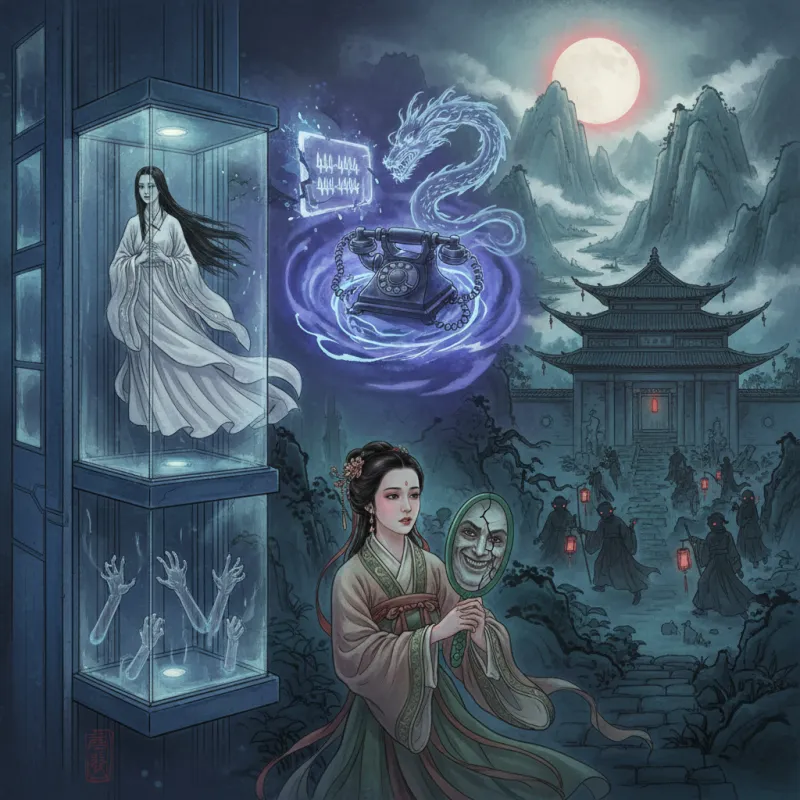
Your phone rings at 2:47 AM. The number on the screen is your own. You don't answer, because you've heard what happens to people who do — and because three of your WeChat groups are already buzzing with warnings about this exact phenomenon. Welcome to Chinese urban legends in the digital age, where a ghost story can achieve viral saturation before sunrise, and where the line between folklore and mass hysteria has never been thinner.
The Elevator Game That Broke the Internet
In 2013, a Canadian tourist named Elisa Lam died under mysterious circumstances in a Los Angeles hotel. The security footage showed her behaving strangely in an elevator — pressing multiple buttons, hiding in corners, gesturing at invisible presences. Within days, Chinese netizens had connected her death to the Elevator Game (电梯游戏, diàntī yóuxì), a ritual that supposedly originated on Korean forums but found its most fervent believers in China.
The rules were specific and widely circulated: Enter a building with at least ten floors alone. Press the buttons in a precise sequence — 4th floor, 2nd floor, 6th floor, 2nd floor again, 10th floor. If a woman enters on the 5th floor, don't look at her, don't speak to her. If you complete the sequence correctly, the elevator will take you to the 10th floor, but when the doors open, you won't be in your building anymore. You'll be in the Other World (另一个世界, lìng yí gè shìjiè).
What made this legend explode wasn't just the Elisa Lam connection — it was the participatory nature. Teenagers filmed themselves attempting the ritual, posting the videos to Bilibili and Youku. Most ended with nervous laughter and nothing happening. A few ended with the camera dropping, screaming, the video cutting out. Those were the ones that got millions of views. Whether they were staged didn't matter. The fear was real enough.
The Elevator Game tapped into something specific about modern Chinese anxiety: the elevator itself as a liminal space. In a country that built more high-rises in a decade than most nations build in a century, elevators became the mandatory passage between home and world, safety and danger. They're spaces where you're trapped with strangers, where the normal rules of social distance collapse, where mechanical failure could mean death. The legend simply made literal what people already felt.
The Cursed Phone Numbers
Before smartphones, there were the cursed numbers. The most famous was 0888-888-888, allegedly a Bulgarian number whose owners kept dying under mysterious circumstances. But China developed its own mythology around telephone numbers, and it was far more elaborate.
The number 4 (四, sì) sounds like death (死, sǐ) — everyone knows this. But the urban legends went deeper. Certain number combinations were said to summon specific entities. 444-4444 would connect you to a funeral home in the underworld. If you called 1-4-4-4 at midnight and let it ring exactly 44 times, a voice would answer and ask for your name. If you gave it, you'd die within four days. If you hung up, you'd die within four hours. The only safe response was to say "wrong number" in a dialect — any dialect except your own.
These legends proliferated in the early 2000s, when mobile phones were new enough to be mysterious but common enough to be universal. The stories spread through SMS forwards, the original viral medium. "Send this to 10 people or you'll receive a call from 444-4444 tonight" — chain messages that exploited both superstition and social obligation.
What's fascinating is how these legends evolved with technology. When smartphones arrived, the cursed numbers migrated to WeChat IDs. Stories circulated about accounts with names like "死神" (Death God) or "鬼新娘" (Ghost Bride) that would send friend requests at 3 AM. If you accepted, your phone would display only a black screen, and you'd hear breathing through the speaker. Some versions claimed your phone would start making calls on its own, always to the same number — your own future death date, encoded as digits.
The phone-based urban legends reflected a deeper anxiety about connectivity itself. In a society that moved from landlines to smartphones in less than a generation, the phone became both lifeline and potential threat. It connected you to everyone, which meant it could connect you to anything.
The Midnight Knock Pattern
This one still makes people nervous in college dormitories across China. The legend is simple: If you hear someone knocking on your door at midnight in a specific pattern — three slow knocks, pause, two quick knocks — don't answer. Don't even acknowledge that you heard it. Because it's not a person knocking. It's testing to see if anyone's home.
The story usually includes a cautionary tale. A student in a dormitory at Nanjing University (the university changes depending on who's telling it) heard the knock pattern. She looked through the peephole and saw nothing. She opened the door. The hallway was empty, but she felt a cold wind rush past her into the room. From that night on, she would wake up at exactly 3:33 AM to find wet footprints leading from her door to her bed. The footprints were always fresh, always wet, and they always stopped right beside where she slept.
What made this legend spread so effectively was its simplicity and its setting. Chinese university dormitories are liminal spaces in themselves — institutional, impersonal, filled with strangers who become intimate through proximity. The thin walls mean you hear everything: conversations, arguments, crying, laughter. So when you hear knocking at midnight, you can't be sure if it's real or imagined, human or otherwise.
The knock pattern legend also played on a specific cultural practice. In Chinese tradition, you're supposed to knock three times when visiting someone — it's polite, it's proper. But the three-pause-two pattern breaks that rule. It's wrong enough to be noticeable, but not so wrong that you'd immediately recognize it as supernatural. It sits in the uncanny valley of social customs.
Variations of the legend spread to apartment buildings, where the stakes felt higher. In a dormitory, you have roommates, witnesses, people who'd notice if something happened. In an apartment, especially for young people living alone for the first time, you're isolated. The knock at midnight becomes a test of whether you're truly alone or whether something has been waiting for you to be.
The Red and White Impermanence on the Subway
Beijing's subway system is one of the world's busiest, moving ten million people a day through tunnels that run beneath a city with three thousand years of history. It was inevitable that it would develop its own ghost stories.
The most persistent legend involves the last train on Line 1, which runs east-west through the city center. Passengers report seeing two figures standing at the end of the last car: one dressed entirely in white, one in red. They never move, never speak, never acknowledge the living passengers. But if you look at them directly, you'll see their faces are painted like opera performers — specifically, like Bai Wuchang (白无常) and Hei Wuchang (黑无常), the White and Black Impermanence, the psychopomps who escort souls to the underworld in Chinese mythology.
The legend says they're not there for the living passengers. They're escorting the dead — people who died in the subway system, in the tunnels, in the construction accidents that the government never fully disclosed. The last train is their ferry across the river of death, and if you see them, it means you're close enough to death yourself that you can perceive what's usually invisible.
This legend went viral on Weibo in 2015 after a user posted a blurry photo allegedly taken on the last train. The image showed two tall figures at the end of a subway car, their features indistinct but their clothing clearly red and white. The post was shared hundreds of thousands of times before it was deleted — whether by the user or by censors was never clear.
What makes this legend particularly Chinese is its fusion of ancient mythology with modern infrastructure. The Impermanence figures date back centuries, appearing in Ming Dynasty novels and Qing Dynasty opera. But here they are, riding the subway, adapted to the modern underworld of tunnels and electric lights. It's a reminder that in Chinese folk belief, the supernatural doesn't disappear with modernization — it adapts, it evolves, it finds new spaces to inhabit.
The subway legends also reflect urban alienation. In a subway car packed with strangers, you're surrounded by people but fundamentally alone. No one makes eye contact, no one speaks. If something supernatural appeared, would anyone else notice? Would anyone help? The legends suggest the answer is no — you're on your own, even in a crowd.
The Tianya Forum Ghost Stories
Before Weibo, before WeChat, there was Tianya (天涯), the forum that dominated Chinese internet culture in the 2000s. And Tianya's supernatural board (灵异版, língyì bǎn) was where urban legends were born, refined, and launched into the broader culture.
The most famous was "The Apartment on the 7th Floor" (七楼的房间, qī lóu de fángjiān), posted in 2004 by a user who claimed to be documenting real events. The story: A young woman rents a cheap apartment in Shanghai. The landlord is eager to rent it, almost too eager. The apartment is on the 7th floor, but the building only has six floors. She doesn't notice this until she's lived there for a week.
The thread ran for months, with the original poster updating regularly, always late at night. Other users would stay up to read the updates in real-time, posting their reactions, their theories, their own similar experiences. The thread became a communal experience, a shared haunting. When the original poster suddenly stopped updating — her last post was "I hear knocking on the door, the pattern is wrong, I'm going to check" — the thread exploded. Users tried to find her, contacted Shanghai police, searched for news reports of missing persons. Nothing was ever confirmed.
Was it real? Almost certainly not. But it didn't matter. "The Apartment on the 7th Floor" established a template for Chinese internet horror: the first-person account, the regular updates, the community participation, the ambiguous ending. It turned readers into witnesses, into accomplices. You weren't just reading a ghost story — you were watching it happen, unable to intervene.
Tianya ghost stories also pioneered the use of "evidence" — blurry photos, audio recordings, scanned documents. The evidence was always just ambiguous enough to be plausible, just clear enough to be disturbing. This was before deepfakes, before sophisticated photo manipulation was accessible to everyone. A grainy photo of a shadow in a doorway could keep people up at night.
The forum format itself contributed to the legends' power. Unlike a published story with a clear author and ending, forum threads were collaborative, open-ended, alive. Other users would add their own experiences, their own evidence, their own theories. The legend became a living document, growing and mutating as it spread. This is how modern Chinese folklore is created — not by a single storyteller, but by a community of believers and skeptics, all contributing to the mythology.
Why These Legends Stick
Chinese urban legends go viral because they're perfectly calibrated to modern anxieties. They're about technology that's supposed to make life easier but instead creates new vulnerabilities. They're about urban spaces that are supposed to be safe but feel alienating. They're about being connected to millions of people but fundamentally alone.
They also work because they're participatory. You can test the Elevator Game yourself. You can watch for the knock pattern. You can avoid the cursed phone numbers. The legends give you agency — the illusion that if you follow the rules, you'll be safe. This is deeply appealing in a society undergoing rapid change, where the old rules no longer apply but the new rules aren't yet clear.
And they work because they're Chinese. They incorporate elements of traditional folklore — the Impermanence figures, the significance of numbers, the liminal spaces between worlds — but update them for the 21st century. They're not Western horror tropes imported wholesale. They're homegrown, rooted in specific cultural anxieties and beliefs.
The internet didn't create Chinese urban legends. It just gave them the perfect medium to spread — fast, viral, impossible to contain. A ghost story that once would have taken weeks to travel from city to city now reaches millions in hours. And in the process, it becomes real in a way that traditional folklore never could. When thousands of people are talking about the same cursed phone number, when hundreds of people claim to have seen the same subway ghosts, when entire forums are dedicated to documenting the same haunted apartment — at what point does the legend become its own kind of truth?
The answer is: it already has. These stories are real in the sense that they shape behavior, create fear, build communities of believers. They're real in the way that all folklore is real — not as literal truth, but as cultural truth, as a mirror reflecting what a society fears and believes.
And they're still spreading. Right now, somewhere in China, someone is posting a new ghost story to a forum, a new warning to a WeChat group, a new piece of evidence to Weibo. By morning, millions will have seen it. By next week, it will have mutated into a dozen variations. By next month, it will be an established part of the urban legend canon, as "real" as any of the stories that came before.
Your phone is in your hand. It's 2:47 AM. It starts to ring. The number on the screen looks familiar. Do you answer?
Related Reading
- Exploring Chinese Supernatural Folklore: Ghosts, Spirits, and Afterlife Beliefs Unveiled
- Chinese Urban Legends: The Ghost Stories Your Taxi Driver Tells
- Modern Ghost Sightings in China: When Ancient Beliefs Meet the Digital Age
- Chinese Campus Ghost Stories: The Haunted Universities
- Ghosts of the Beijing Subway: Urban Legends Underground
- The Ten Kings of Hell: A Complete Guide to Chinese Underworld Justice
- The Best Chinese Horror Films: A Genre Guide — Cnspirit Perspective
- Exploring the Depths of Chinese Supernatural Folklore: Ghosts, Spirits, and Afterlife Beliefs
Explore Chinese Culture
- Explore ancient mythical creatures
- Explore Daoist exorcism traditions
- Explore Chinese folk beliefs and superstitions