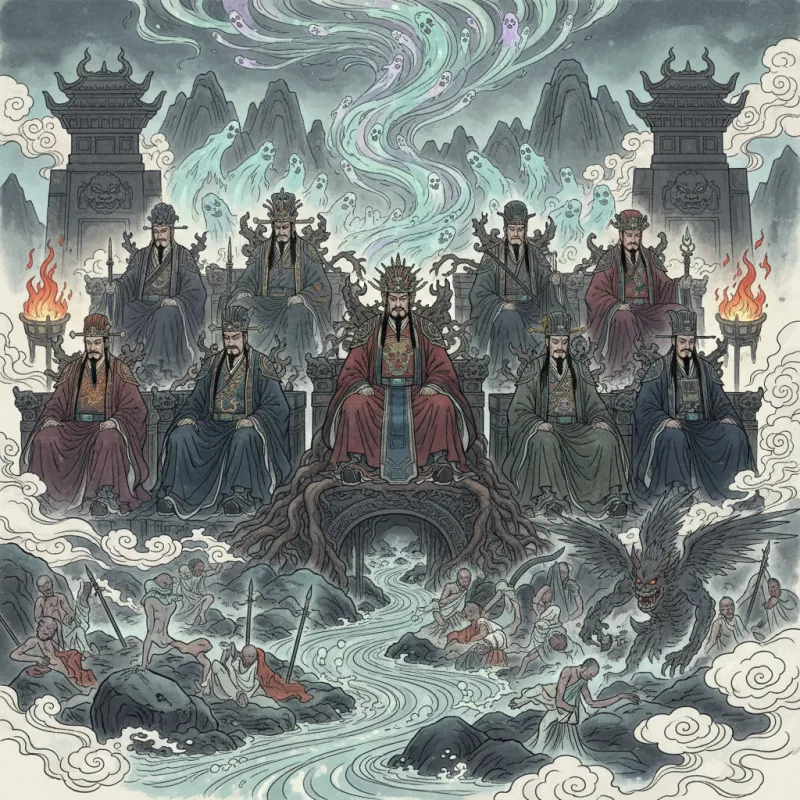
You die. Your soul separates from your body like steam rising from rice. Within seven days, you'll stand before the First King of Hell, and he will ask you a single question: "Did you live well?"
Your answer doesn't matter. He already knows.
The Ten Kings of Hell (十殿閻王, shí diàn Yánwáng) aren't demons. They're judges. Bureaucrats, really — celestial civil servants who process souls with the efficiency of a well-run tax office and the mercy of one too. They sit in ten sequential courts, each specializing in different categories of sin, each dispensing punishments so precisely matched to crimes that the system feels less like divine wrath and more like cosmic accounting. You sinned? Fine. Here's your invoice.
This isn't the fire-and-brimstone hell of Western imagination. This is something far more unsettling: a hell that makes sense.
The Structure of Underworld Justice
The Chinese underworld operates on a simple principle: every soul must be processed. There are no exceptions, no fast passes, no VIP lounges. When you die, you enter Diyu (地獄, dìyù) — literally "earth prison" — and begin your journey through ten courts, each presided over by a Yama King (閻羅王, Yánluówáng, from the Sanskrit Yama-raja).
The system emerged during the Tang Dynasty (618-907 CE), though earlier Buddhist texts mention Yama as a singular judge. By the time the Jade Record (玉曆寶鈔, Yùlì Bǎochāo) was compiled during the Ming Dynasty, the bureaucracy had expanded to ten kings, each with specific jurisdictions, specific punishments, and specific paperwork requirements. The Chinese took the Buddhist concept of karmic judgment and did what they do best: they organized it.
Each court examines different aspects of your life. The First King handles preliminary judgment. The Second King runs the Department of Living Souls (活大地獄, huó dà dìyù), where those who harmed living beings are punished. The Third King oversees the Black Rope Hell, reserved for those who disrespected their superiors. And so on, through ten increasingly specialized departments of cosmic justice.
Between courts, you cross bridges, climb mountains of knives, wade through pools of blood — the geography of hell is both metaphorical and, according to the texts, disturbingly literal. Souls report that the journey takes months, sometimes years. Time works differently when you're dead.
The First Court: King Qinguang's Preliminary Judgment
King Qinguang (秦廣王, Qínguǎng Wáng) sits at the entrance to the underworld, and his job is triage. He reviews the Book of Life and Death (生死簿, shēngsǐ bù), a ledger maintained by underworld clerks that records every action of your life. Good deeds in one column, bad deeds in another. The math is simple.
If your good deeds outweigh your bad, you're sent directly to the Tenth Court for rebirth assignment. You skip the punishment phase entirely. This is rare.
If your bad deeds outweigh your good, Qinguang determines which subsequent courts you'll visit based on your specific sins. Murdered someone? You're going to the Second Court. Cheated in business? Third Court. Disrespected your parents? Fourth Court. The system is nothing if not thorough.
But here's where it gets interesting: Qinguang can be appealed to. If you died unjustly — murdered, executed wrongly, killed in an accident before your natural lifespan ended — you can petition for redress. The underworld keeps meticulous records of everyone's allotted lifespan, and if you were cut short, you have grounds for complaint. Qinguang has been known to send souls back to the living world as ghosts to settle unfinished business or to haunt those responsible for their premature death.
This is why hungry ghosts exist. They're not all evil. Some are just bureaucratically inconvenienced.
The Middle Courts: Specialized Departments of Suffering
Courts Two through Nine are where the real work happens. Each king specializes in particular categories of sin, and each court contains multiple sub-hells (小地獄, xiǎo dìyù) designed for specific punishments.
King Chujiang (楚江王, Chǔjiāng Wáng) of the Second Court handles crimes against living beings. His sixteen sub-hells include the Freezing Hell for those who abandoned their families, the Hunger Hell for those who wasted food, and the particularly creative Hell of Tongue Ripping for liars and gossips. The punishments are literal. Your tongue is ripped out, you scream, it grows back, and the process repeats for however many years your sentence requires.
King Songdi (宋帝王, Sòngdì Wáng) of the Third Court specializes in crimes of ingratitude and disrespect. If you were ungrateful to your parents, disrespectful to your teachers, or cruel to your servants, you'll spend time in his sixteen sub-hells. The most famous is the Hell of Hanging, where souls are suspended by their ribs from iron hooks. The pain is described in the Jade Record as "like ten thousand needles piercing the heart simultaneously, forever."
King Wuguan (五官王, Wǔguān Wáng) of the Fourth Court judges tax evaders, corrupt officials, and those who hoarded wealth while others starved. His eighteen sub-hells include the Pool of Blood (血池, xuèchí), where souls wade through blood up to their necks, and the Stone Mill Hell, where souls are ground between millstones like grain. The symbolism is heavy-handed but effective.
The pattern continues through the remaining courts. King Yanluo (閻羅王, Yánluó Wáng) — yes, the Yama, the original judge of the dead — presides over the Fifth Court, which handles crimes of murder and violence. King Biancheng (卞城王, Biànchéng Wáng) of the Sixth Court deals with crimes against religion and blasphemy. King Taishan (泰山王, Tàishān Wáng) of the Seventh Court judges those who violated graves or disrespected the dead.
By the time you reach the Eighth Court, presided over by King Dushi (都市王, Dūshì Wáng), you're being judged for crimes of filial impiety — the worst category in Confucian ethics. His sixteen sub-hells are reserved for those who caused their parents suffering, and the punishments are correspondingly severe.
King Pingdeng (平等王, Píngděng Wáng) of the Ninth Court is the final checkpoint before rebirth. His job is to catch anything the previous eight courts missed. He reviews your entire case file, checks for clerical errors, and ensures all punishments have been properly administered. He's the quality control department of hell.
The Tenth Court: Rebirth Assignment
King Zhuanlun (轉輪王, Zhuǎnlún Wáng) — literally "King of the Turning Wheel" — doesn't punish anyone. He assigns your next life.
After you've been processed through the previous nine courts, after you've served your sentences and paid your karmic debts, you arrive at the Tenth Court for rebirth. Zhuanlun consults the updated Book of Life and Death, now adjusted for your punishments and any remaining karma, and determines what you'll be reborn as.
Six paths are available, arranged in descending order of desirability: gods (天道, tiāndào), demigods (阿修羅道, āxiūluó dào), humans (人道, réndào), animals (畜生道, chùshēng dào), hungry ghosts (餓鬼道, èguǐ dào), and hell beings (地獄道, dìyù dào). Most souls are reborn as humans or animals. Rebirth as a god requires extraordinary merit. Rebirth as a hell being means you're coming right back to Diyu for another round of punishment.
Before rebirth, you're given a bowl of Mengpo's Soup (孟婆湯, Mèngpó tāng), a brew that erases all memories of your previous life. You drink, you forget, and you're pushed through the appropriate gate into your next existence. The cycle continues.
Some souls refuse to drink. They become ghosts, trapped between worlds, clinging to memories of their previous lives. This is considered a terrible fate — worse than any punishment in the courts, because it's self-inflicted and potentially eternal.
The Bureaucracy Behind the Scenes
The Ten Kings don't work alone. Each court employs thousands of underworld officials: clerks who maintain the ledgers, guards who escort souls between courts, torturers who administer punishments, and messengers who deliver souls from the living world.
The most famous underworld officials are the Black and White Impermanence (黑白無常, Hēibái Wúcháng), a pair of psychopomps who collect souls at the moment of death. Black Impermanence is tall and grim, White Impermanence is short and cheerful, and together they ensure that no soul escapes its appointment with the First Court. They're depicted in folk art as somewhat comical figures — death's bureaucrats, not death's angels — which tells you everything about Chinese attitudes toward mortality.
Then there's Ox-Head and Horse-Face (牛頭馬面, Niútóu Mǎmiàn), the guards who patrol the underworld and prevent escapes. They're exactly what they sound like: demons with the heads of oxen and horses, carrying weapons, looking perpetually annoyed at having to chase down souls who think they can outrun cosmic justice.
The entire system is overseen by Dizang Bodhisattva (地藏菩薩, Dìzàng Púsà), known in Sanskrit as Ksitigarbha, who vowed not to achieve Buddhahood until all hells are empty. He's been waiting a long time. He'll be waiting longer still. But he walks through the courts, offering mercy where the kings offer only justice, and occasionally intervening on behalf of souls who show genuine remorse.
This is the loophole in the system: sincere repentance can reduce your sentence. The kings are judges, but they're not cruel. They're fair. If you genuinely regret your actions, if you understand why they were wrong, if you vow to do better in your next life, the kings will take that into account. Hell is correctional, not vindictive.
Cultural Impact and Modern Interpretations
The Ten Kings appear everywhere in Chinese culture. They're depicted in temple murals, carved into tomb walls, illustrated in popular religious texts. During the Ghost Festival (中元節, Zhōngyuán Jié), offerings are made to them to ensure favorable treatment for deceased relatives. Families burn paper money, paper houses, even paper smartphones — anything the dead might need to bribe underworld officials or make their stay more comfortable.
The system has been satirized, too. Journey to the West (西遊記, Xīyóujì) features a scene where Sun Wukong breaks into the underworld, finds his name in the Book of Life and Death, and simply crosses it out, making himself immortal through bureaucratic vandalism. The Ten Kings are furious but ultimately helpless — the paperwork has been altered, and even cosmic judges must respect proper documentation.
Modern Chinese horror films and television shows continue to explore the Ten Courts. The 2018 film Dying to Survive references the underworld bureaucracy as a metaphor for China's healthcare system. The 2021 series The Ferryman: Legends of Nanyang reimagines the courts in a contemporary Southeast Asian setting, with the kings as overworked civil servants dealing with the complexities of modern sin.
The enduring appeal of the Ten Kings lies in their fundamental fairness. They're not arbitrary. They don't play favorites. They don't damn you for being born wrong or believing wrong. They judge you based on your actions, and they punish you proportionally. In a world where justice often feels absent, the idea of a cosmic bureaucracy that actually works — that actually holds people accountable — is deeply comforting.
Even if it involves having your tongue ripped out.
Practical Implications for the Living
So what do you do with this information? How do you prepare for your inevitable appointment with King Qinguang?
The traditional answer is simple: live virtuously. Honor your parents. Be honest in business. Don't murder people. The bar is not particularly high. The Ten Kings aren't looking for saints; they're looking for people who made a reasonable effort not to be terrible.
But there are specific practices that can improve your underworld prospects. Reciting the Dizang Sutra (地藏經, Dìzàng Jīng) accumulates merit that can offset minor sins. Releasing captive animals (放生, fàngshēng) demonstrates compassion for living beings. Donating to temples ensures that monks will perform rituals on your behalf after death, which can reduce your sentence or even secure early release from punishment.
Some people take a more direct approach: they bribe the underworld officials in advance. During funeral rites, families burn elaborate paper offerings — not just money, but contracts, deeds, letters of recommendation — all addressed to specific kings and officials. The logic is transactional: if you're going to be judged by bureaucrats, treat them like bureaucrats. Grease the wheels. Make sure your paperwork is in order.
Does it work? The texts are ambiguous. The Jade Record condemns bribery as corruption but acknowledges that it happens. The kings are supposed to be incorruptible, but their subordinates are not. It's a very human system, which means it has very human flaws.
The deeper truth is that the Ten Kings aren't really about the afterlife. They're about this life. They're a moral framework, a way of thinking about consequences, a reminder that your actions matter and will be accounted for. Whether you believe in literal underworld courts or see them as metaphor, the message is the same: live in a way that you could defend before a judge who knows everything you've ever done.
Because someday, you will.
Related Reading
- Ox-Head and Horse-Face: The Messengers of Hell
- How to Avoid Punishment in Chinese Hell: Loopholes, Bribes, and Good Behavior
- The Underworld Courts: How Chinese Hell Judges the Dead
- Mengpo Soup: The Drink That Erases Memory
- Haunted Temples: Where Gods and Ghosts Coexist
- Unraveling the Mystique of Chinese Supernatural Folklore and Afterlife Beliefs
- Shamanism in Chinese Folk Religion: The Original Spirit Workers
Explore Chinese Culture
- Explore ancient mythical creatures
- Explore Daoist exorcism traditions
- Explore Chinese folk beliefs and superstitions